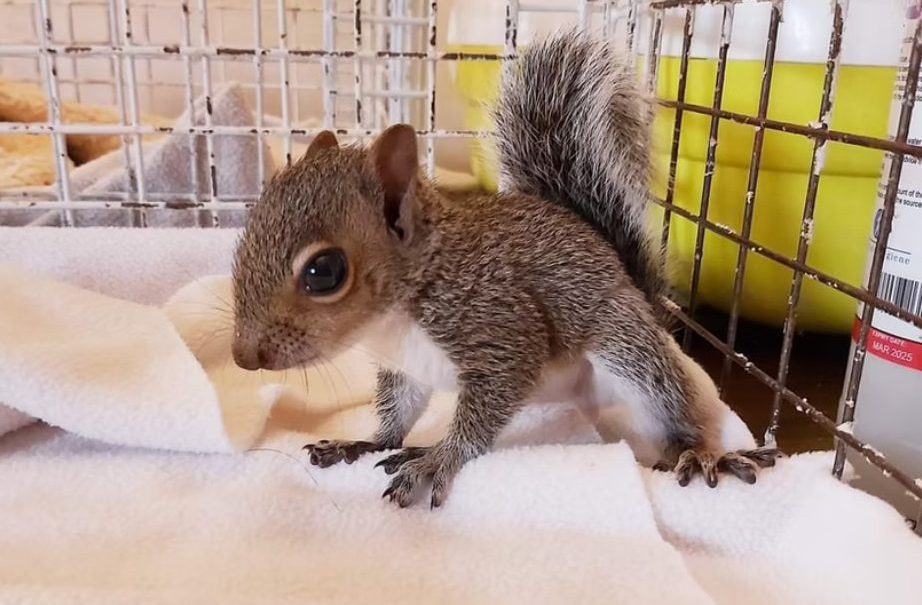
An animal advocacy charity says that grey squirrels have been unjustly labelled as an ‘invasive species’, following Red Squirrel Awareness Day on January 21.
Urban Squirrels, a London-based wildlife trust, has appealed for the plight of the grey squirrel population since the introduction of the Invasive Alien Species (Enforcement and Permitting) Order in 2019.
The act currently prohibits the breeding or release of 30 listed ‘Invasive Alien Species’, including grey squirrels, making it illegal for animal rescue centres to rehabilitate and return the animals back to the wild.
As a result, Natalia Doran, founder of Urban Squirrels, said that some larger wildlife centers have started to euthanise injured grey squirrels.
She added: “I think even more are just left to die a slow death. It’s really horrendous, especially considering they’re animals too. They’re not just these ‘invasive species’.”
The charity, with one unit in Roehampton and another in Harrow, is only licensed for a combined capacity of 24 grey squirrels. With the centre now full, Doran has no choice but to turn away those that phone in, asking for help for their animal companions.
Doran said: “Healthy wild animals should be out in the trees. But we can’t take new ones, and that is the biggest problem. It’s soul-destroying.”
The charity has just concluded another unsuccessful round of petitioning to the government, asking to amend the legislation for a licence which would allow wildlife rehabilitators to release healthy grey squirrels back to their natural habitats.
She said: “Our main point is that the numbers we release are negligible. Whatever you think about the ecological impact of squirrels, there are about 3 million in the country.
“All the rescue centres in England combined release a few hundred at the most, which wouldn’t make any difference to their ecological impact whatsoever.
“If you think they’re destroying the country, they will still be destroying the country with or without the animals we release. But to the compassion footprint, it does make a lot of difference.”
Doran believes that an unfair narrative has been pushed surrounding grey squirrels since their introduction from North America in 1870s, where common misconceptions include spreading the squirrelpox virus (Parapoxvirus) – which greys are immune from but red squirrels succumb to – and causing the destruction of woodlands.
Her research into the virus found that red squirrels are more likely to catch the pox from other red squirrels via shared feeders, and other factors, including habitat loss through intensive farming, have further contributed to the species’ loss – of which there are currently around 120,000 in the UK.
Low genetic diversity has also made red squirrels more susceptible to diseases, where a study from the University of Edinburgh found that it was lower than some of the world’s most endangered animals.
This also may offer an explanation as to why red squirrels are so slow to develop resistance against the virus.
As for causing the destruction of woodlands, Doran said: “For natural tree regeneration, grey squirrels are the most important animals; they plant new trees when they cache seeds and nuts. So they’re actually helping ecology.”
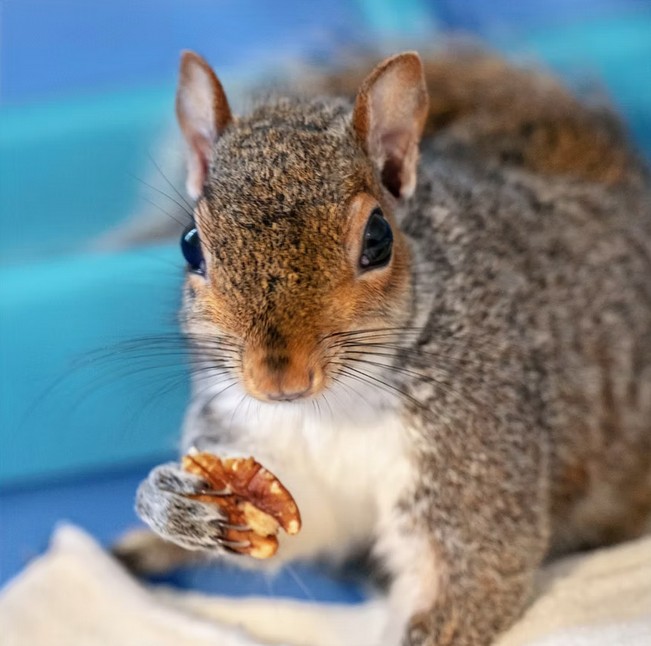
Although legislation is unlikely to change anytime soon, Doran’s licence fortunately allows her to move a number of rehabilitated squirrels to centres in the North of England, which have more capacity for them.
In the meantime, she will continue to care for the squirrels in her unit – who are now healthy, happy, and thriving thanks to her work.
Featured image credit: Natalia Doran