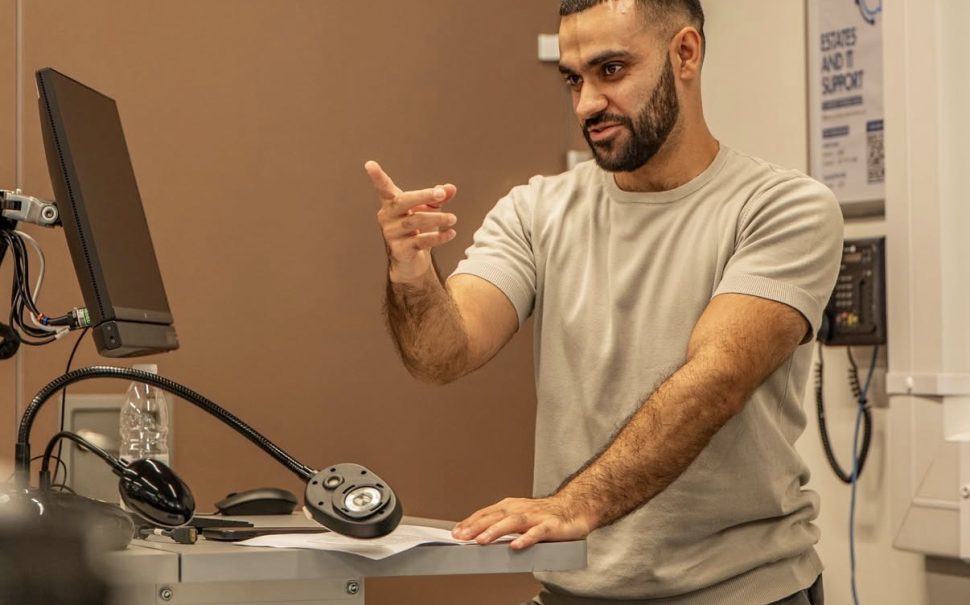
A British Palestinian journalist based in London at Declassified UK, Hamza Yusuf claims that bias in how Britain covers Gaza is not an occasional error, but a structural feature of how British newsrooms operate backed by sourcing habits, institutional caution, and, in some cases, direct pressure from Israeli officials.
His most significant piece of evidence came in February 2025, when Declassified UK published his investigation “Battle for the Truth: Pro-Israel Bias Inside UK Newsrooms Revealed.”
Yusuf had spoken to half a dozen current and former staff at the BBC, Sky News, ITN, the Guardian and The Times, all speaking on condition of anonymity for fear of professional consequences.
That alone shows journalists at some of Britain’s most prestigious outlets know how their publishing houses cover one of the defining conflicts of the decade.
His sources said that at Sky News, Palestinian guests were, at times treated with open hostility on air, muted, interrupted, challenged in ways Israeli spokespeople rarely were.
Some sources went further, telling Yusuf that Israeli officials with access to senior figures at the network had pressured producers and threatened to pull correspondents’ access when coverage displeased them.
The Guardian, did not escape scrutiny either: insiders told Yusuf its foreign desk ultimately tracked the same institutional line as its more conservative competitors.
In a November 2025 piece for Brave New Europe, he examined how the BBC, Guardian, Times, LBC, Sky News and Financial Times described renewed Israeli strikes that killed more than 100 Palestinians, including dozens of children, in the weeks after a ceasefire happened.
Coverage across those outlets characterised the strikes as a “test” of the ceasefire’s “fragility.” Yusuf claims that framing tells readers that violence is the exception to to the ceasefire that never stopped.
He has made similar arguments about how prisoner-and-hostage exchanges get reported, arguing in The New Arab that Western coverage tended to invite sympathy for Israeli hostages while implicitly suggesting Palestinian prisoners belonged behind bars.
His Declassified UK investigations have traced the physical and political infrastructure connecting Britain to Israel’s war effort: British spy flights over Gaza, RAF personnel training alongside Israeli F-15 pilots on UK soil. An investigation run by John McEvoy that caught the attention of the government.
Yusuf has also tracked how Palestine has reshaped British electoral politics, documenting Labour’s shifting position on the issue across successive leaderships and the voters the party has lost as a result.
His reporting appears almost exclusively in outlets with an openly pro-Palestinian editorial position, and he makes no claim to neutrality on the underlying conflict.
But the more interesting fact about Yusuf’s work is what it shares with research from organisations entirely unconnected to him.
The Centre for Media Monitoring’s analysis of hundreds of thousands of British broadcast clips found Israeli deaths received dramatically more coverage per fatality than Palestinian ones.
NewsCord’s 2026 linguistic study of the BBC, Sky and the Guardian found passive voice used in reports on Palestinian casualties, obscuring who was responsible.
Yusuf questions the whole media industry and why its coverage of the deadliest conflict of the decade so consistently reads the way it does.
In the interview below, Yusuf goes further into the specifics of that reporting, and what he believes it will take for British newsrooms to change how they cover Palestine.