North London’s Jewish community have been grappling with security concerns around religious celebrations, following UK government sanctions on Israel.
Rosh Hashanah, from 11 to 13 September, marks the start of the High Holy Days in the Jewish calendar, lasting until Yom Kippur on 21 September.
However, ongoing concerns about antisemitism meant that private security guards were deployed outside synagogues and to accompany individuals in public.
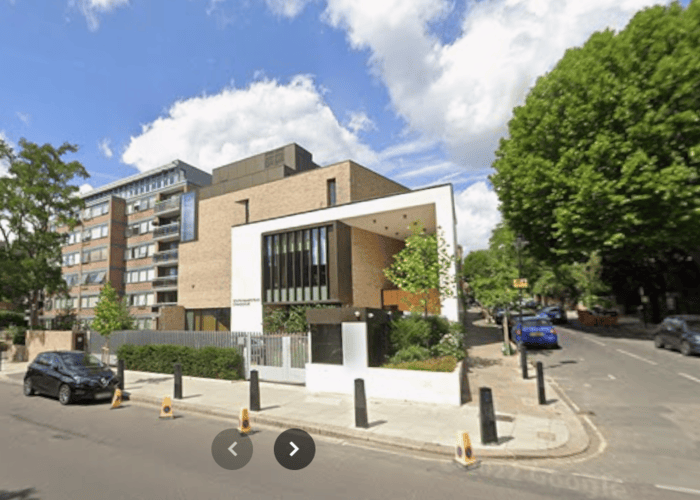
On Sunday, several security guards stood outside the South Hampstead Synagogue in Primrose Hill. They had been there since 8am and estimated that 500 people had visited the synagogue throughout the day.
A further two security guards, one of which held a walkie talkie and wore a protective vest under his shirt, accompanied a Rabbi on the street.
Security guard Jordan Joseph, 29, said: “Generally, our job is to be on a site in a position, and to protect that site. If it’s high season, festival season, sometimes you’d have to accompany people.
“There have been so many things happening in Jewish areas, like in Golders Green, the ambulances. I definitely think it’s justified. A lot of Jewish teenagers and kids live in fear.
“I definitely feel like they’re more comfortable when they come in. It makes them feel safer, which is basically what our job is essentially, to make people feel safe.”
Fears of antisemitic hate were renewed in the days before Rosh Hashanah, when Foreign Secretary Ed Miliband announced UK sanctions on Israeli settlements in the West Bank.
Chief Rabbi Sir Ephraim Mirvis said: “This is truly a dark day for British Jews… On the eve of Rosh Hashanah and at a time when our community is more vulnerable than ever to the wave of extremism that has been building over recent years, these sanctions do nothing to advance the cause of peace.”
Miliband, who is Jewish, rejected claims that the sanctions made British Jews any less safe and said he did not agree with the Chief Rabbi.
Antisemitism in the UK has risen considerably in recent years, including across North West London.
The Community Security Trust, a charity that works to protect Jewish people in Britain from antisemitism, reported 1,926 antisemitic incidents in the first half of 2026, an increase of 21% from the first half of 2025.
Rabbi Rebecca Birk, from Finchley Progressive Synagogue, agreed that the risk is heightened following the announcement of sanctions on Israel.
“Naturally there are concerns about increased hostility to local Jews. Any critique of the Israeli government can create this, no matter what Jews themselves believe,” she said.
However, she claimed that she had not noticed this cause any changes to the ways the congregation worships, even whilst holding present concerns.
“People want connection and to be part of a thoughtful contemporary Jewish community that considers contemporary issues as well as tradition,” she said.
“Security, safety and care is always an issue and yet we also want to welcome everyone we can.”
The question of security was met with action by the Metropolitan Police, who committed additional resources around the occasions.
A spokesperson for the Met Police said: “There will be an enhanced policing operation to support and protect London’s Jewish community, including increased patrols and security measures around synagogues and other key community locations throughout the period.”
Detective Chief Superintendent Luke Williams, who leads policing in North West London, said: “We recognise the impact recent antisemitic incidents have had on communities and the concern they can cause. We are committed to ensuring that those responsible are brought to justice and to providing a visible and effective policing presence throughout the High Holy Days.”
Despite the Police’s commitment to enhanced policing operations, private security has remained a regular presence, reflecting the extent of the perceived threat and the high standard of protection required.
On the way to the synagogue, Rabbi Eli Levin spoke about the Rosh Hashanah celebrations, whilst flanked by security personnel.
“Everyone’s been very upbeat,” he said.
He then recited blessings before demonstrating the symbolic thirty blows of the Shofar, a hollowed-out horn blown loudly like a trumpet.
A short distance away, security guards remained stationed at the synagogue’s entrance as people arrived to worship.
Featured image credit: Google Maps