Just 3% of almost 4,600 recorded offences of violence against women and girls on London’s transport network resulted in a charge or summons last year, according to official figures.
In nearly six in 10 cases (around 58%) no suspect was identified, a recent report published by the Police and Crime Committee revealed.
This troubling picture has led many to call on Transport for London and British Transport Police to start doing more to hold the offenders accountable.
The South West Londoner spoke to Zan Moon, an activist who experienced public sexual harassment on the London Underground and is now fighting for a safer transport network for women and girls.
Moon said: “The Central line is the most unsafe. When I was working with Sadiq’s team I was told that it’s the most common line for sexual assault reports because it historically didn’t have CCTV so perpetrators targeted that line in particular.
“Men have been disrespecting and harassing women for years with cat-calls, groping and stalking and it’s time that it got some attention.”
In July 2024, the National Police Chiefs’ Council and the College of Policing described violence against women and girls (VAWG) as a ‘national emergency’.
More than a million VAWG-related crimes were recorded nationally in 2022/23, which represented 20% of all police-recorded crime.
As of recently, TFL have introduced a new Central Line Improvement Programme, which is set to be completed in 2029.
The £500 million pound scheme will see the installation of CCTV in tube carriages themselves rather than just on the platforms.
Prior to this, there were no cameras on board the trains that would be able to capture incidents of violence and harassment.
This raised concern among passengers, particularly women, over the increased vulnerability that comes with knowing that it would be far more difficult to come forward as a victim of safety incidents with no solid proof to back up your claim.
Describing her experience of harassment on the underground, Moon said: “I was travelling with my girlfriend and a man started shouting homophobic slurs and asking me and my partner to perform sexual acts in front of him, getting into our personal space and licking his fingers.
“We cried out for help but no one did anything. I reported it to the British Transport Police but no one responded until a week later.”
Moon explained that by the time the authorities got round to hearing her report, the CCTV footage had been automatically deleted as it only had a three-day retention period.
They told her that there was nothing they could do to help.
“I was furious and decided to go public about what happened. I asked women everywhere to come forward with their stories about sexual abuse on TFL”, she said.
After just two weeks, Moon had received over 20 pages of testimonies from victims which she compiled into an open letter and sent to Sadiq Khan, the Mayor of London, in hopes of enacting change to better protect women.
One of the main things Moon pushed for was increasing the CCTV retention period and argued that three days was not enough time for victims to come forward.
As a result of her campaign, the CCTV retention period was increased to 30 days.
She said: “I believe this is a really important change. CCTV is imperative across all lines to provide more evidence to hunt down perpetrators.”
The public numbers of VAWG offences on public transport likely understate the true scale of harm.
Many incidents go unreported as victims fear no action will be taken, even if they do come forward.
“One of the biggest problems we have is the lack of reports. So many women normalise this behaviour as ‘everyday life’ that they do not bother to come forward. We want to encourage women to speak up and allow the police to do their job.”
Tricia Hayes, Chair at London TravelWatch, told the Police and Crime Committee that 80% of sexual offences on public transport go unreported.
Moon explained how bringing these matters to the attention of the police is crucial to allow them to identify which tube lines are hotspots so they know which areas to monitor closely.
In the case of repeat offenders, a report would notify the police as to where they are at that time and increase the chance of them being caught.
The crowded, fast paced nature of public transport can sometimes make it difficult to recognise and respond to VAWG.
Susan Leadbetter, Transport Consultant and Specialist in Gender-Sensitive Design at WSP explained that sometimes women and girls are unsure if what was happening to them was harassment because it was so busy they couldn’t tell.
They’d then only come to realise once they got off, making it more challenging to tackle.
Some women adopt avoidant behaviours in response to a fear of facing harassment or assault, demonstrating the depth of harm it causes in the lives of women.
Hayes at London TravelWatch revealed in 2025 that 70% of women were choosing not to travel at particular times of day, or not travelling at all because they were worried about their personal security.
Moon explained how a lack of trust in the authorities is a major reason why so few women feel comfortable opening up about their stories.
“TFL has not done enough. Simply playing ‘see it, say it, sorted’ every day across their lines does not do enough to build trust,” she said.
A YouGov survey taken for the London Assembly last year revealed that 61% of respondents had little to no confidence at all in TFL to tackle hate crime and VAWG.
A similar trend was displayed against BTP and MET Police with 54% and 63% respectively.
Many of the testimonies that Moon received had women stating that they were treated poorly by BTP officers with platform staff being absent or diminishing what happened when victims asked for help.
Moon called for evidence of proper intervention – plain clothed and undercover police monitoring the tube lines, checking in with passengers on the night tube, mobile signal across the network and bystander intervention campaigns.
After what happened to her, Moon worked with BTP to create posters providing tips for bystanders to ‘get involved’ safely when witnessing a public sexual harassment.
She said: “We want to see platform staff intervening when a woman is alone, being shouted at by drunk men coming home from a football match.
“Once we see headlines of perpetrators being caught and put in prison, then we will trust them enough to speak up.”
Moon feels that it would help significantly to have more female police officers patrolling the tubes as many women have lived experience of harassment and may pick up on cues that a male officer might have missed.
Since her campaign, Zan Moon is now a member of the team at BTP as a consultant on violence against women and girls.
She said: “I believe my report has helped TFL to prioritise women’s safety a little more. I have seen that there is a lot of hard work going on behind the scenes but there is always more to be done.
“We need more funding for initiatives that focus on prevention instead of being reactive once the harassment has already happened.”
Moon drew attention to apps like ‘WalkSafe’ the UK’s leading personal safety app, and suggested calling ‘Strut Safe’, a UK-wide phone line for those out alone at night.
Siwan Hayward, TFL’s Director of Security, Policing and Enforcement has commented on the issue, saying: “The safety of women and girls is an absolute priority for us, and we are committed to tackling sexual offences and harassment.
“Everyone deserves to feel safe when travelling across the network, and to have the confidence that any incident they report will be taken seriously and acted upon.”
TFL have been working with the British Transport Police over many years to raise awareness of the issue through their sexual harassment campaign on the network that states these behaviours won’t be tolerated.
They aim to make the transport network a hostile place for offenders, through using intelligence-led policing operations to target offenders and hotspot locations.
Hayward added: “Any instance of sexual harassment or assault is utterly unacceptable, and we are working hard to stamp it out across our network.
“We encourage anyone who experiences or witnesses this behaviour to report it to the police by texting 61016 or a member of staff, so that we can take action against offenders and ensure preventative measures are in place.”
BTP have agreed that tackling violence and intimidation against women and girls on the railway is a top priority.
A BTP spokesperson said: “As a force our solved rate for sexual offences is five times higher than the national average, but we want this higher. We’re committed to doing everything in our power to ensure victims get the justice they deserve.
“We have officers across the London rail network every day conducting intelligence-led patrols, both in uniform and plain clothes. You may not see them, but they are there keeping passengers safe.”
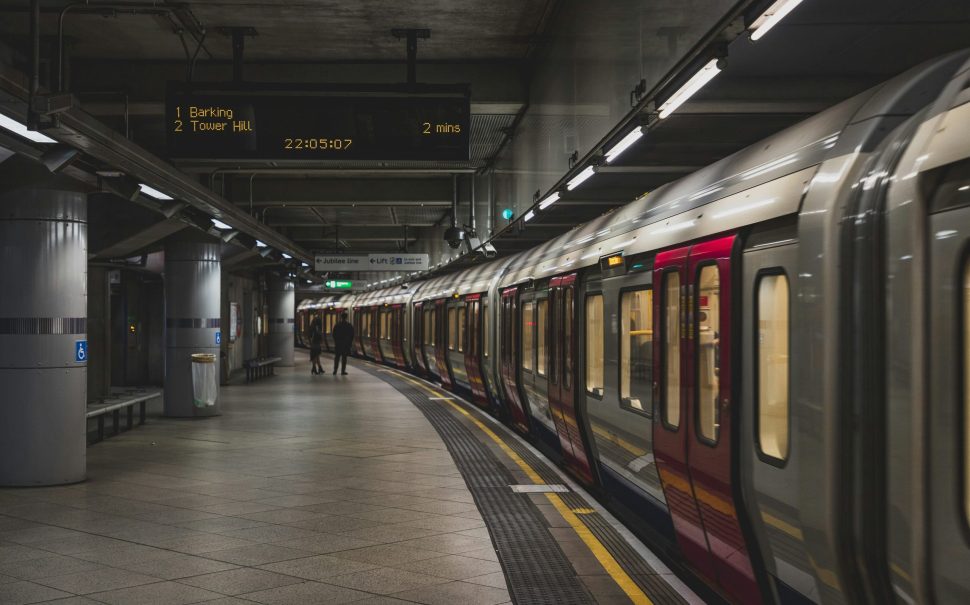
Featured image credit: Joël de Vriend on Unsplash