If the River Nile is mythic, and the Amazon, exotic; if swimming down the Aare in Switzerland is part of the daily commute, and Berliners, Amsterdammers, and Parisians have all reclaimed their lakes, canals, and yes, even the River Seine after more than a century of disuse, then where does that leave us Londoners with the Thames, that smelly and storied river that kings once swam in, made famous by the Eastenders title sequence?
As far away from the waterway as possible would be the usual answer. But Marlene Lawrence, the founder of the Teddington branch of the cold-water swimming group the Bluetits, has noticed a change in the tide. In just one week, she has signed up 200 new members to the club. I guess it isn’t every day that a heatwave coincides with the opening of London’s first official designated bathing site along the Thames.
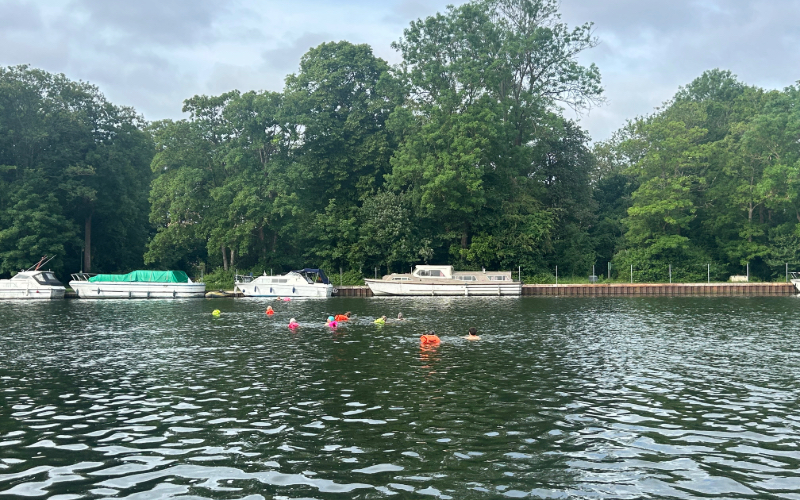
From the 15 May, the beginning of bathing season, this stretch of water between the Half Mile Tree and the YMCA Hawker Centre in Kingston, will join other sites across the country – including a tidal inlet off the River Yealm in south Devon and a section of the River Swale in Yorkshire – in being official spots for wild swimming and bathing. The status brings with it weekly water-quality monitoring by the Environmental Agency throughout the summer months, offering swimmers something that has long been in short supply on the Thames: confidence that the water is indeed swimmable.
“We were overjoyed to get the status, and now, this past week, when the weather’s been so lovely, there’s been hundreds of people here all enjoying the water,” said Lawrence.
Twickenham MP Munira Wilson echoed this sentiment: “The news that our stretch of the river will be part of London’s first-ever official bathing spot is wonderful for all of the swimmers, kayakers, paddle boarders and rowers who love and enjoy our precious river.”
Yet for all the buzz about this being the beginning, and a breakthrough, and the ‘OFFICIAL FIRST-EVER’, for Kingston it is more of a homecoming – the latest chapter in the Thames long established swimming history.
“People have always swum in the Thames, from kings to poor children,” said novelist and non-fiction writer Caitlin Davies, whose books have often charted the waterway’s history. “But it really became a passion in the mid-to late 19th century.”
For the Victorians, who loved nothing more than a show and spectacle, the riverbank functioned as a natural colosseum. They began producing swimming manuals to teach the sport to the masses. Then came the races.
“You could well have been part of a huge crowd watching a swimming star like Agnes Beckwith, who did long swims along the Thames,” said Davies. “You’d have seen her little head bopping up and down with her hat and ribbons on, completely surrounded by a swarm of boats. She would have had a large boat accompanying her with her father on it and a brass band, and as she arrived at her destination they would play ‘See the conquering hero comes.’
“You could have seen bizarre displays too, like Jules Gaultier, a swimming professor who swam with his wrists and ankles tied together, towing a boat with a rope in his mouth. You could have seen all sorts in the Thames.”
Bathing islands, open air baths, floating platforms, pontoons, temporary lidos, the river had it all. Kingston’s first public swimming pool, which was for men only, was opened on Steven’s Eyot, in 1872. It was the first one on the Thames.
For women, when access was finally, slowly granted to them to use bathing sites and pools, the river was a life source – a way for them to express their capability in a society that was largely still yet to realise it. When Kingston got its first indoor swimming pool in 1897, the Kingston Ladies group was established. They became formidable athletes.
“They had a number of champion swimmers, particularly in the early 1900s,” said Davies. “Florence Harper swam from Hampton Court Bridge to Teddington in four hours. Ethel Littlewood swam 16 miles between Sunbury and Richmond. She spent eleven hours in the water and beat seven men.”
If all this makes Kingston’s new bathing designation sound less revolutionary, that is because the battle being fought today is a familiar one. When the Thames Conservators – Thames Water’s Victorian ancestor – attempted to remove a pontoon in the 1880s, a localised rebellion broke out.
“It was like a miniature war,” said Davies. “The Thames Conservators were trying to get hold of the pontoon and physically drag it away, and all the residents, councillors, and aldermen were saying no. There were large crowds, loads of shouting, and they were attacking each other with boat hooks. The council won and everybody cheered.”
The dispute demonstrates an early glimpse that still defines Kingston’s relationship with the river today: a determination to defend the right to swim.
“This is early proof that the people in Kingston wanted their bathing and they were not going to be told you can’t have that. They were really fighting for the right to swim, and we’ve got exactly the same thing, 150, 170 years later,” said Davies.
The area of river that is now the official designated bathing spot once had the sixth greatest concentration of toxic substances in the UK – eleven times higher than the safe levels set out by the EU. But with campaigning by the Bluetits, both in their initiating the proposal and in continuing to rally against Thames Water’s sewage recycling proposals upstream of the site, steps are finally being taken to create and maintain the highest levels of water quality for people and wildlife.
“I wanted to do something to try and keep the water companies in check,” said Lawrence. “It’s a good start for the Thames, and a clear message that we want the water quality to be good and that we want to use the river. It’s a wonderful natural resource flowing through London that should be free and used by all.”
On the Sunday morning I joined the Bluetits for a dip, I text my friends. “You aren’t.” “Lol, is it actually safe?” “Crazy.” These were just some of the responses. I had half a mind to listen to them.
But as I paddled underneath the willow trees, swans gliding past me and the sun beaming down, I could have been in any of the crystal lakes I’d enjoyed in outer Berlin or the IJ river in Amsterdam. This bathing spot might not be the beginning of London’s wild swimming history, but it is the necessary next chapter in helping Londoners rediscover and reclaim the river they were once so close to.
Featured image credit: Katie Bevan