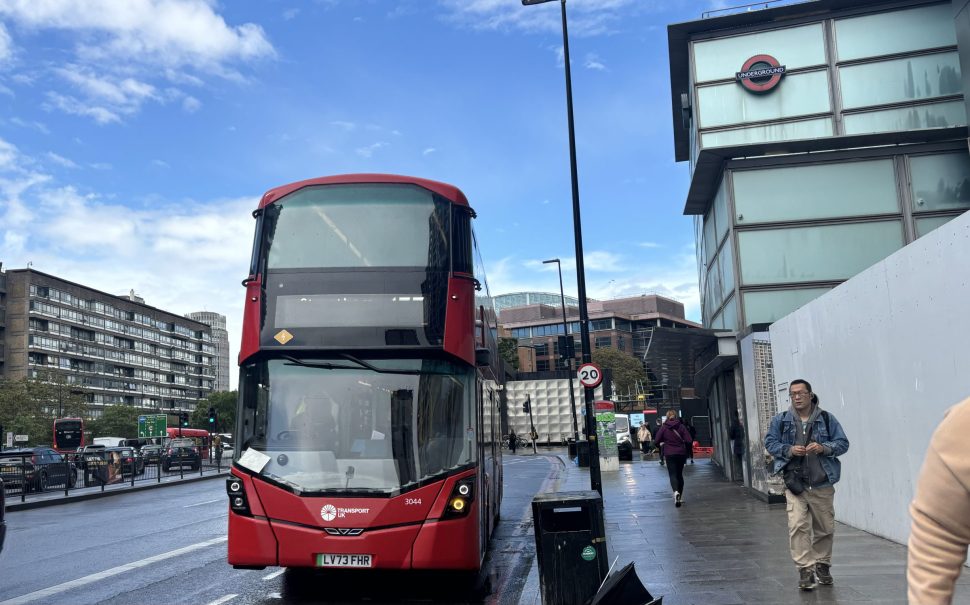
Commuters from Asian backgrounds reported fears of facing hate crime on Transport for London services at more than double the rate of the average traveller.
Nearly seven in ten Asian respondents expressed worry about facing hate crime on TfL journeys in a YouGov survey commissed by the Mayor’s office and conducted in November.
Moreover, there were 120% more Asian respondents who were “very worried” than the survey-wide average of 16%.
Crime committed on London’s public transport has seen an unprecedented surge since the early 2010s, and in 2024, which the most recent data details, monthly offences per million journeys had gone up by 5.5 incidents since 2014.
Akeela Ahmed MBE is CEO of the British Muslim Trust (BMT), a charity that offers support for victims of islamophobic hate in the UK.
She pointed to the phenomenon of far-right nationalist marches, like this week’s Unite the Kingdom rally, as a major factor towards fear in Asian communities.
Ahmed said: “We’re hearing people trying to take time off work. They can’t take time off and are scared of using public transport on the day of the march.
“They are worried about being able to get home. It does tend to be Muslim women and young people who report fear, or parents who tell their children, ‘don’t go out and meet your friends’.”
She said that BMT data saw a slight difference between Asian men and women in reporting feeling unsafe, mentioning that xenophobic hate frequently becomes layered with misogyny.
When asked about fears of both harassment and hate crime on TfL services, up to 38% of women reported a sense of worry compared to 21% of men.
And, according to a recent London Assembly report, only 3% of Violence Against Women and Girls (VAWG) offences resulted in a charge or summons in 2025 – in hate incidents, it was only 2%.
Dr. Darrick Jolliffe, head of UCL’s Department of Security and Crime Science, said: “A hate crime seems to carry even more emotional valence. That has to do with the security people feel in society if they have protected characteristics.
“It is more difficult as where they can turn for support is less well known. They may be more insecure about their status in society, I believe.
“Fear of crime is very, very powerful to people. It has the ability to motivate people to change where they live, and change massive aspects of their lives because they are afraid.”
Ahmed reflected similar observations on how fear alters the everyday routine of the communities she works with.
Talking particularly about the effects on Muslim women, she said: “People who are experiencing abuse will not travel anymore and switch to shopping online, or will ask their husbands to do it for them.
“Critically, they are not able to make those social connections, which you want in a healthy society.”
She said that hate tends to spike around terror-related incidents, but levels in reporting do not necessarily decrease afterwards, despite a vast number of aggressions going unreported.
These trends, she says, do not just affect Muslims, but all people of colour and other religious groups like Sikhs and Hindus.
Talking about why hate fears may be heightened on public transportation like tubes and buses, Dr Jolliffe said: “When you are walking down the road and sense that you are experiencing fear, or that something is coming, you can cross the road. Whereas on transport, that’s not so much a capability.”
Ana, who is using a different name to maintain anonymity, was harassed on the London Underground in the early evening after meeting friends.
She said she had been avoiding a man on the train carriage after he had been staring and following her on a quiet East London tube platform.
He tried to follow her off the train when she arrived at her destination, but the doors slammed shut before he was able to.
“He was banging on the door, pressing the button to get off and shouting at me,” she said.
“What I kept saying in my head was, ‘Oh my God, if there had been ten seconds of difference, I would have found myself in genuine danger’.”
Ana believes that all women are hyper-vigilant when travelling alone on TfL, and says that she always catches herself looking over her shoulder to check who is nearby.
But she added: “I’m trying not to let it impact how I go about my day to day. If you do that, then you’re going to stop yourself from travelling.”
TfL have introduced posters that say “Staring at someone in an intrusive sexual way is a form of sexual harassment and is not tolerated.”
Discussing how these signs impact victims, Ana said: “It makes them realise: it is all right that this has made you feel anxious. It’s normal that this feels like a violation of your safety.”
Dr Jolliffe underlined a perceived shift in recent years regarding people’s discriminatory beliefs, and thus their actions towards others in public.
He said: “There’s been a massive shift in what people feel comfortable exposing.
“Its very difficult to pinpoint when that changed. Brexit seems to be a watershed moment, Donald Trump seems to have been a watershed moment.
“Obviously there was a building-up to those discreet moments, but there’s no doubt that individuals who feel that way feel empowered.”
Ahmed added: “With certain politicians feeling that they can openly call for restrictions on Muslims, there is a sense of foreboding amongst communities about the changing political landscape and what that would mean for their everyday lives.
“We feel an enormous sense of responsibility to people and really try to make sure that they are protected and able to go about their lives freely and safely.”
A TfL spokesperson said: “Everyone has the right to feel safe and be safe when travelling around London at all times without fear of abuse, and we are committed to ensuring all passengers and staff are protected from harm.
“This is why we maintain a strong, visible police and enforcement presence across our services and stations to deter crime and support those affected.
“Tackling hate crime is an absolute priority for TfL, and we take a zero‑tolerance approach to abuse on the transport network.
“We run clear and visible campaigns encouraging passengers and staff to stand together against hate and abusive behaviour, and ensure our staff are trained to support victims with compassion and take reports seriously. We also provide clear guidance to help customers intervene safely if they witness hate crime.”