England is heading towards a severe water supply deficit unless urgent action is taken, according to new government modelling.
Official government analysis shows the public water system could face a shortfall of 4,940 megalitres a day by 2055, equivalent to nearly five billion litres.
This figure represents roughly a third of current daily public water supply across England.
The projection is based on a ‘do nothing’ scenario which presumes there will be no additional water resources beyond existing plans.
Tim Wainwright, chief executive of WaterAid UK, said: “Recent years have exposed just how vulnerable global water systems are to the pressures of climate change and growing populations, and no country is immune.”
Environmental requirements are the largest single pressure, accounting for around 2,600 megalitres a day of additional water demand.
Population growth contributes a further 990 megalitres a day, increasing household and non-household consumption.
Drought resilience measures add approximately 630 megalitres a day, reflecting the need to withstand extreme dry weather events.
Climate change is expected to reduce water availability by around 340 megalitres a day by the 2050s.
However, the impact will not be evenly distributed across the country with the south-east predicted to face the greatest challenge.
Recently, the water crisis across Kent supplied by South East Water illustrates this crisis.
FInnlay Dexter, 23, a film runner of Tunbridge Wells told the Londoners his household has been without a reliable water supply for week long stretches since November 2025.
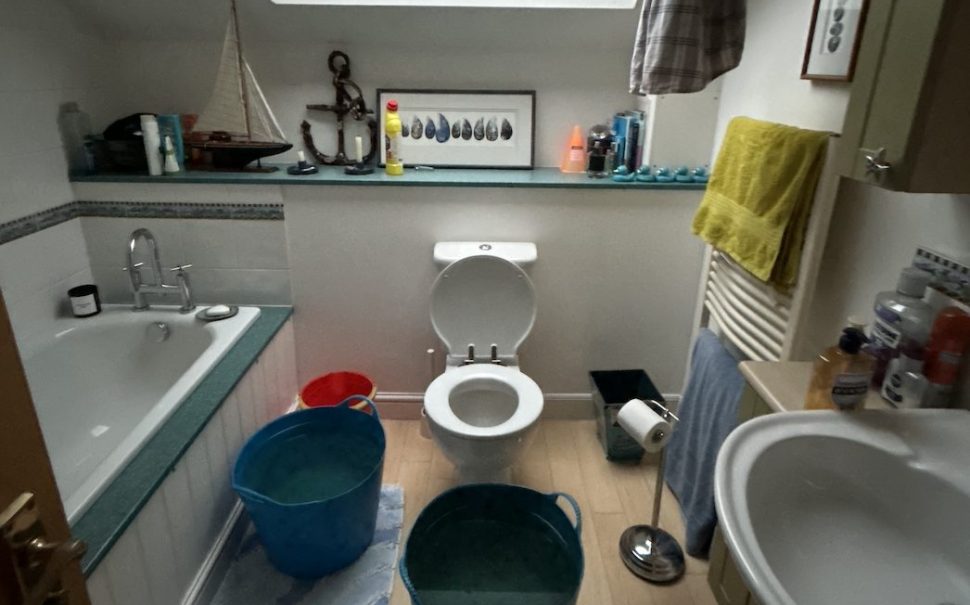
Water pressure weakens slowly, hinting that buckets need to be filled up, before cutting out entirely.
Dexter said: “We ended up just hoarding water to flush the toilets. For drinking water we’ve been getting through something like 16 to 24 bottles a day.”
While parts of the town continued to receive water, the outage appeared to affect specific streets, forcing families to rely on bottled supplies and improvised solutions.
“It’s a vital utility — when it goes away, life does go a bit wonky,” Dexter said.
“This has just become the new normal way of life. It’s quite dystopian.”
By contrast, northern regions are expected to face smaller, though still significant, supply gaps.
Government modelling shows that even with planned water company schemes, substantial deficits may remain.
Supply-side solutions will also be required, including new reservoirs and inter-regional water transfers.
Without action, temporary water use bans and regional shortages could become more frequent.
Long-term planning and immediate investment are both essential to protect economic growth and environmental resilience.
Featured image credit: Tara Russell