Andy Burnham has been encouraged by academics to introduce a 2% minimum wealth tax on households with more than £100million in wealth.
This fiscal reform outlined in a report by economists Dr Ben Tippet, from King’s School of Global Affairs, and Professor Gabriel Zucman, from Paris School of Economics, suggests this tax could raise £10billion in 2026 while affecting fewer than 1000 households in the UK.
The new prime minister hasn’t ruled out the implementation of a wealth tax, as he is yet to reveal the details of his ten year strategy for fairer taxation and improved public services.
Rebecca Gowland, executive director of Patriotic Millionaires, argued extreme wealth is responsible for a range of harms to society.
She said: “We face an unprecedented level of extreme wealth concentration at the very top.
“This means a vast amount of unproductive wealth is stuck while our economy needs investment – and people are living with a neverending cost of living crisis.
“Beyond this, extreme wealth is also leading to quite intense harm to our society.
“From wealth and power buying and undermining democracy, to social unrest and lack of social mobility, through to the increased level of emissions – billionaires are responsible.
“The very wealthiest people aren’t wealthy because they’ve saved more or worked harder than many, many ordinary people. Wealth makes wealth.
“We have to have a fairer system of taxation that recognises this and then taxes people appropriately.”
Critics of the wealth tax warn of potential unintended consequences such as high net-worth departures, reduced revenue and investment.
John Muellbauer, a professor of economics at the University of Oxford, said: “Many of the elements of wealth are mobile, and I worry that a good deal of wealth would escape the net.
“Personally speaking, I’d focus on tax reform of land and housing wealth because of the win-win for growth and equity – and because land and buildings are immobile.”
Despite his concerns, Muellbauer was optimistic about the proposed reform by Gabriel Zucman.
He said: “What is attractive about the Zucman proposal is that with under 1000 households affected, it looks realistic to spend considerable resources in measuring their wealth.
“AI makes the task easier than it would have been five years ago.
“The key success metrics after three to five years I’d look for are: does the revenue collected match the forecast, and has the number of households on which the tax is raised remained reasonably steady – or increased if asset values continue to rise?
“Success on both would suggest that potential negative incentive effects or the ability of mobile assets to move had not been very significant.”
Some proponents of the wealth tax remain confident in its feasibility despite concerns over an exodus of super-rich entities.
Joe Wright, policy and advocacy manager at Tax Justice UK, cites the abolition of France’s wealth tax in 2017 as a reason why he disagrees with the critics’ concerns of capital flight.
He said: “Although wealthy people do respond to tax changes, it tends not to be nearly as sort of pronounced as one would think.
“So for instance, when France abolished its wealth tax in 2017, there was only a very, very negligible change in wealthy people’s migration in and out of France.
“You’d think that if the wealth tax meant that wealthy people were leaving France, scrapping it would bring them back – but there was almost no change.
“That’s not to say, if someone wants to move to Dubai to minimize their tax bill, they’ll probably do that regardless of if we have a wealth tax or not.
“We’ve seen it with Liz Truss’s budget that investors losing confidence in a country can happen very quickly, but if a wealth tax is well designed and part of a coherent economic plan that investors have confidence in, it shouldn’t be too much of a problem.”
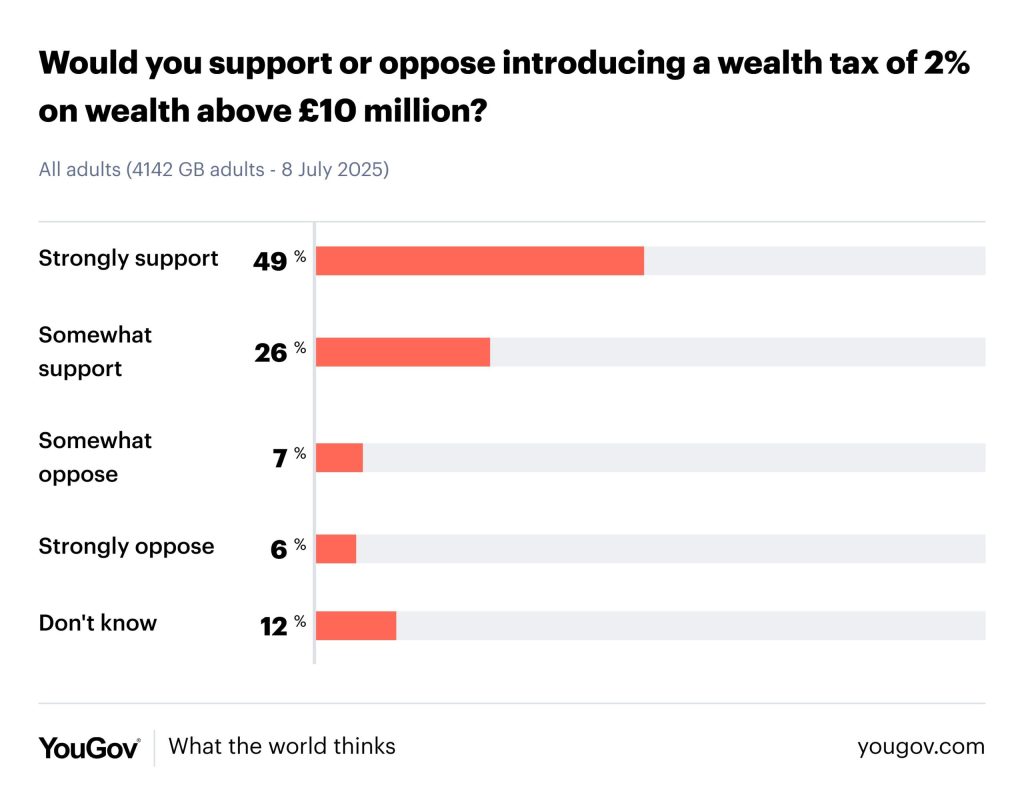
A YouGov poll from last year indicated that 75% of British adults are in favour of introducing a 2% wealth tax.
As Burnham prepares to unveil his new fiscal vision for the country over the coming weeks, the consensus suggests calls for a wealth tax are sure to grow louder.
Only time will test whether the targeted taxation of the super-rich can fund public services without harming the economy that generated their wealth.
Featured image credit: Tomek Baginski via Unsplash