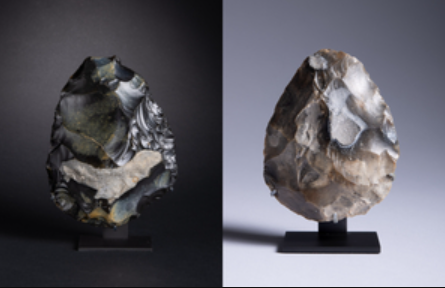
Two remarkably well-preserved prehistoric handaxes believed to be around 500,000 years old have been placed under a temporary export bar by the Government.
This gives UK museums and heritage institutions the opportunity to acquire and display them.
The two flint tools were discovered on the shoreline at Happisburgh in Norfolk.
They offer a rare glimpse into the lives of some of Britain’s earliest inhabitants and are considered very significant in understanding the first occupation of northern Europe.
Culture Minister Baroness Twycross announced the decision after receiving recommendations from the Reviewing Committee on the Export of Works of Art and Objects of Cultural Interest (RCEWA).
The two handaxes were found following storms along Norfolk coast stripped back the layers of clay from the beach, revealing ancient land surfaces that had lain buried for hundreds of thousands of years.
Crafted from flint using stone or antler hammers, the tools were carefully shaped by removing flakes from both sides of the stone to create sharp cutting and scraping edges.
As with many Acheulean handaxes of the period, they were used without handles.
One of the handaxes measures 13cm in length and weighs 465 grams, with an asymmetrical form and patches of orange-brown staining from the ancient sediments.
The second, measuring just over 10cm long and weighing 308 grams, is mottled grey and brown in colour, with part of its original chalky outer surface still visible.
Announcing the export deferral, Baroness Twycross described the handaxes as offering a unique insight into Britain’s prehistoric past.
“These handaxes present a window into the lives of some of our oldest ancestors. The Britain they inhabited was very different from our own and items like these provide a valuable insight into a world that is extremely difficult to research,” she said.
“I hope these handaxes can find a UK buyer who can keep them accessible to the public, so that we can all share in the revelations they bring about some of Britain’s very first settlers.”
Tim Pestell, a member of the RCEWA committee, said: “Happisburgh, on the East Norfolk coast, can be said to represent the first page in British history.”
“These wonderfully tactile flint handaxes help provide internationally significant evidence of the earliest human occupation in northern Europe.”
The two handaxes are among the oldest objects to be placed under export deferral in the past decade and are the seventh temporary export bar issued by the Government so far this year.
Each artefact has been valued at £15,000.
During the deferral period, UK museums, galleries and other institutions will have the opportunity to make offers to acquire the tools.
The Reviewing Committee recommended the export bar because the handaxes meet two of the Waverley Criteria, these being their outstanding connection to Britain’s history and their exceptional significance to archaeological research.
For archaeologists, the humble flint tools represent a link to a distant past when some of the first humans ventured into the challenging landscapes of prehistoric northern Europe.
Featured image credit: Gov UK