
The suicide rate is higher among men than women in London, new data has found.
Figures released by the Office for National Statistics (ONS) found between 2023-2025, the suicide rate in London among men was 11.5 per 100,000 people and 4 per 100,000 among women.
The London borough of Ealing recorded the highest number of deaths by suicide in 2025 with 29 in total – with men three times as likely to die by suicide.
This is consistent across all boroughs of London with the number of male deaths by suicide almost doubling that of women in 2025.
Sonya Trivedy, executive director of external engagement at Samaritans, said: “Today must act as a wake up call. The current approach is not working. We need meaningful action and proper funding if lives are to be saved.”
In the decade between 2015 and 2025, men accounted for the majority of deaths by suicide in each borough of London.
Despite this, London recorded the lowest rate of suicide deaths of any English region in 2025 – 7.3 deaths per 100,000 people.
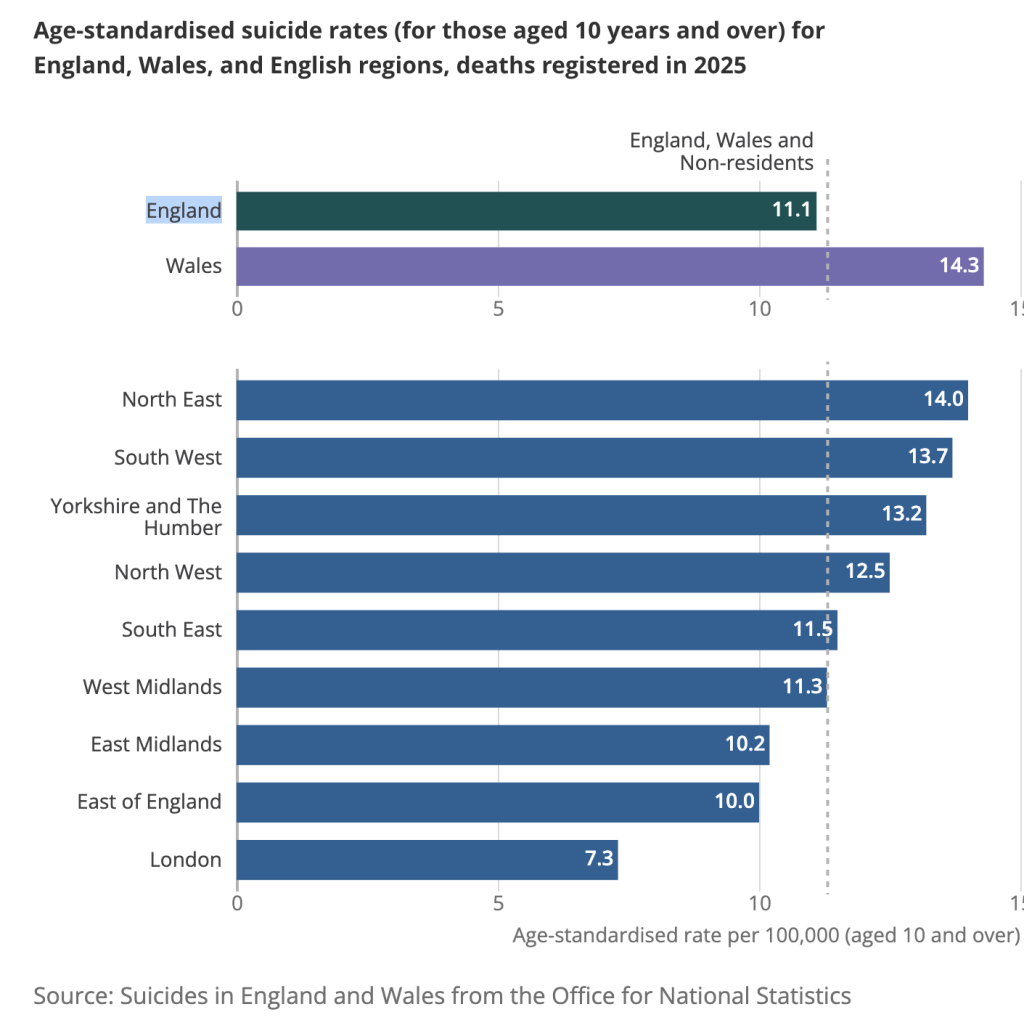
This is down from 8.2 per 100,000 suicide deaths recorded in the capital in 2024.
Between 2015 and 2025 the number of recorded deaths by suicide dropped from 735 to 573 in London.
This is in contrast to the North-East of England, which recorded the highest suicide rate of any English region in 2025 with 14 suicide deaths per 100,000 people.
The national picture
The suicide rate among men in England and Wales has now reached a record high.
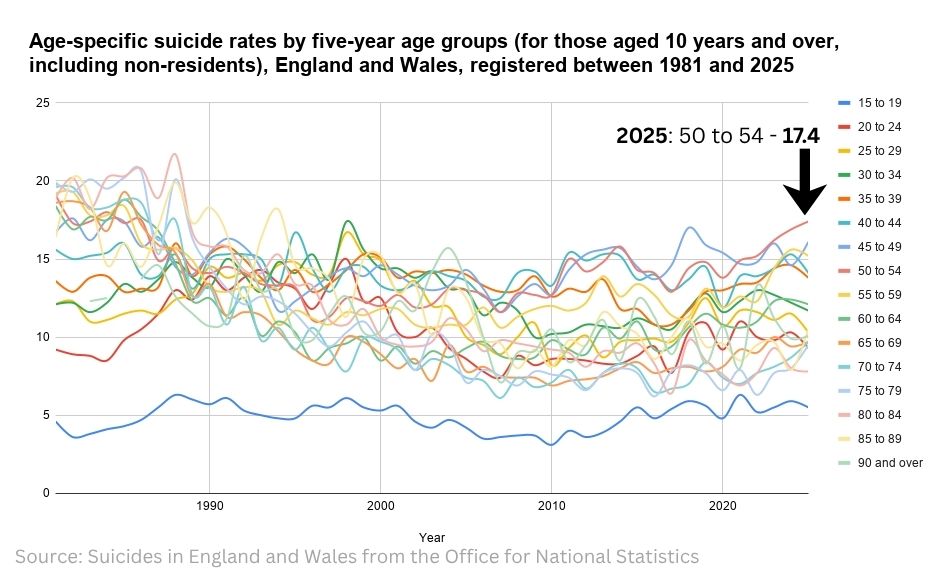
A total of 532 suicide deaths were recorded among men aged 50 to 54 in 2025 – equating 28 deaths per 100,000 people.
This is the highest figure among men of any age group and the highest since the ONS started collecting data on this issue in 1981.
The 2025 figure is an increase from 27.3 per 100,000 people recorded in 2024 for the same age group.
In four of the last five years, the 50 to 54 age group accounted for the highest rate of suicides among men.
Ellen O’Donoghue, chief executive of James’ Place – a nationwide charity offering support to men with feelings of suicide – said the data presented by the ONS mirrors what they’ve seen in their centres across the country.
“In 2025-2026, 13% of the men that came to us for help were in their fifties,” O’Donoghue said.
“These men told us that life events – such as the breakdown of a relationship, family problems, work and money issues – were driving their suicidal crisis.”
In comparison the data provided by the ONS found women continue to show lower rates of suicide.
In 2025, women aged 45 to 49 had the highest number of deaths by suicide – 7.7 per 100,000.
This is up from the 2024 figure of 7.9 per 100,000 for women aged 45 to 49.
There was a total of 6,152 suicide deaths registered in 2025 – equal to 11.3 deaths per 100,000 people. This was similar to the 2024 figure of 11.4 deaths per 100,000.
A stark reminder
Trivedy said the data released by the ONS is a stark reminder that when addressing the issue of suicide complacency is not an option.
“The latest ONS figures show that suicide rates are among the highest recorded rates this century. Men remain three times more likely to die by suicide than women, and middle aged men continue to have the highest suicide rate of any group, a trend that has persisted for decades,” Trivedy said.
“The evidence is clear that successive governments have failed to deliver on their promise to reduce suicide rates and make suicide prevention a priority.”
In 2025, the Labour government announced England’s first ever men’s health strategy to address the physical and mental challenges men and boys face.
Part of the strategy included investing £3.6 million across three years to aid suicide prevention projects for middle-aged men across England.
The ONS noted in their findings that there is typically a delay between when a death occurs and when it is formally registered as a suicide.
This varies depending on the severity of the case and only after an inquest has taken place.
In 2025, there was an average delay of 188 days in England and 249 days in Wales to register the death after it occurred.
This means not all suicide deaths registered in 2025 would have taken place in the same year.
If you are experiencing feelings of distress, or are struggling to cope, you can speak to the Samaritans, in confidence, on 116 123 (UK and ROI), email [email protected], or visit the Samaritans website to find details of your nearest branch.
Featured image credit: Kyle Miller



Join the discussion