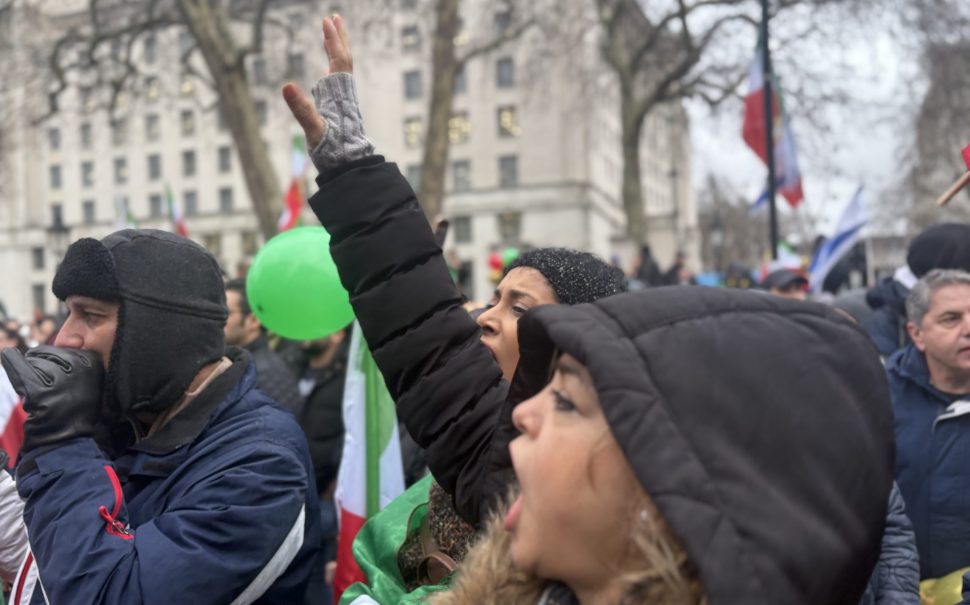
A crowd of more than 3,000 people gathered outside Downing Street on Sunday to protest against Iran’s bloody crackdown on anti-government dissidents.
Organised by the Iranian Committee for Freedom, in collaboration with Jewish advocacy group Just Stop Hate, there was a strong desire for change amongst demonstrators who called for the fall of the Islamic Republic’s regime.
Ayatollah Ali Khamenei, Iran’s Supreme Leader, also came under fire for his role in authorising the deployment of the Islamic Revolutionary Guard Corps to suppress dissent, with protesters accusing him of using lethal violence in Iran.
An estimated 2,000 demonstrators have been killed and more than 10,000 arrested since the unrest began, according to a Tehran official.
Verification of these figures is difficult, however, due to internet connection within the country being severed on Thursday, as officials try to mask the uprising.
Triggered by a major crash of the Iranian rial, the protests began with shopkeepers in Tehran’s Grand Bazaar on 28 December, and quickly spread.
Subsequent waves of nationwide resistance have seen the Islamic Republic face the greatest threat to its leadership since the 1979 Islamic Revolution toppled Iran’s monarchy.
Shadi Karimi, a 38-year-old Iranian scientist, stood still amidst the sea of fractious protestors chanting in Farsi, as she said: “I’m here today to be the voice of my people in Iran. It’s been three days. It’s a complete shutdown of the internet and landlines.
“We haven’t been able to hear anything from Iran, and we want to be the voice of people who have been suppressed for over 47 years.”
Family in the crossfire
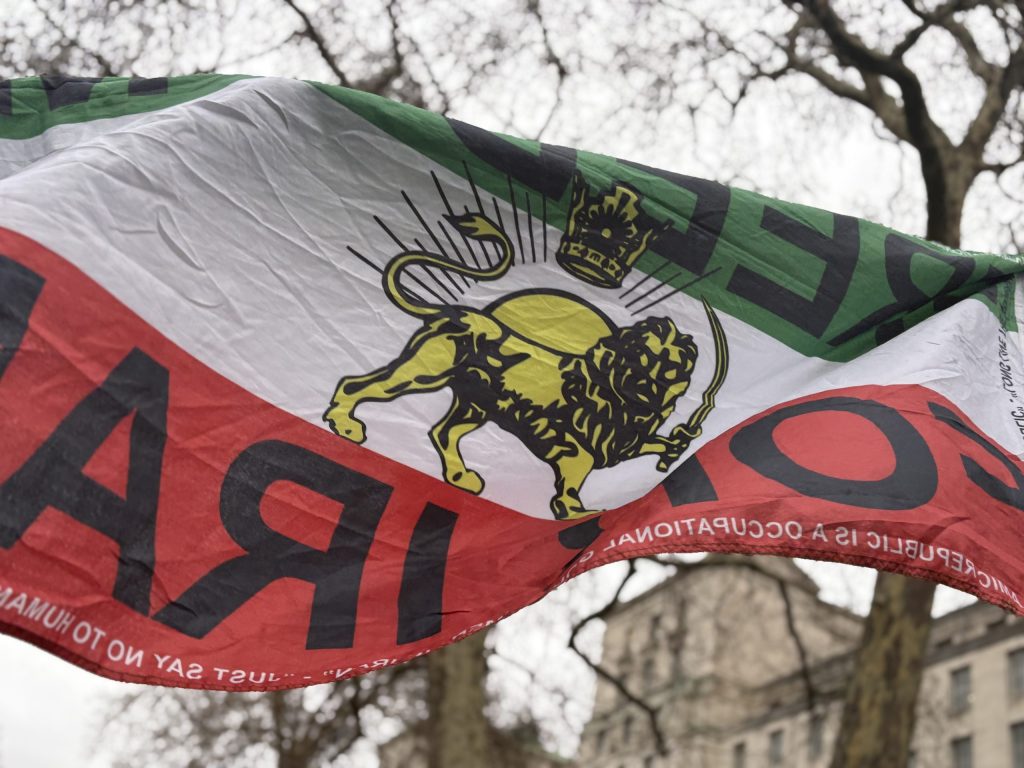
For many protesters, flying the lion and sun flag of pre-revolutionary Iran and speaking out for their compatriots was not merely an act of patriotism, but a deeply personal cause.
Iranians have led UK asylum applications over the past decade, with 62,000 lodged between 2015 and 2024, according to the Home Office.
This statistic was evident, as Iranian’s in the diaspora were present in such numbers on Sunday that they burst past police lines and spilled into the street, filled with fear and hope for their families at home.
Medi Seti, 32, an electronic engineer whose father was shot in the leg during an anti-regime rally in Iran, spoke to us about his concerns for him.
Although communication with Iran has all but disappeared, Seti was able to contact his friends who told him about his father via Starlink, Elon Musk’s satellite-based internet provider.
The images and videos trickling out of the country through this connection show a defiant public setting government buildings on fire and lighting their cigarettes with burning images of the Supreme Leader.
However, other videos show hundreds of body bags in a Tehran morgue and pro-government supporters rallying, giving protesters in London many more reasons to worry than celebrate.
The last time Karimi spoke to her parents was Thursday, when they were in the street protesting.
She said: “Since then, I have had no news from them; it’s very stressful.
“Time doesn’t pass – every day feels like a year for us.”
Attention (or lack thereof) in a blackout
Protesters outside Downing Street also bristled with frustration at what they considered to be minimal Western media coverage of the crackdown.
Somayeh Zamirinejad, a British-Iranian psychologist, 37, said: “The free world has to act. The regime has cut the internet and the landline, and they’re committing a massacre in Iran.
“I don’t know if there’s some kind of a blanket ban on the news on Iran, I don’t know what’s happening, but we don’t seem to be getting the attention of the people of the free world.”
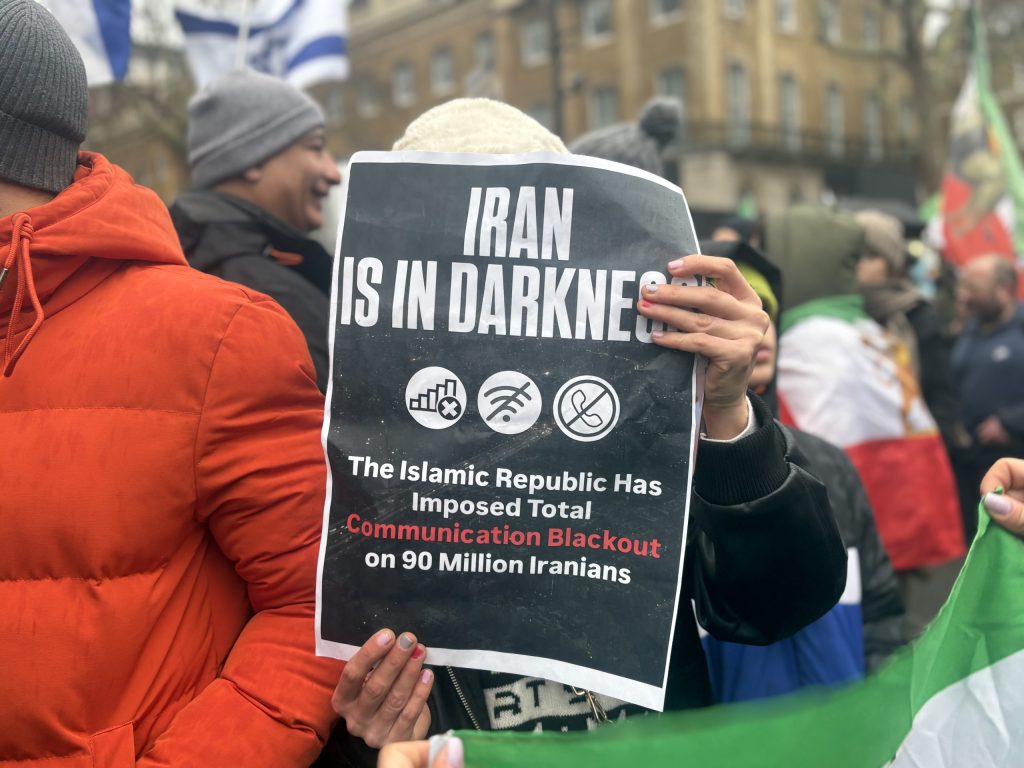
Placards held by demonstrators also demanded the British government proscribe the Islamic Revolutionary Guard Corps as a terrorist organisation, as dissidents within Iran recount their shooting of protestors at point-blank range.
Responding to the calls, Business and Trade Secretary Peter Kyle said an independent review published last year concluded that applying domestic terrorism legislation to a foreign organisation would not be “appropriate”.
Speaking to TimesRadio, he added: “You can see we’ve already used the sanctions against Iran to the full extent we can.”
The United States has taken a less cautious approach, as President Donald Trump issued a statement following reports of the first fatalities on 1 January.
He warned that if Iran “violently kills peaceful protesters,” the United States “will come to their rescue”, saying that the US was “locked and loaded and ready to go”.
Buoyed by the Trump’s message of support on 2 January, demonstrations in Iran expanded to more than 100 locations.
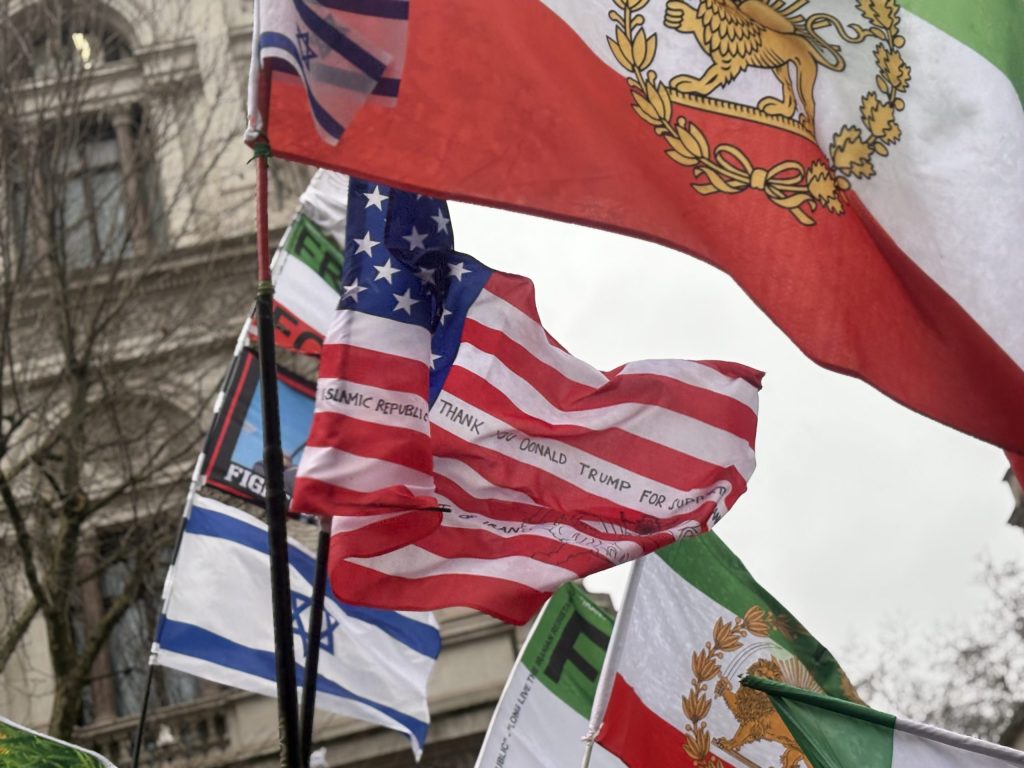
Despite many people flying Trump flags outside Downing Street on Sunday, there was a sentiment that any US intervention should be immediate and brief, and leave Iranians to control their own future without foreign influence.
Bahar Mahroo, a 25-year-old Jewish Iranian bartender, said the President’s support would be essential, but that it could not just be rhetorical.
“We believe that Trump may help us, but we need his help now, not next year, now,” she said.
Karimi said she believed Western support was necessary for regime change, but argued Trump’s motives were driven by capital rather than benevolence.
Pointing out the country’s vast oil reserves, she said: “If they didn’t have any [financial] interest, they wouldn’t go for it.”
Is this a revolution?
Abbas Araghchi, Khamenei’s foreign minister, assembled international diplomats in Tehran yesterday to tell them the situation in Iran had “come under total control”.
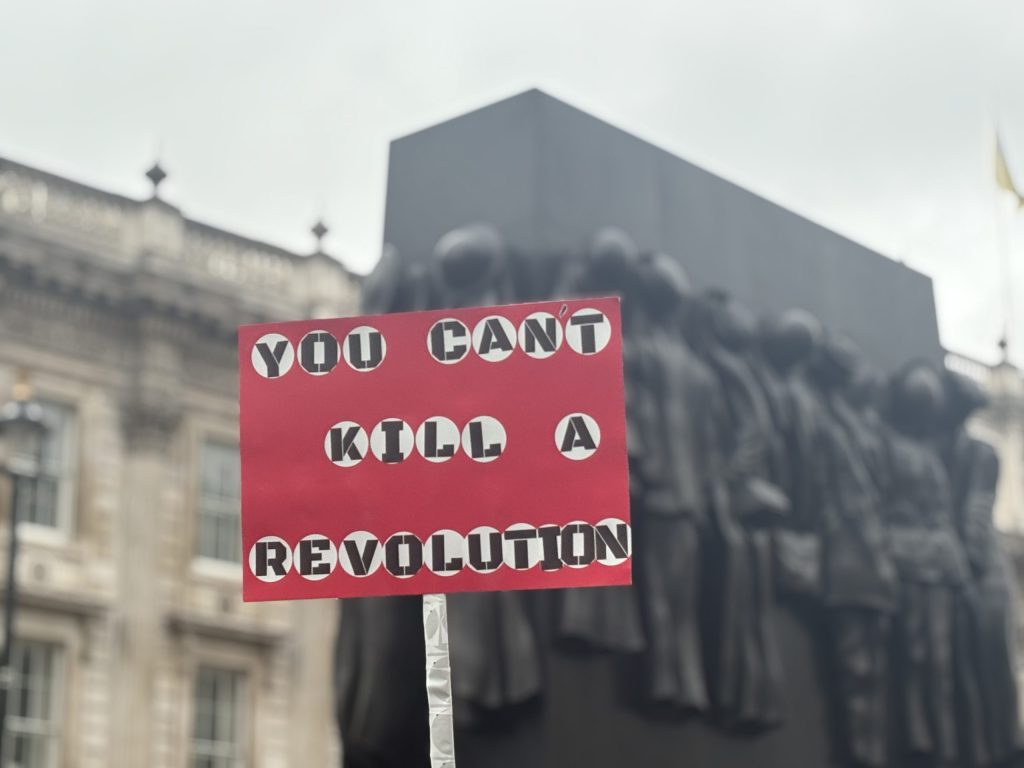
However, in London, there was a sense that irreversible steps had been made towards revolution, as demonstrations start to eclipse the size of the Woman, Life, Freedom protests, which swept the country in 2022.
These protests had been in response to the death of 22-year-old Mahsa Amini at the hands of Iran’s so-called morality police after she was arrested for wearing her hijab out of compliance with government standards.
She reportedly suffered a fatal brain injury as a result of being beaten while in custody, and her death triggered marches across the country that saw women removing their headscarves and cutting their hair in protest.
While Karimi acknowledged that the 2022 protests were snuffed out by violence, as the IRGC killed 1,400 people and took many more prisoners, she felt that this time was different.
She said: “I think when that happened, the government brutally killed all the prisoners to scare people not to do it again and that brought much more anger.
“And this time, when they are in the street, they are not peacefully in the street, they are there to fight and this is much stronger.”
Many Iranians at home and abroad have also found strength in unity, as a figurehead for their struggle emerged in Reza Pahvali, the exiled son of the last shah.
A previously tame voice of resistance living abroad in Washington DC, Pahvali has since positioned himself as a leader for a liberated Iran, calling on his supporters to continue fighting against the regime.
Posting on X he said: “Our goal is no longer merely to come into the streets. The goal is to prepare to seize city centres and hold them.”
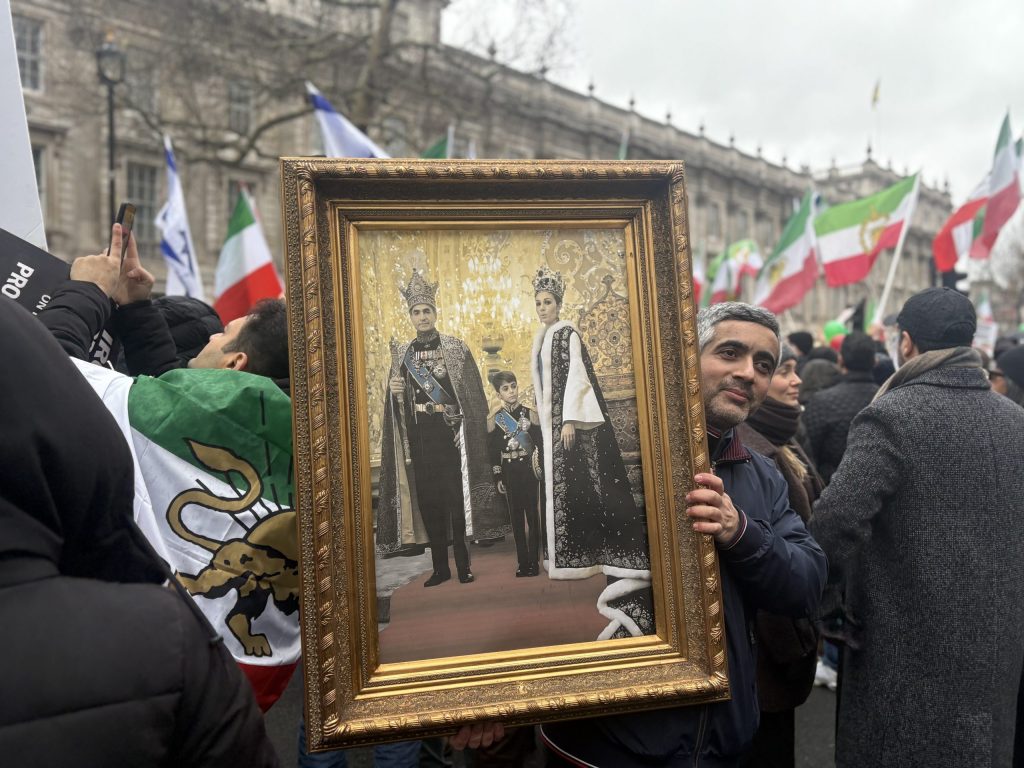
A man holding a large portrait of the Iranian royal family moved slowly through the crowd, and thousands of people shouted “Shah!” in the direction of Number 10, as Seti said: “We have only one option – and he is Reza Pahlavi. He wants to bring freedom and democracy to Iran, so we support him.”
Karimi offered a more sceptical opinion, remembering the corruption which caused Iranians to rise up against the monarchy, as she said: “The main thing is what people want. What I want is different; I want democracy. But what the people want is monarchy.
“These days I see people think Reza Pahlavi is the only alternative, so I’m supporting whatever can change this regime and finally end the suppression.
“Unfortunately, the current regime put the situation to the point where anything that comes after it would be an improvement.”
Despite Karimi’s scepticism, Pahvali’s face grinned out from hundreds of posters outside Downing Street on Sunday, daring people to believe that change may be imminent.
Mahroo talked animatedly as she looked across the crowd and said: “We are human, we want freedom, we don’t want Islamic Republic in our country – the people of Iran want a revolution.
“This is not reform, this is revolution.”
Featured image credit: Megan Norcott