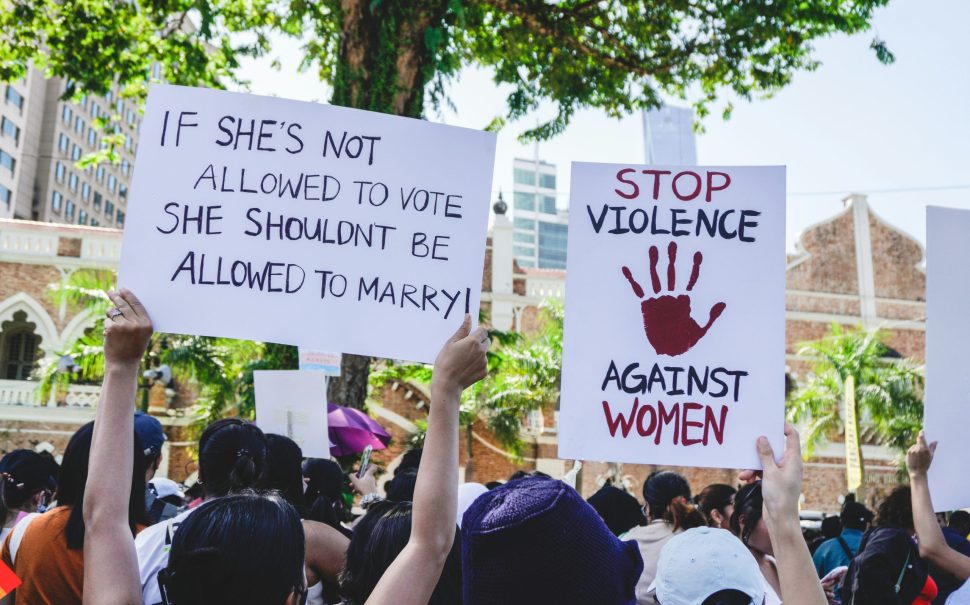
The number of female knife crime victims has surged in the last five years, despite the launch of the Mayor’s violence against women and girls strategy in 2022.
The number of female victims across London have increased by 28%, from 2,217 in 2020 to 2,838 in 2024, data from the Office of National Statistics shows.
Mayor Sadiq Kahn says official figures show the number of knife crime offences are dropping month on month in the capital, noting a 7% drop in offences over a 12-month period to August 2025.
But while recent numbers do demonstrate an overall drop in knife crime offences, the rise of female victims paints a troubling picture for women.
Tom Jewkes, Head of Programmes at the Ben Kinsella trust, a knife crime prevention charity, said: “The levels of knife crime across London, and the country as a whole, are too high and we are facing a situation where over the last decade or so we have had a doubling of weapon enabled offences.
“One knife related death is one too many.
“We are beginning to see tangible, positive results but there is still a lot of work that needs to be done in this area.
“We do not want anyone to be complacent about the scale of the issue and there are still far too many knife related offences taking place.”
In London in 2024 there were 16,346 knife crime offences recorded and in 2025, so far, there have been 70 reported deaths.
According to the College of Policing, knife crime offences refer to articles other than just knives, encompassing bladed or pointed instruments, and includes the use of a knives for threats and burglary as well as violence.
Among the increase of female victims of knife crime, London has also seen a rise in the number of assault incidents involving a knife or sharp instrument where domestic abuse was flagged.
Apart from a dip in 2021, there has been a gradual increase in number since the pandemic with a sum of 1,054 reported cases in London in 2024.
Additionally, 88,948 cases of domestic abuse were reported in the capital in 2024.
A woman involved in such a case, speaking anonymously, told the Londoners that she was in a relationship where she was the victim of domestic abuse.
She said: “He was violent, he gaslit me, and financially controlled me. If I did not obey him, he would hit me.
“I left the day he came home with a machete covered in blood.”
Jenny Holt, refuge worker for Solace women’s aid, London’s largest domestic abuse and sexual violence charity, said: “Knife crime is something that is seen frequently in domestic abuse cases.
“Knives are often used to intimidate women, we have cases where knives are used to intimidate women, to threaten them and emotionally abuse them.
“Women are often the victims of knife crime, and extreme misogyny results in such violent attacks. I think when we hear about knife crime, women’s experiences are rarely included, but we should absolutely look to include more of these stories in the conversation.”
In England and Wales similar trends can be seen with an increase of sexual offences involving a knife or sharp instrument increasing by 30% from January 2024 to December 2024.
The number of rape offences involving knives also increased in this period by a third.
Holt also shared concerns, stating that the government are not doing enough to tackle the issue of violence against women and girls.
She said: “We have just had the budget released, and there has been no mention of VAWG (violence against women and girls), which the government has promised to halve in the next ten years.
“With insufficient funding, organisations such as Solace struggle to support women.”
Earlier this year, the government reiterated their 2024 manifesto commitment to halving violence towards women and girls in a decade.
The National Police Chiefs Council and the College of policing described violence towards women and girls as a national emergency.
Deborah Stillman, head of women and girls for Advance, a national charity supporting women and girls who have experienced domestic abuse and violence, said: “Technology and online spaces are one of the key driving forces behind the rise in abuse towards women and girls.
“We are seeing a rise in misogynistic ideologies and men’s ideas, from very early on, about how they should treat women.
“One of our biggest concerns right now is how violence is being normalised and how social media is perpetuating abuse and violence.”
A government spokesperson said: “Halving knife crime and violence against women and girls in a decade are part of our central missions.
“Our Winter of Action plan will see more police patrolling our high streets and targeting areas most impacted by knife crime. We have also bought in new laws to stop knives being sold illegally online, strengthened bans on zombie-style knives, machetes and ninja swords, and removed nearly 60,000 knives from our streets.
“We have also strengthened protection for domestic abuse victims, set out measures to tackle spiking and stalking and invested £13 million in new national policing operations. Our upcoming violence against women and girls strategy will go further to halve it within a decade.”