Richmond Council has chopped the number of its borough’s smokers in half over the last 10 years, and the prospect of a ‘smokefree’ borough is now tantalisingly close.
However, as its number of smokers falls, the challenges for its Smoking Service rise – and is the cessation of smoking an end goal that works for all?
In 1962, a landmark national study by the Royal College of Physicians, Smoking and Health, found that 70% of men and 40% women were smokers.
Today’s Britain could not be more different. A 2024 ONS study found that only 10.4% of men and 8.2% of women were smokers.
The Conservative Government outlined plans in 2023 to create a ‘smokefree generation’, culminating in the 2025 Tobacco and Vapes Bill currently going through the House of Lords.
Under these plans, the Government set a national target to make smoking ‘obsolete’ by 2030 – meaning that less than 5% of the population are smokers.
Shannon Katiyo, Director of Public Health at both Richmond and Wandsworth Councils, said that the 2025 Tobacco and Vapes Bill had ‘five key areas’.
He said the bill would aim to create a ‘smoke-free’ generation by phasing out the sale of tobacco products to children born after 2009.
It would also strengthen existing bans on smoking in public places, ban the marketing of all nicotine and vape products, and introduce a licensing scheme for these products. Lastly, it would toughen the enforcement of these practices.
Regarding Richmond Council’s plans, Katiyo said: “Our primary aim by 2030 is to be smoke-free in accordance with the national definition of smoke-free.
“Roughly 5.3% of the borough is still smoking, so Richmond is currently quite close to that 5% goal. But I think there’s an acknowledgement that there’s a lot of work we must still do in terms of the prevalence of smoking in the borough.
“There are still a few thousand people in the borough who could benefit from our stop smoking service.”
But what is the council’s strategy to bring about a ‘smoke-free’ Richmond, and will it be able to bring down smoking prevalence in the borough?
Smoking cessation in Richmond
The borough’s smoking cessation efforts coalesce around its stop smoking service, working with local NHS health providers to provide people who want to quit with advice, guidance, and treatment.
According to NHS England data from April 2024 to March 2025, 58% of those who participated in the council’s Stop Smoking Service reported that they successfully quit smoking – above the London average of 53%.
This puts the borough’s smoking service within the top 10 most effective in London.
It has also chopped the number of smokers in half within the last 10 years, according to Richmond’s 2025 public health report.
However, Katiyo argued that whilst the borough has made strides in cutting down the prevalence of smoking, it’s become even more challenging.
He said: “We’re now really trying to reach out to the people who struggle the most in terms of trying to quit smoking and need some more support.
“Although people perceive Richmond as an affluent borough, it is more relevant than they think, and certain groups are disproportionately affected by smoking, such as those in routine or manual jobs, people over the age of 50, some young adults, and individuals with mental illness.
“We are really looking at how we can target our support to those specific groups.”
NHS England data from April 2024 to March 2025 shows a disproportionate emphasis on older residents participating in the scheme, with those 60 and over being two-and-a-half times more likely to take part compared to residents aged 18-34.
The same dataset also showed a similar trend on a national scale, with younger people less likely to be referred to the service, with the 45-59 age group most predominant in participating in national smoking services.
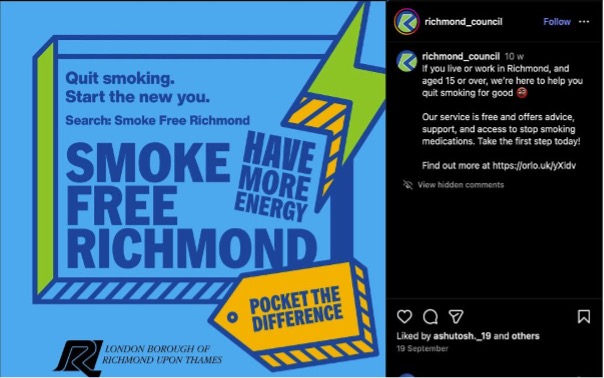
Katiyo acknowledged the lack of young people participating in the service, saying that during the council’s ‘Stoptober’ smoking campaign, social media was a key strategy in helping them reach out to younger people in the borough.
The treatment phase
The Richmond service provided support with residents predominantly through two methods: tailored one-on-one support and advice from a stop smoking advisor, as well as supporting people to access medical treatments.
Katiyo said: “There is no particular treatment or therapy that works for everybody.”
NHS England data shows that the Richmond Upon Thames Smoking Service used a vast array of different treatments to assist participants in stopping smoking.
Katiyo also remarked that some elect to go without treatment and only use the service for support, as evidenced by 38 participants.
Most commonly, participants chose a combination of nicotine replacement therapies (NRT), including things like nicotine patches, lozenges, and oral and nasal sprays.
However, the treatment that proved significantly the most effective was nicotine vapes, with 80% of those using vapes alongside NRTs reporting that they had successfully quit.
Combined with the national ‘swap to stop scheme’ – in which councils provided vape kits to adult smokers who can’t afford them – Katiyo argued that this was not mixed messaging regarding other plans to cut down on vaping.
He said: “The key message is that for adults who already smoke, vaping can be a useful tool to stop them from smoking.
“For people, especially children and young adults, the message is very clear not to start smoking or vaping if they haven’t already.”
Is a smoke-free Richmond the right path for everyone?
In October, Richmond Upon Thames Council launched their ‘feel free’ campaign, encouraging people to take a four-week break from smoking.
Katiyo said: “Abstaining from smoking means reclaiming freedom from cravings, to breathe easier, to feel stronger, to save money, and to embrace a future with clearer lungs.”
However, this wasn’t a view universally shared by everyone.
Shaun, 23, is a Richmond resident and smoker, who claimed he has suffered in the past from mental health issues.
He argued the council is oversimplifying the matter of smoking by making it people’s end goal, suggesting that it can be a ‘necessary evil’ for those with complex needs.
He said: “When you go outside for a smoke, you are mimicking the patterns of meditation or breathing, of taking deep breaths in.
“And that helps people in ways that we can’t calculate.”
Katiyo said that despite the goal to make Richmond ‘smokefree’ there was no pressure on residents to be part of a stop smoking scheme.
He said: “We take a very supportive approach. We don’t target people on the street and try to compel them to stop smoking.
“It’s about making a range of offers available, so when people are comfortable, they can just reach out.”