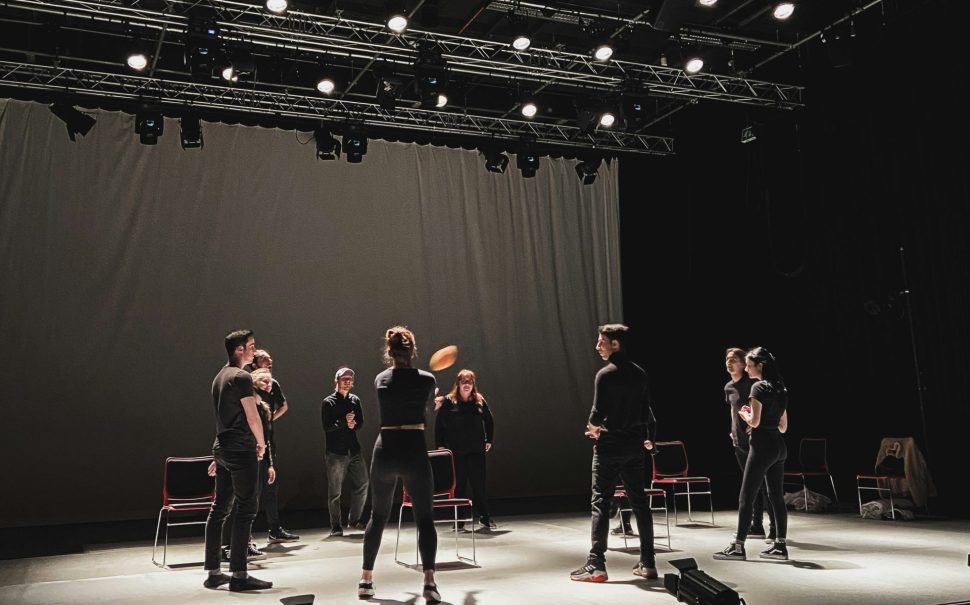
The uptake of Drama in English schools has seen a staggering decline in both GCSE and A Levels since 2010, official data shows.
Uptake for Drama GCSE has decreased by more than a third in England since 2010, and halved for A Level, figures from the Department for Education (DfE) revealed.
In 2010 there was nearly 75,000 Drama GCSE entries which dropped significantly to only a provisional 48,450 entries in 2025, a decrease of 35%.
The data used for the 2024/25 academic year is provisional but follows the same pattern in decline as previous years – a marginal decrease on 2023/24.
The National Education Union lead the Arts and Minds Campaign, which drives putting creativity at the heart of the curriculum.
It believes all children should have the right to study creative subjects and is pushing to restore arts funding in schools.
NEU’s Deputy General Secretary Sarah Kilpatrick said: “Every child should be able to see themselves in the curriculum.
“Every child should be able to recognise something about themselves, if that is a disabled child or a child who is not white, or a child who is care experienced, all children should be able to recognise something about themselves reflected back at them in their learning.
“The arts teach critical thinking, the arts teach questioning skills, and we’ve eradicated opportunities for that all across the curriculum, so it’s so important that we have access to the arts for all children in school, and that’s what the Arts and Minds campaign has been all about.
“It’s very much about a curriculum reform, because we know that this is what children need, and that by extension, that’s what our society needs.
“We need a return to decent, critical thinking skills and the ability to ask questions.”
Drama is not the only arts subject that has suffered as Media, Film and Television GCSE entries have almost halved with Music entries showing a decrease of 20%.
The reduction in the uptake of arts related subjects has correlated with the introduction of the English Baccalaureate (EBacc) in 2010, which encouraged students to study across five key areas: English Language, English Literature, Maths, Double Science or Biology, Chemistry and Physics, a humanity and a language.
Following significant pressure to review the curriculum, the current Labour government last month that they will be scrapping the EBacc, which has been well received within arts education.
Of Drama GCSEs that were taken in state-funded schools across England in 2025, 41% were taken by students from London and the South East.
Take up was lowest in the West Midlands (7%), Yorkshire and the Humber (6%), and the North East (only 2% of the total).
Kilpatrick claimed since the introduction of the Ebaccalaureate and Progress 8 there has been a 42% drop in arts GCSE uptake since 2010, and added there is no secret about how that happened.
She said: “When you prioritise other subjects and you say that arts is not important, that music, drama, dance, it’s not important.
“That is not something that is being said to children from backgrounds which are affluent, it’s just not. These children have access to the arts in the form of piano lessons, dance lessons.
“These things are something that is taken for granted by more affluent families, and you would never see the arts sidelined in our wealthiest fee-paying schools. It just wouldn’t happen.”
Along with GCSE, A Level Drama has almost halved in uptake since 2010/11 when there was a total of 14,597 entries which dropped to only a provisional 7,372 entries in 2025.
For A Level Drama in 2025, the South East accounted for a fifth of Drama entries and take up in London was 13%.
National Drama is the UK’s leading association for drama teachers, educators and theatre practitioners that aims to provide its members with a framework and guidance.
They advocate for Drama to be a Foundation subject with the same status as other arts subjects.
Executive Committee Chair and Consultant in Theatre and Drama Education Dr Geoffrey Readman said: “Drama is one of the easiest ways in which children make sense of the world. That applies to 18-year-old children, as well as to six-year-old children. Drama is not simply a curriculum subject. It’s an art form.”
Dr Readman connected the decrease in Drama GCSE uptake to a string of government reforms, starting with a 1988 decision to not make Drama a Foundation subject, and since then, reforms in 2010 and 2016 have marginalised and undermined Drama as a subject.
He said: “Senior leaders in schools do not understand drama and they are putting young people off choosing it at GCSE.
“If you haven’t got a good drama teacher, you won’t get in there at all anyway, if you’ve got somebody who’s finding their way in drama as a teacher, they won’t have a strong voice within the school.
“Senior leaders are really to blame. Numerous examples of them telling youngsters it’s no good for university, why are you doing that? You don’t need to do that.”
He said that the current assessment at GCSE is 70% written and 30% practical, which he argued is not for the benefit of the young people taking their GCSEs, but rather so that the school can be assessed in national tables.
Lola Shalam, a former student of GCSE Drama at a London state school said: “Drama GCSE was based on people taking a career in dramaturgy or production, it was skewed through an academic wash as opposed to, this is someone who is really interested in acting.
“The curriculum just didn’t lend itself to young people interested in their craft.”
Shalam commented that schools were telling students that the subject wouldn’t lead to a career.
She added: “If you’re being told that this isn’t a valuable skill and you’re not going to be good at it unless you’re inherently loud and confident, you’re not going to go anywhere near it – apart from the odd kid that thought maybe they could give it a go.”
The current Labour government has responded to the Curriculum and Assessment Review and is developing a new curriculum that will be published in Spring 2027 and is to be taught from September 2028.
Photo by Hamish Kale on Unsplash