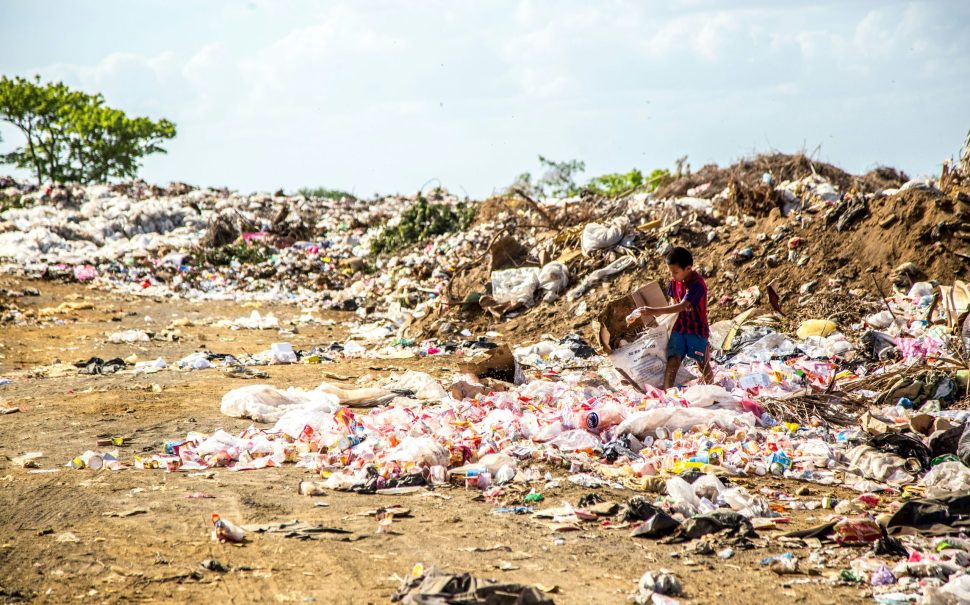
London has seen a 14% decrease in textile waste in the last year – the largest annual dip recorded in the capital following gradual year-on-year increases.
The figures, compiled from London borough council waste reports between 2018 and 2025, track textiles collected through household waste and recycling systems.
London’s councils recorded 9,732 tonnes of textile waste in 2024, up from 8,154 tonnes in 2018, but in 2025, this fell to 8,346 tonnes.
South London and West London saw the most notable reductions, with decreases of 25% and 19% respectively.
Gianpaolo Vignali, a Manchester-based Professor in Sustainable Fashion Business, said there are “small pockets of people showing ways that clothing can be repaired,” pointing to the growth of reworking and repair-led businesses.
Businesses like TLZ Movement reflect this shift towards circular fashion.
TLZ Movement’s founder, Nadia Piechestein, moved from designing clothes into upcycling after becoming overwhelmed by the volume of existing textile waste. She now runs a studio focused on repurposing garments.
She said: “I am concerned with the amount of clothes in production, but I can see the evolution and how it is becoming more trendy to be sustainable. I do feel positive about the future.”
Despite the overall fall in London, the trend is not evenly distributed across London.
This comes to light by looking at East London, the same area the TLZ Movement studio is located in on Westferry Road.
While the capital city overall saw a 19% rise in textile waste between 2018 and 2024, before the recent drop, East London recorded a 53% increase over the same period.
At the same time, the Annual Survey of Hours and Earnings (ASHE) reported that East London wages from 2018-2024 were 12% lower than in South and West London combined.
By then looking at 2025 – where South and West London saw huge reductions in their textile waste whilst East saw a 5.5% increase – the figures suggest an overlap between lower average incomes and higher textile waste.
This raises the question – how equal is the spread of access to sustainable fashion alternatives across the city?
Councils having the budget to implement better textile waste systems is part of the solution, but experts argue that consumer behaviour is equally important.
Hannah Standen, CEO and co-founder of upcycled fashion marketplace Alterist said: “Shame or guilt tripping doesn’t work.
“You need to market the clothes as the better option that not only looks great but that also helps the planet and is cost effective.”
Alterist has recently opened a permanent space in North London, reflecting growing demand for sustainable fashion.
“Fast fashion encourages mindless consumption,” Standen said. “So we ask designers to show how long each garment took to make so the price reflects the labour and encourages a connection with clothing.”
Standen is just one voice in many playing a growing role in changing the narrative towards fast-fashion consumption.
Vignali added: “A lot of the blame is quite rightly being put on the retailers and the sheer volume of what they are manufacturing each year.”
This comes down to policies being introduced to change production lines.
The EU’s Eco-design for Sustainable Products Regulation (ESPR), introduced in 2024, establishes a framework for the Digital Product Passport (DPP) and strengthens requirements for companies selling into the EU.
Such policies tackle the “thoughtless consumption” Standen referenced and the explosion that fast fashion retailers have had on the market by encouraging transparency and circularity across the system.
However, experts argue that policy alone is not driving change.
Instead, it is the combination of regulation and shifting consumer attitudes within the fashion industry.
Vignali said: “We find ourselves in a very challenging time. Baby boomers were one of our most sustainable generations because they repaired clothes with tailors and cobblers.
Fast forward 30 years and we see the explosion of fast fashion retailers.
“We need to make sustainability accessible through renting, reuse, and innovative practices. There is no single formula except rewarding those doing it well.”
Vignali points to the premium price that is often added to sustainable options, one which marginalises those who cannot afford to pay for it.
Bringing back the physical presence of shopping is one way to encourage mindful consumption because as Vignali put it: “Fast fashion caused the art of shopping to disappear.”
Standen echoed this tension of reducing reliance on fast-fashion trends.
“As an activist pushing the fashion industry to be more sustainable, we met many upcycling designers who had no platform to showcase their work,” she said.
“We wanted to give upcycling a voice alongside recycling and reuse.
“Sometimes it is cheaper for fast fashion giants to destroy their textile waste than upcycle it, so there needs to be an economic incentive.”
With a combination of policy shifts and changing attitudes, London’s textile waste is beginning to decline as communities lean into sustainable options.
However, the challenge remains ensuring that these green shopping habits are not confined to higher-income groups.
As Vignali noted, future policy will likely increase producer responsibility further, but the success of that shift may depend less on regulation alone, and more on whether sustainable fashion becomes economically and socially accessible across the capital.
He mentioned that he teaches his students to think not just about the construction of clothes, but their deconstruction too, and how these new designers are bringing the future of circular fashion into our present day.
“We need to shop with our values, learn how to sew and repair or utilise second hand and upcycling platforms. There are so many positive ways to engage in sustainable fashion,” said Standen.