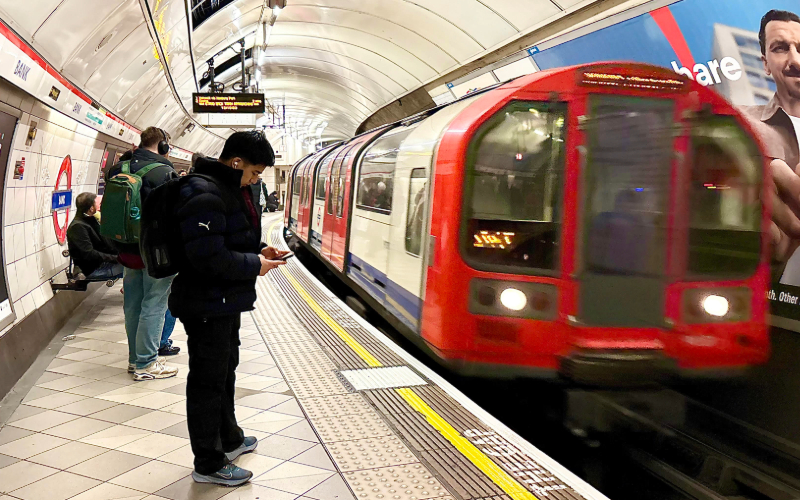
We’ve all felt the frustration of trying to chat on the Underground, only to have that familiar screech halt the conversation in its tracks.
But according to new data, this occurrence is not only irritating, it could be harmful to your hearing.
Several of the busiest Tube lines have consistently recorded noise levels above 90 decibels (dB), a volume high enough to potentially contribute to hearing damage among commuters.
Normal conversations usually take place at around 60 decibels, whilst noise levels above 90 decibels are comparable to a motorcycle engine, heavy traffic, or a lawnmower.
So it’s no surprise that passengers on these routes must raise their voices, or, more often than not, give up on conversation entirely.
To measure the noise on the Underground, TfL used LAeq. It is a single value that represents the average sound level over a given period, expressed in A-weighted decibels (dB(A)).
The A-weighting adjusts the measurement to reflect how the human ear perceives sound.
The data, obtained through an FOI (Freedom of Information) request to Transport for London and reviewed by JRPass, highlights the loudest stretches of the network.
The loudest tube journeys:
Green Park to Victoria (Victoria line) – 92.9 decibels
Liverpool Street to Bethnal Green (Central line) – 92.8 decibels
Highbury & Islington to Finsbury Park (Victoria line) – 92.1 decibels
Highbury & Islington to King’s Cross St Pancras (Victoria line) – 91.5 decibels
Gants Hill to Newbury Park (Central line) – 91.1 decibels
For context, just a small increase in decibels has a large impact on how loud the sound is: 90dB (A) is 10 times as intense as 80 dB (A).
The hidden hearing risk:
Guidance from iHasco suggests exposure to noise levels of around 92 decibels for more than 1 hour and 35 minutes, can exceed the recommended maximum daily noise limit.
Of course, most Tube journeys are much shorter than this. However, regular commuters travelling on these noisy lines could accumulate a significant proportion of their daily noise exposure just from their journeys to and from work.
Although earplugs have become an essential for nights out, most people remain unprotected from additional everyday sounds including household appliances such as blenders or food processors, loud traffic or noise from children.
All of which have the potential to further increase overall exposure throughout the day.
Within the data, the Victoria and Central lines appear most frequently among the loudest sections recorded.
Both are deep-level lines that operate through narrow tunnels and include tighter curves, which can amplify noise as trains pass through enclosed spaces.
These lines are of most concern, carrying over 700,000 passengers every day, their noise levels are consistently high.
How is TfL making Tube journeys quieter?
In response to the data, TfL told North East Londoner: “The main source of rail noise is rail corrugation, which is treated by grinding the rails with specialist equipment and is not a permanent fix.
“Our challenge is how we manage our resources to carry out as much grinding as we can, and we do this by using a data-led approach, grinding around 17,500 metres of track every 6 months.”
“We are also undertaking other measures such as new types of resilient track fixings, speed variations and a softer under rail pad that absorbs the energy from passing trains.”
As the sound was recorded in the operators cab rather than the passenger saloon, TfL said: “There is a small difference, noise levels are slightly higher in the passenger saloon.
“However, the overall exposure to noise for passengers is lower as they will spend less time on the train in comparison to the train operator on a multi-hour shift, and the levels of noise they are exposed to will vary depending on factors such as the number of other passengers on the train, or whether the train windows are open.”
TfL’s recordings show that noise levels on the Underground vary by station-to-station section, rather than by line alone.
Factors such as tunnel depth, curvature, train speed, and track condition all influence how loud a particular stretch becomes.
Comment from the British Society of Audiology:
An officer from the British Society of Audiology said: “Whilst some individuals may find noise uncomfortable or upsetting, others may not, and that is not the same as saying that the noise levels are damaging.
“Sound levels peaking at 90-93 dBA over short periods of time would not be considered as likely damaging.
“These levels of sound would not be considered as liable to damage hearing in the workplace unless they were sustained for 1-2 hours.
“However, that’s not the same as saying that some people might find it uncomfortable.”
Daniel de Nieuwe, head of product at JRPass, said: “The London Underground is one of the world’s oldest metro systems, and this data shows just how much noise levels can vary depending on where you’re travelling.
“People aren’t imagining it – some Tube stretches are averaging above 90 decibels. In those sections, even a quick conversation can turn into shouting.”
For most Londoners, the Tube and its briefly jarring symphony, is just a part of the daily routine.
But as this data shows, the noise isn’t just an annoyance, it may be quietly (or not so quietly) adding up, and what we overlook as background noise could come at a cost.
Featured image credit: Gemma Hamilton