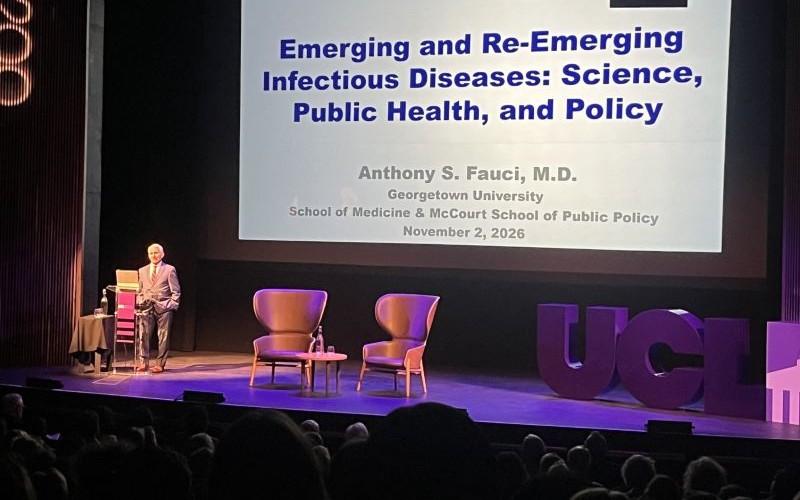
Scientist Dr Anthony Fauci warned of key threats to global pandemic preparedness at this year’s UCL 200th year Prize Lecture on Monday.
The former advisor to seven US presidents explained how infectious diseases re-emerge throughout human history and emphasised the need to prepare for the next outbreaks.
According to the UK Health and Security Agency, the rate at which infectious diseases are emerging in England is rising.
Scientists attribute this to factors like climate change, urbanisation and greater contact with animals, with dense cities like London experiencing rapid viral spread.
Fauci said: “Emerging and reemerging infections have been with us forever.
“We’ve experienced at least two of them in our lifetime – HIV/AIDS and Covid – and they will be with us forever.
“So because it’s a perpetual challenge, unlike what some people are saying right now, we have to be perpetually prepared.”
He also warned of a loss of vaccine coverage for widely treatable infections like HIV/AIDS and Covid due to misinformation, which may cause avoidable harm.
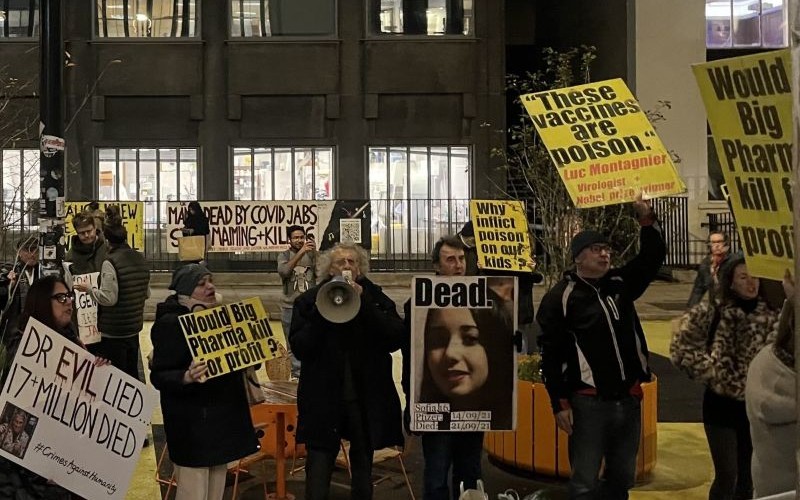
Fauci spoke amid anti-vax protests outside of Bloomsbury Theatre, where the lecture took place.
He added: “The four horsemen of the apocalypse are now five horsemen, and one of them is misinformation.
“Misinformation and disinformation about the origin of Covid has negatively impacted the preparation for the next inevitable pandemic.”
Dr Leo Swadling, a group leader at UCL’s Institute of Infection, Immunity and Transplantation who attended the Prize Lecture, is spear-heading research to develop a new vaccine that prevents infection by all viruses of the coronavirus family.
He said that scientific learnings from Covid-19 have improved the UK’s preparedness for the next pandemic – but that losses in vaccine uptake could put it at risk.
Swadling said: “As soon as we identify a new virus, we can create a vaccine quicker.
“We know how to test to see if it works and we know that we’ve got the capacity to use it.
“Where vaccine coverage is dropping, we’re seeing these infections come back and that can be really frustrating because you’ve got highly effective vaccines.
“Infectious diseases are among the leading causes of death and disability everywhere still. We shouldn’t take our eye off them.”
Dr Christina Pagel, mathematician and Professor of Operational Research at UCL, identified wider challenges to the UK’s pandemic preparedness, including an erosion of trust in government-backed public health recommendations.
Pagel, whose testimony was used to inform the UK Covid-19 Inquiry, linked this decline in trust with miscommunication about the uses of predictive modelling during the pandemic.
She said: “In modelling, the more successful you are, the more you will be accused of overreacting.
“During Covid, the government would do something, it didn’t happen, but it was pitched as the model has got it wrong.
“It didn’t happen because we did something to try and stop it happening.
“But I don’t think that nuance was ever really communicated well.”
Pagel also expressed concern about the impact of public mistrust in health institutions – and backlash from vocal groups – on dialogue between researchers and policy-makers.
She added: “The thing that worries me most is the loss of trust between the public and authority, and the disincentives now for independent experts, whether that’s academics or public health doctors, to contribute, when they know that the downsides often outweigh the upsides.”
Results from Exercise Pegasus – a government-run test of national pandemic preparedness, including information exchange and responses to misinformation – are due to be published this winter.
Featured image credit: Skye Duarte-Colardelle




Join the discussion