Visually impaired football fans are taking it upon themselves to help make matches more accessible for others like them.
A former groundsman at Brentford and Fulham, has Stargardt disease, and found attending live football matches more challenging since he was diagonsed in his twenties.
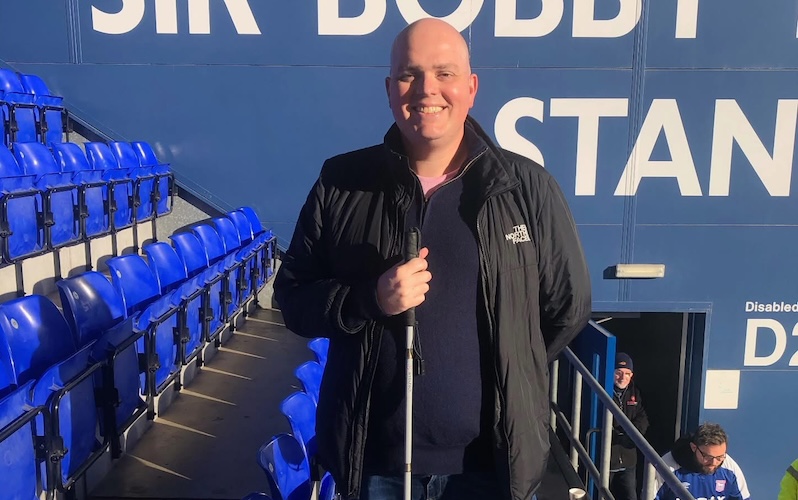
The now 39-year old, Andrew Birch, has since set up Game Day Vision, that aims to make live sporting events more accessible by pairing visually impaired fans with a sighted guide for match-days.
Volunteers guide visually impaired fans to and from games and in many cases the support they provide is vital to making sure fans are able to access stadiums safely.
Stargardt disease is a form of macular dystrophy, which causes damage to the central retina or macula.
Birch said: “I went through my mobility training with the cane and that helped me become more independent.
“But all my mates have got kids now and it was harder to find people to go to the football with.
“My eyesight was getting bad enough so I wasn’t confident enough to go on my own, so I wouldn’t go if I couldn’t find someone.
“That’s when Game Day Vision was born.”
In the UK, two million people live with sight loss and that number is expected to double by 2050, according to Royal National Institute of Blind People (RNIB) research.
The RNIB also found that visually impaired people were half as likely to attend live sporting events compared to the England average.
Birch, who also runs a visa processing business, added: “You feel like you’re doing someone some good. I feel like I’m helping them out, making their day easier.”
But the uptake from clubs across the capital and beyond has been slow, and they currently partner with only a handful of clubs in London.
Neale Ormston, 54, is a season ticket holder at Crystal Palace and developed diabetic retinopathy during the pandemic.
He said: “It was a horrible time for me personally, I got very depressed.
“I was contacted by the disability access team at Palace to ask if I’d be interested in testing the GiveVision headset.”
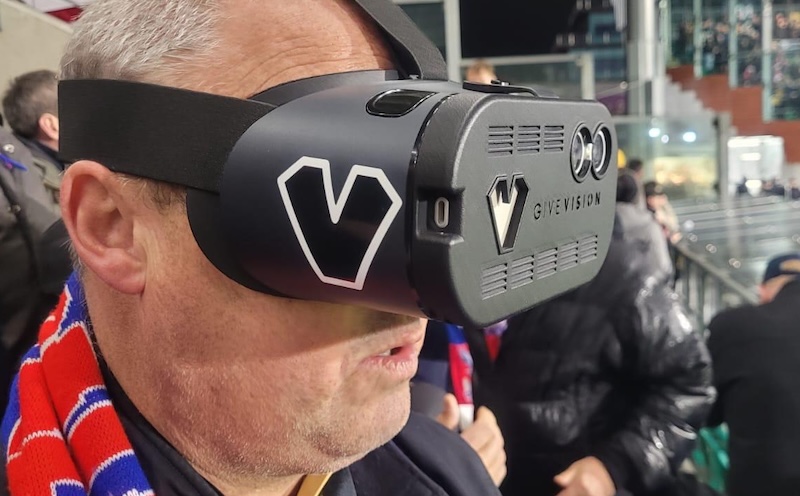
GiveVision is similar to a virtual-reality headset that helps enhance the remaining sight of users.
Ormston first wore the headset when Palace hosted Bournemouth at Selhurst Park in 2022.
He said: “With this headset I was able to witness the goal. I got emotional because it was very surreal.
“I describe it as like being at home sitting in front of the TV, but I’m also experiencing the atmosphere, it’s that good.
“I feel like the luckiest fan there.
“I still get goosebumps, it still feels special that I’m able to enjoy it.”
Currently, Crystal Palace are the only football team in England to use the technology.
Through Premier League run disability working groups, Ormston has been lobbying the league on accessibility.
He is also in touch with fans from Newcastle, Leeds, Manchester United, Liverpool and others, pushing clubs to introduce something like GiveVision.
Ormston is currently helping GiveVision to develop a new, more portable headset that should make wider adoption easier.
In their See Sport Differently report, RNIB CEO Matt Stringer said: “Too often, access to and within grounds and the facilities on offer is difficult to negotiate.
“In many cases this deters sports fans with sight loss from getting involved.
“Think of the excitement we all feel being part of a crowd experiencing the visceral thrill – a goal, a try, a tackle, a race.
“It is unfair to deny this to people with sight loss because not enough thought and effort goes into making the sporting facility and experience accessible.”
Richard Neale runs the sports consultancy Elite Auditory Communication.
The 35-year-old audiologist has been looking at the impact Auracast, a new Bluetooth technology, will have on partially sighted sports fans.
Auracast is an audio broadcast accessible to an unlimited number of compatible devices.
It is hoped Auracast technology will soon be available within sports stadiums.
Neale said: “Anyone in the stadium, wherever they’re sat, would be able to login to that instantaneous stream.
“Theoretically, if you were attending a game, you could tune into the TV, radio or audio description broadcast, with your own headphones.
“It’s high quality and low latency. That’s the tech we’re starting to see rolled out.”
With the help of a friend, Ormston was in Leipzig, Germany, to see Palace beat Rayo Vallecano in May’s UEFA Conference League final, which was Palace’s third trophy in as many years.
He said: “I’ve got a tattoo on my calf of all three cups and the eagle.
“I’ve never ever wanted a tattoo in my life. But I said I’d do it if Palace won a trophy and we go and win three.”
Featured image credit: Neale Ormston

Join the discussion