Fewer Londoners support the Metropolitan Police using facial recognition technology than last year, a survey has revealed.
The Mayor’s Office for Policing And Crime found 76% of people surveyed support using this technology to identify criminals who commit serious offences – an 8% drop in the past year.
This comes as the Met is set to roll out Live Facial Recognition (LFR) technology in central London after trialing it on board police vans at events and in a pilot scheme in Croydon.
The cameras, which scan people’s faces as they walk past and compare them to a list of wanted suspects, are set to be installed in the West End and Soho – where crime rates are among the highest in the capital – by Christmas.
Big Brother Watch, a civil liberties group campaigning against ‘Orwellian’ surveillance technology, claims tens of millions of people in the UK have already been scanned by LFR cameras.
Jack Coulson, Big Brother Watch’s head of advocacy, said: “The British public does not want to live in a ‘papers, please’ society.
“They emphatically rejected mandatory digital ID, and as they learn more about invasive facial recognition technology, they are rejecting it too.
“It is outrageous to subject millions of innocent people to intrusive biometric identity checks when they have done absolutely nothing wrong.”
Last year, the The Equality and Human Rights Commission (EHRC) voiced concerns about the Met’s use of LFR technology.
The EHRC acknowledged that the technology can help combat crime, but stressed that the public’s right to privacy and freedom of expression must be taken into account.
John Kirkpatrick, chief executive of the Equality and Human Rights Commission, said: “There must be clear rules which guarantee that live facial recognition technology is used only where necessary, proportionate and constrained by appropriate safeguards.
“The Met, and other forces using this technology, need to ensure they deploy it in ways which are consistent with the law and with human rights.”
During the six-month pilot scheme in Croydon, in which static LFR cameras were deployed, crime in the area fell by 10.5% compared to the same period the previous year.
The pilot, which ran from October 2025 to March 2026, saw the Met arrest more than 170 wanted criminals – one arrest every 35 minutes.
Lindsey Chiswick, national and Met lead for live facial recognition, said in May: “These results show why live facial recognition is such a powerful tool when it’s used carefully, openly and in the right places.
“This technology is helping us find people wanted by the courts, identify serious offenders quickly and focus our resources where they make the biggest impact, all with exceptional accuracy.”
The cameras were only activated during deployments when officers were present on the ground, and no one was arrested because of a false alert from LFR, the Met reported.
However, public support for using LFR in Croydon to identify those who commit violent or serious offences is at 72%, below the Greater London average.
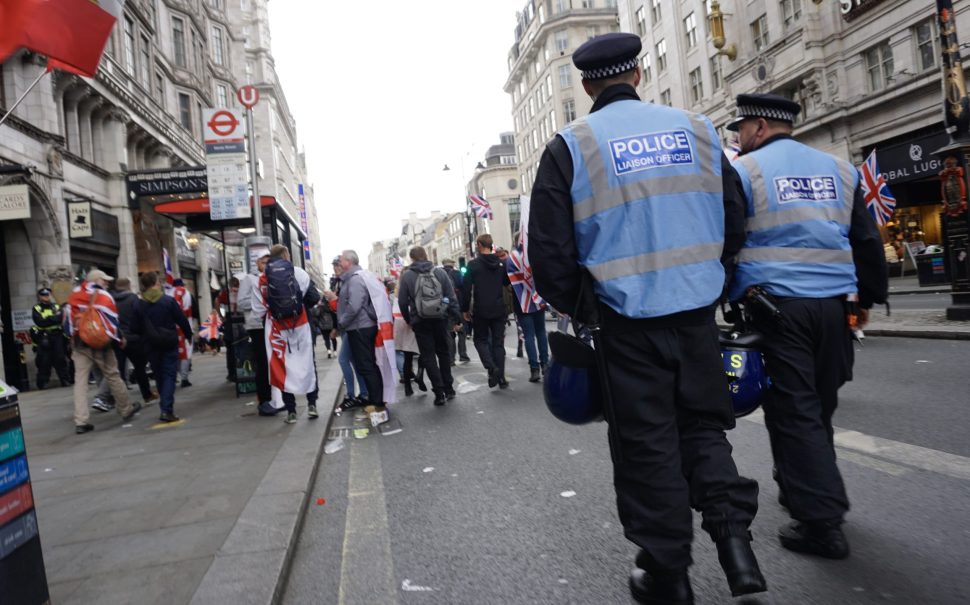
In May, LFR was used in a protest for the first time in the UK, when mobile units were deployed to the Unite The Kingdom march organised by Tommy Robinson.
Big Brother Watch remains skeptical of the technology.
Coulson added: “Inch by inch, London’s camera network is becoming AI-charged, with digital watchmen on every corner.
“We have spent years campaigning for proper scrutiny of live facial recognition.
“Until strict laws regulating this Orwellian technology are passed, LFR use must be halted.”
Featured Image credit: Louis Greaves