Housing experts have called for firmer regulation on ‘out of control’ short-term rentals after new ONS data reveals London’s holiday homes hosted over 21 million people last year.
Between 2024 and 2025, the number of guest nights spent in properties available on platforms such as Airbnb increased by more than 6% across the capital, and by nearly 20% in boroughs such as Croydon and Harrow.
The practice has been criticised for squeezing London’s housing supply and pushing up prices for local tenants, as well as damaging communities due to more properties being used by temporary residents.
According to the national tourism agency Visit Britain, around 80,000 properties in London are currently listed across the holiday rental websites Airbnb, Booking.com, and Vrbo – just 8000 short of the number of new homes London needs to build annually.
Paul Williams, national organiser at the housing union Acorn, said: “The issue is that generally private landlords are there to make as much money as possible, so the incentive for them is the chase where that money is more profitable.
“It’s the problem of having a housing market controlled by people who don’t care about the well-being of the community or tenants – they only care about making as much money as possible.
“The more houses that leave the market, then the less houses there are for people to live. There’s a massive housing shortage in London and as many houses as possible need to be used for residents of the city.”
In London, properties are legally required to have planning permission if they are used as short term rentals for more than 90 days each year.
But in Westminster, which has the highest number of guest nights spent in short-term lets in the country, the council believes that more than a fifth of the 13,000 properties used for short-term letting in the borough are illegally above this limit.
In a letter to Airbnb and Booking.com seen by The Londoners, leader of Westminster Council Paul Swaddle asked the platforms to share information on rentals with councils in order to crack down on ‘out of control’ and ‘rogue’ operations.
“Our community’s well-being and the integrity of our neighbourhoods are paramount; for far too long the people of Westminster have had to live with blatant disregard for the 90-night cap in London, and the problems caused by dumped rubbish and noisy parties for which occupiers, owners and the platforms take no accountability,” Swaddle said.
Swaddle’s demands for tracking short-term rentals are supported by Acorn, who believe there should also be mandatory registration of holiday lets so they can be regulated by local authorities.
Williams said: “I’m sure in places where the housing need isn’t as severe, it can be useful for the local tourist economy to have some. But when it’s massively at the expense of people who need somewhere to live, it is too skewed in [landlords’] favour.”
Despite the Renters’ Rights Act banning no-fault evictions, Williams said he has also heard examples of landlords legally evicting tenants by claiming they would move into the homes themselves, before advertising the property as a holiday rental.
In a bid to reduce unregulated short-term letting, some buildings have seen bans on the practice entirely.
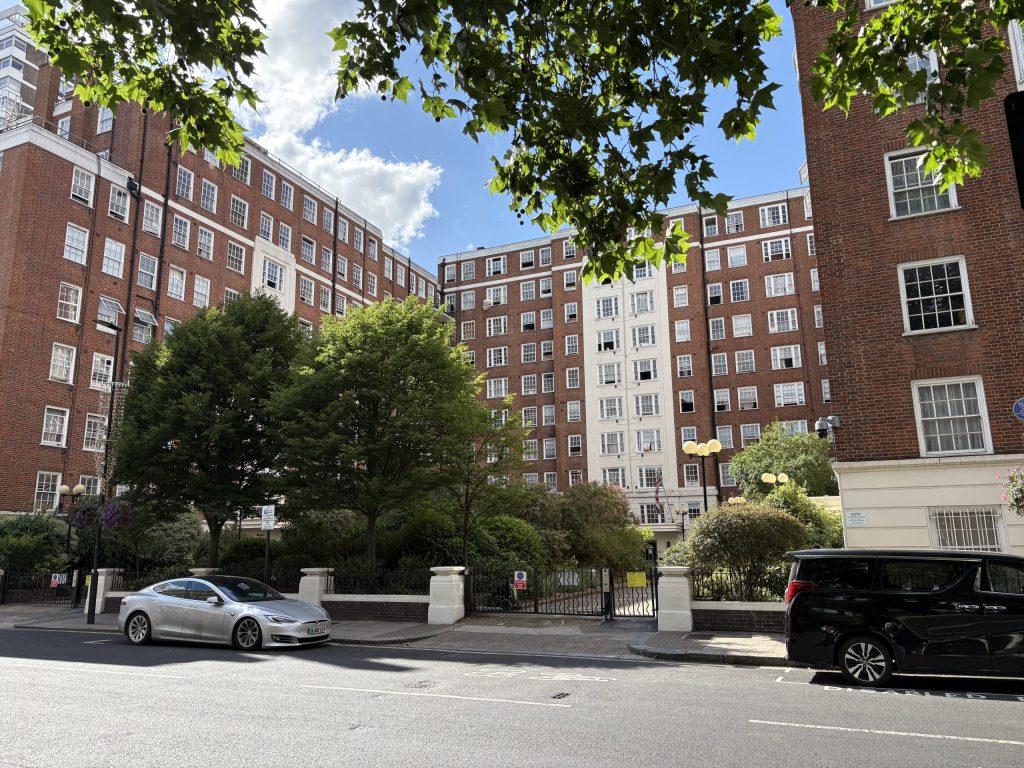
One apartment complex in Westminster, Park West, was said to have more tourists staying each night than The Ritz just two years ago.
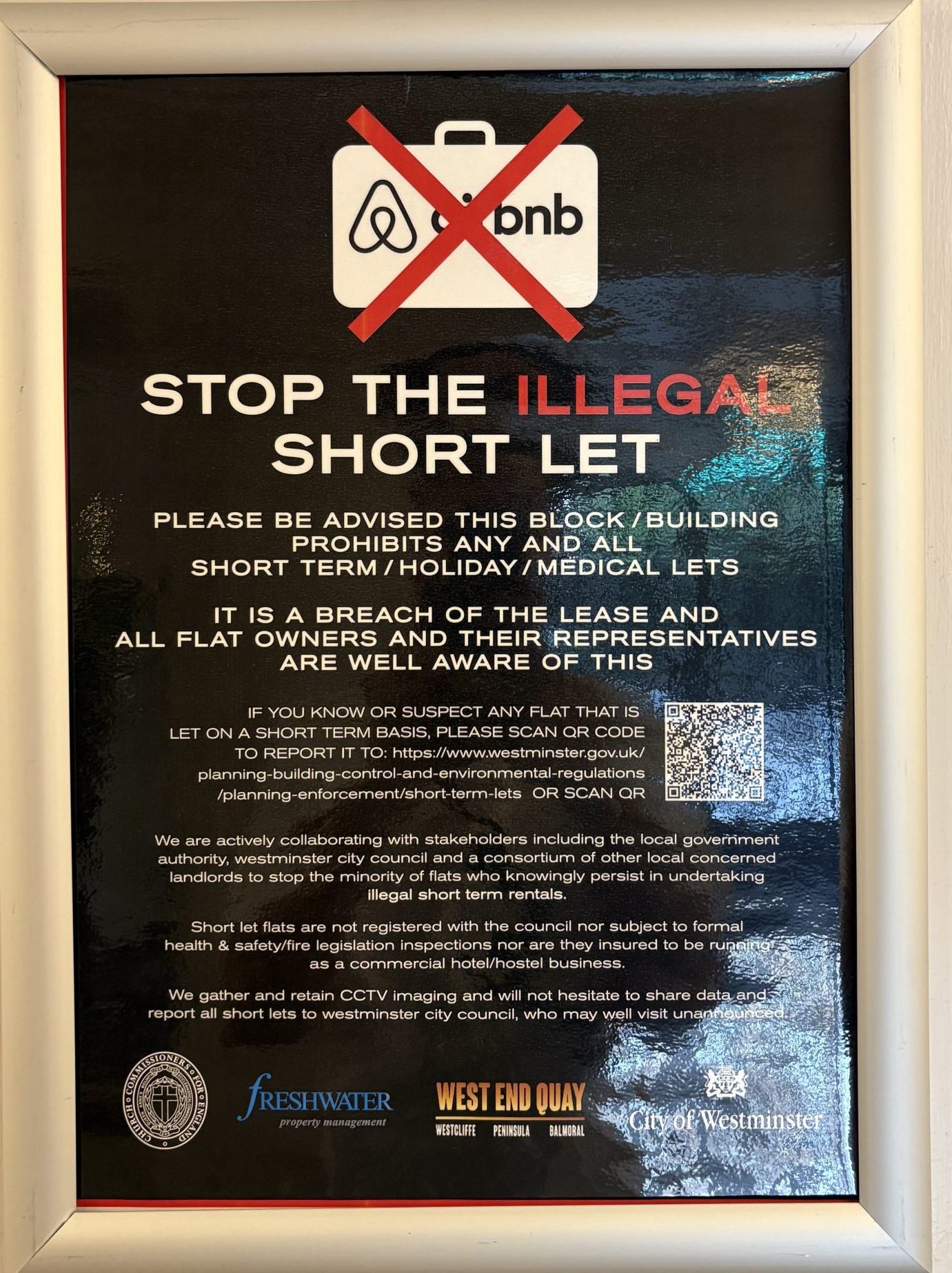
Now, renting flats through Airbnb is banned from the building after a joint crackdown by Westminster Council and the complex’s property manager, Freshwater.
One resident showed The Londoners posters in the lobby of Park West that asked residents to report properties they suspected of being used as Airbnbs.
However, they added that with many flats occupied by students or leaseholders who live between different countries, people frequently coming and going from the building made it hard to know if there were still Airbnbs in operation.
The Londoners could identify six properties explicitly advertised on Airbnb in the Park West complex, with nine more having a matching location but making no mention of the building.
In a review of one apartment, one visitor said that they were informed by the concierge on arrival that Airbnbs were prohibited in the building but were unable to obtain a refund through the host.
Another tourist said that their electronic keys were blocked from a different apartment after the concierge realised the owner was illegally renting the property during their stay.
The building manager could not be reached for comment.
Greg Tsuman, former president of the estate agent body Propertymark, said that while most landlords have not turned exclusively to short-term lets over traditional rentals, the perception of a ‘hostile atmosphere’ to landlords from successive governments has led some to view the practice as a more attractive option.
As the Renters’ Rights Act does not cover short-term letting, Tsuman believes the law must be extended over properties used for holiday rentals to limit malpractice and noncompliance.
He said: “I think the government should look at this as a potential problem, and protect consumers, law abiding landlords, taxpayers, and local residents from the rogue operators who are trying to bypass the spirit of the act.
“I think that unless it’s very clearly defined what a short-term rental is – perhaps through legislation if required – it leaves a lot to fall through the gaps. It’s not good for consumers, it’s not good for the country.”
Under the act, short-term lets do not need to be registered on the Private Rented Sector database set to be introduced later this year, which will be used to confirm property licenses and safety requirements have been met.
Tsuman said: “They’re pretty much running a hotel, almost without the relevant licenses.
“Why should somebody be exempt from letting a compliant and a safe property just because a person is living there for a couple of weeks rather than a longer period of time?”
Without clear regulation, many landlords are thought to be ‘portal juggling’ – meaning they advertise properties on different online booking platforms to bypass the 90-day limit.
“The problem with the approach, and this concept of writing letters, is that, sadly, it does very little to improve standards in reality. The rogues ignore those letters, and local authorities find it difficult to enforce because there is no mechanism to easily enforce it,” Tsuman said.
In addition to landlords circumnavigating the legislation, some tenants have also been found to have sublet properties for a profit without the landlord’s consent.
Tsuman said: “Those operators often apply for more than one tenancy and then sublet it, earning a profit without giving too much regard to the people who live in those properties which were never designed for the short-term rental market.”
He added key boxes next to front doors are a telltale sign that the Airbnb market is rife in areas such as Westminster.
“Whilst it’s fair to say that some of them will be left for cleaners or au pairs, you can also statistically say with a lot of confidence that many of them are used to provide access to short-term tenants,” Tsuman said.
The Ministry of Housing, Communities, and Local Government told the Londoners that the government is set to launch a mandatory registration scheme which will “give councils more oversight of local short term lets while landlords who let beyond the 90 limit could face hefty fines”.
A government spokesperson added: “We are actively considering what additional powers we might give councils to enable them to respond to the pressures created by short-term lets.”
The scheme is planned for later this year and aims to capture any property used as short term rental accommodation, including second homes.
Airbnb and Booking.com were approached by The Londoners for comment.
Featured image credit: Luke Tanis via Unsplash