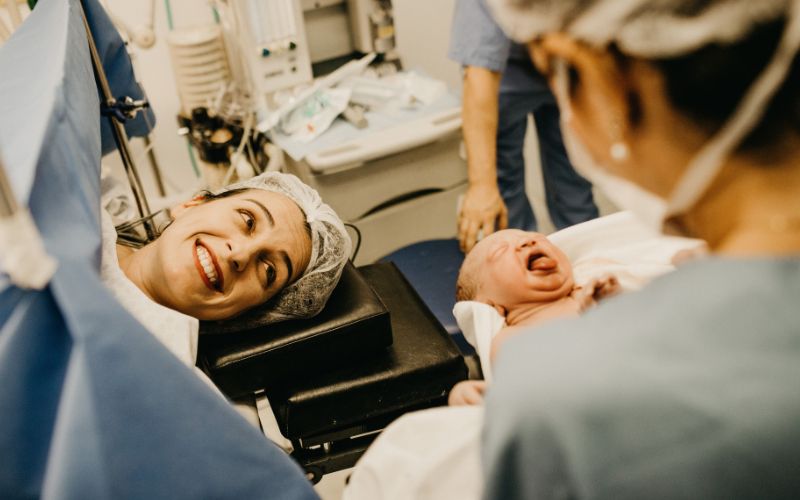
The number of midwives working in London hospitals has reached a record high after maternity services added almost 600 staff in just two years, according to the latest NHS workforce figures.
There are now 4,826 full-time equivalent midwives working across London maternity units – the highest number ever recorded, data published by NHS England last month shows.
This represents an increase of more than 14% from a recent low of 4,233 in March 2023.
Source: NHS England
The growth marks a significant recovery for maternity services that faced severe staffing pressures in the years following the Covid-19 pandemic.
One London-based NHS midwife said: “There were shifts where we were constantly firefighting and rarely even had time for a break.
“Everyone was doing their best, but there simply weren’t enough people on the ward, so you’d finish exhausted and still feel like you hadn’t been able to give every woman the time and support she deserved.
“You’d spend the whole day worrying about what you haven’t had time to do.
“Having more midwives on the ward means safer care, but it also means more compassionate care. Instead of rushing around, we’re able to sit with mum, answer questions, support and make sure no one feels alone. It gives us the chance to be the kind of midwives we trained to be.”
London’s progress is particularly notable given that, while England’s overall midwifery workforce grew by almost 2% between 2020 and 2023, the capitals shrank.
During that period, London lost more than 60 midwifery posts overall, leaving hospitals struggling to meet demand and placing increasing pressure on existing staff.
Source: NHS England
The decline coincided with the period examined by the Care Quality Commission (CQC) in its national review of maternity services.
Inspectors visiting units across England between 2022 and 2024 found that staffing shortages were frequently affecting the ability of services to provide consistently safe care.
In its report, the CQC warned: “As the demand for maternity services continues to increase, the staffing levels need to keep pace with the changes to keep women and babies safe.
“Not having enough staff affects the quality-of-care staff are able to provide and puts women at risk.”
Similar concerns were highlighted by the Royal College of Midwives (RCM), whose 2024 survey found midwives across England were collectively working around 100,000 hours of unpaid overtime every week to help keep services running safely.
Almost nine in ten respondents (87%) said their maternity unit had not been staffed safely during the week they completed the survey – in London, 78% reported facing unrealistic workloads.
Source: Royal College of Midwives
An NHS spokesperson said: “Since the Care Quality Commission’s 2024 review, there has been a clear, system-wide commitment to improving staffing, retention, and leadership, and early signs suggest these efforts are begin.”
The recent increase in workforce numbers follows the implementation of NHS England’s Three-Year Delivery Plan for Maternity and Neonatal Services, which aims to improve recruitment, retention and staffing levels across the country.
The strategy includes commitments to improve maternity workforce fill rates by 2027/28 and introduce local retention plans by 2023/24, designed to improve job satisfaction and keep experienced staff in the profession.
In London, targeted investment has also supported the creation of additional preceptorship midwife posts and dedicated Practice Development Midwives at every maternity site across the capital.
An NHS spokesperson added: “These roles are making a genuine difference, strengthening supervision and professional development for newly qualified midwives, helping them transition confidently into clinical practice, and ultimately improving the care and experience families receive.”
Data on maternity outcomes suggests staffing improvements may also be benefiting mothers and babies.
Source: NHS England
Breastfeeding initiation rates for a baby’s first feed across London fell by more than 11% between 2020 and 2024, broadly mirroring the period of workforce decline.
Since staffing levels began to recover, the rate has risen again to 87% – almost 13 percentage points above the national average.
Rates of immediate skin-to-skin contact between mothers and newborn babies, widely recognised as important for bonding, breastfeeding and infant health, also declined during the period of workforce shortages before recovering in recent years.
A London NHS midwife said: “Our job is about much more than delivering babies – it’s about supporting women through pregnancy, labour and those first crucial days afterwards.
“When we have enough staff to keep up with the demand it means we’re able to build those relationships and provide the kind of personalised care that families remember.”
For expectant parents across the capital, the latest figures offer encouraging signs that maternity services are moving in the right direction after years of pressure.
An NHS spokesperson said: “While we know there is more to do, we are committed to building on this momentum.
“We are focused on sustaining these gains, reducing variation in outcomes, and ensuring every woman and family receives the high-quality, equitable care they deserve.”
With more midwives than ever working across London’s maternity units, hospitals now have a stronger foundation to provide safer care and better support throughout pregnancy, birth and the postnatal period.
Featured image credit: Pexels