
Photo by Micah & Sammie Chaffin on Unsplash
Generational loneliness, why are young people in Britain the most isolated and most depressed?
The generation which is the most connected through smartphones, social media at their fingertips and have more ways to communicate than all the generations before them, and yet data shows they are the loneliest.
Data from ONS reveals a picture that complicates the assumptions that many have about who is suffering the most from loneliness.
The elderly widow living alone, the man who is retired and lost in his social circle, the couple whose children have flown the nest all experience loneliness and the data reflects that.
But there is also data to speak on the age at the other end of the spectrum.
The 21-year-old who consumes hours of content, scrolling through hundreds of videos of other people’s lives, comparing it to their own speaks to a bigger picture.
Young adults in Britain have become more and more isolated.
The Office for National Statistics, Opinions and Lifestyle Survey tracks social and wellbeing trends across Great Britain produced a report in May 2025 as part of Mental Health Awareness Week.
ONS data shows that in April 2025, 31% of adults between the ages of 16 and 29 reported that they felt lonely always, often or some of the time.
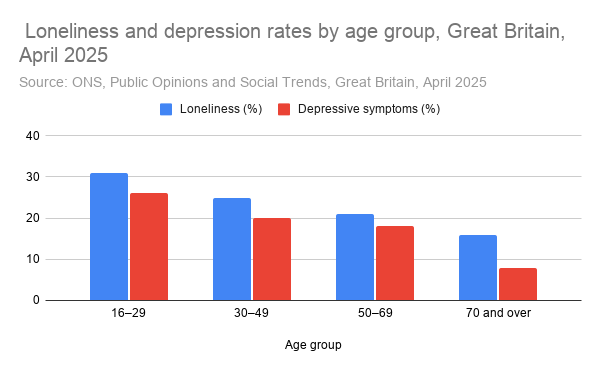
In comparison, adults aged 70 and over made up 16%, almost half the percentage.
The loneliness figures paint a vivid picture but combined with the data regarding depression, it is grounds to claim this a crisis.
One in four adults experienced moderate to severe depressive symptoms in April 2025.
Amongst adults aged 70 and over, the figure was 8%.
Compared to the 26% in young adults, this difference is alarming.
Dr Zack Ncube, a GP, said: “Young people have it so hard these days.
“Yes they have all the electrics, gadgets and the fastest internet but they are my most common patients.
“They are the unhappiest, they are experiencing all sorts of mental health issues and it is happening right under the roof of unsuspecting parents, all because they presume they have it easy.
“Things may be easier, but their challenges are new and they are navigating uncharted territory.”
Many campaigns, charities and government policies focus on elderly loneliness and rightfully so as older people genuinely are at high risk of loneliness.
But the data raises questions on whether the problem has slowly and quietly shifted over the years.
The cost of living crisis is pricing young people out of socialising.
Remote and hybrid working has removed the formal and informal contact that office culture provides.
And although the purpose and design of social media is to connect, it seems to be doing the opposite.
Replacing real connections and relationships are performances of success and happiness, which may leave young people feeling worse.
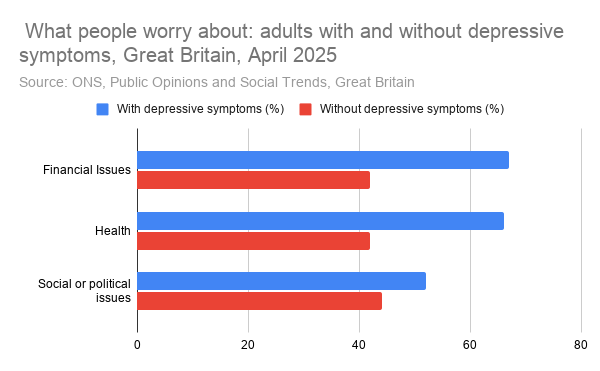
Amongst all adults with moderate to severe depressive symptoms, the most commonly reported worries are financial issues, at 67% and health concerns, cited at 66%.
These figures significantly higher than amongst those with no or mild depressive symptoms, where financial worries were reported 42% of adults overall.
Young people are already navigating a brutal housing market, low wages and rising interest rates and the lingering aftermath of the pandemic, which disrupted some of the most formative years of their lives.
The overlap between financial stress, poor mental health and loneliness is not coincidental.
A young person from a youth group in Bromley, who asked to remain anonymous, said: “We are expected to have it all together and it is so unrealistic and unfair.
“We need to sort out our careers, eat healthily, manage our mental load, survive the cost of living crisis and still make time for ourselves.
“Life sometimes feels like a miserable existence but we are just trying to cope.”
Trust is also a factor that needs to be taken into consideration.
The ONS data shows that adults with moderate to severe depressive symptoms reported significantly lower trust in other people, 44%, compared to the 72% among those with no or mild symptoms.
Low trust and loneliness are mutually reinforcing: when you do not feel you belong, you trust less and when you trust less, authentic connections become more of a challenge.
For young people already navigating a world that feels increasingly unstable, this cycle is difficult to break.
There are tell-tell signs that young people are trying to cope and improve their mental health.
The ONS data found that 76% of adults 16 to 29 reported spending quality time with friends and family to look after their wellbeing, significantly higher than the 65% figure recorded across all adults.
They are reaching for connection and yet loneliness still persists.
In 2018, the government published a loneliness strategy, the first of its kind.
It appointed a minister of loneliness and pledged to treat isolation as a public health issue.
Seven years later, the data suggests that strategy failed to reach the people who now need it the most.
Funding for youth mental health services remains overstretched and waiting lists for therapy on the NHS stretch into months.
There are no easy solutions.
For too long, loneliness has been framed as something that comes towards the end of life.
But the data shows it is happening at the beginning of it too, in bedsits, flatshares and lecture theatres.
If you are struggling with loneliness or your mental health, the following organisations offer free support:
- Mind — mind.org.uk | 0300 123 3393 — mental health support and information for anyone experiencing a mental health problem
- Campaign to End Loneliness — campaigntoendloneliness.org — research, resources, and a directory of local loneliness services across the UK
- Young Minds — youngminds.org.uk | crisis text line: text YM to 85258 — mental health support specifically for young people
- Samaritans — samaritans.org | 116 123 (free, 24/7) — confidential support for anyone in emotional distress
- Shout — giveusashout.org | text SHOUT to 85258 — free, confidential crisis text support, 24/7
- The Mix — themix.org.uk | 0808 808 4994 — support for under-25s across mental health, relationships, money and more