Public libraries in England are used the most by people from Asian and Mixed Ethnic backgrounds, and least by white respondents, according to the latest government figures.
Less than one in five white respondents 16 and older reported using a public library in the Government’s most recent participation survey – the lowest rate of any ethnic group surveyed.
The chart above shows usage clustered tightly between 19% and 25%, but the ordering indicates an arguably unexpected result.
Every non-white ethnic group surveyed used libraries at or above the national average of 20%, but white respondents, at 19%, were the only group to fall below it – six percentage points behind the joint leaders, Asian/Asian British and Mixed/Multiple Ethnic Groups, both on 25%.
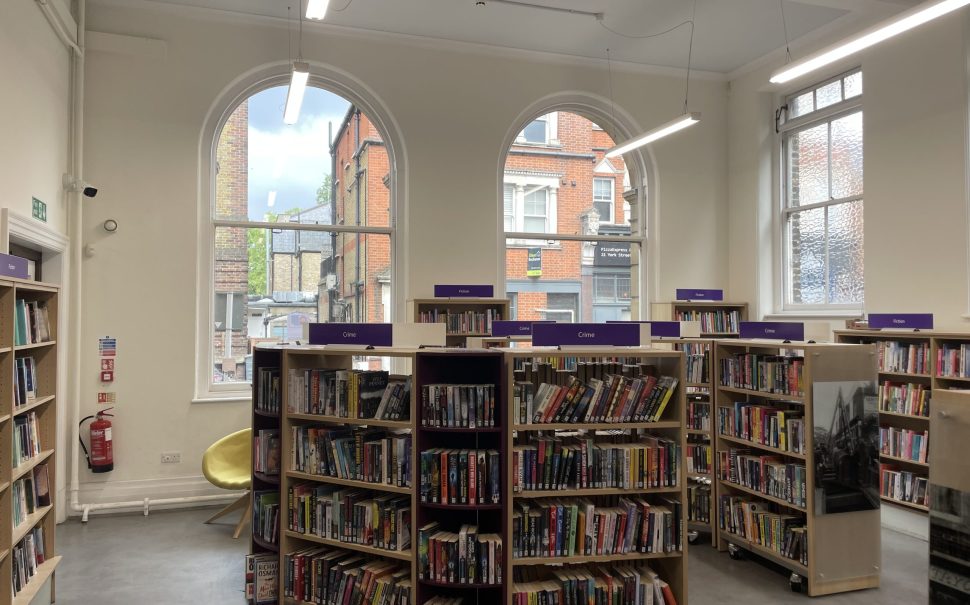
Darren Morris, a library supervisor at Twickenham Library who has worked there for 20 years, claimed these figures match his experience of who attends the library.
He added: “Ethnicity wise, my impression is it’s quite mixed.”
Measuring visits by ethnicity, libraries also stand out when set against other cultural activities.
The same survey data records that 91% of white respondents had engaged in the arts in the past year, and 70% had visited a heritage site.
Both of these figures are above the national average and higher than the rates for most other ethnic groups.
For museums and galleries, the white figure of 33% sits exactly on the average, meaning libraries are the only one of the four cultural activities measured where white respondents are the least likely group to take part.
They are also visited on the whole the least out of any cultural space: of all respondents, 33% said they had visited a museum in the last year, and 67% said they had visited a cultural or heritage site.
The question is then why libraries are the exception.
The most obvious reason is that library use itself has changed – once exclusively places to borrow and read books, they now function as community hubs and ‘third spaces’ – defined as a social environment separated from a home or workplace.
Visitor numbers also saw an unsurprising drop when Covid-19 hit the country.
Morris explained that the function of libraries has changed in his experience, with increased dealings of e-books and offerings of community sessions.
“That’s one thing that has changed,” he said.
“When I started we’d just deal with physical books, but now it’s a lot of e-books. A lot of books and magazines are available on our website now instead of exclusively physical copies.
“E-books really shot up in usage during Covid, but it was probably going that way anyway.
“It’s obviously not just about the books anymore. It’s much more of a community hub nowadays.
“There are various community groups, kids groups, rooms we hire out, citizens advice bureau sessions.”
A spokesperson for the London Library, an independent subscription library founded in 1841, made the same point about the changing role of libraries.
“Libraries as a third space is an important aspect of the role they play in people’s lives,” they said.
“Members value the unique studious setting which is a haven away from the workplace and the distractions of being at home.
“Book borrowing has declined, but we continue to loan around 60,000 books per year in addition to the huge amount of use that our fantastic range of online resources and eBooks get.
“Libraries are different things to different people.”
The idea that a community might rely on third spaces because mainstream institutions are not meeting its needs has been made directly elsewhere.
In a 2019 conference paper delivered at SOAS University of London, author Habeeb Akande described the ‘third Space’ as “an institution that seeks to fulfil the particular needs of a faith community which are not being met by mosques, schools or traditional religious institutions.”
It noted that “a Third Space can be a community centre, library, or social media networking site.”
Writing specifically about Black British Muslim communities, Akande argued that such spaces are created “to cater to the needs of isolated or excluded” subgroups.