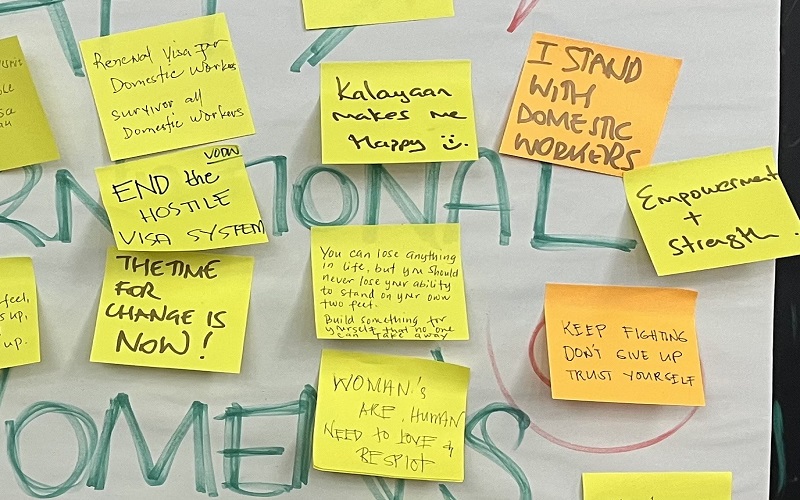
Since 2012, the UK has been operating a visa system which places thousands of domestic workers at risk of abuse and exploitation behind the doors of some of the country’s most affluent households.
For Kalayaan, a London-based charity who provide legal support and political advocacy for this vulnerable workforce, reforming the Overseas Domestic Worker visa has been an ongoing fight for the last 14 years.
Hindered by the reluctance of successive governments to implement key changes, gaining momentum has been an uphill battle.
However, after the London Assembly joined calls to reform the visa, Kalayaan may have a reason for hope after years of inertia.
“This problem has not gone away,” said Kalayaan’s CEO, Hannah Billington.
“We’ve been continuously communicating, sharing the data, talking to politicians, putting amendments down in legislation, but the political will to safeguard this powerless community has been too weak.”
In a not-too-distant past, the UK had an internationally recognised visa regime which gave crucial protections to domestic workers who experienced abusive employment and, in some cases, human trafficking.
However, in 2012, these protections were stripped away.
As the visa lost its safeguards, many of the 20,000 migrant domestic workers who are granted the visa each year have lost their means of escape.
Kalayaan’s research shows that their predictions about the visa changes have all come true, but vindication is likely to be of little comfort.
Despite the evidence linking increased levels of abuse and exploitation to the removal of the previous protections, no government since has been moved to reinstate the original system.
“It’s very much an invisible problem,” Billington reflected.
“It’s not seen, it’s easy to not care about it because these people don’t have a voice.
“It’s very rare that employers would ever be held to account for their abuse because collecting evidence from private domestic settings is challenging.”
The workers that Kalayaan represent come from across the globe. Predominantly, they are women from countries such as the Philippines, Indonesia, or India who have taken domestic jobs abroad to support their families back home.
Many are brought to the UK with their employers from the Middle East, unknowingly facing extremely long working hours and frequently being confined to private homes.
Despite legal requirements for employers to pay workers the minimum wage, research from Kalayaan shows that the median wage for workers on the visa stands at just 52p per hour. Only 6% of overseas domestic workers are given a day off from work.
However, following calls from the London Assembly to reinstate the original visa system, Billington spoke with a cautious optimism about her hopes for progress within a political climate that is paralysed by negativity towards migration: “Every time we put amendments forward, we build up more contacts and more people who understand the issue.
“We can prove that the structure of the visa is linked to the levels of abuse and exploitation. A blind eye has been turned for many, many years, and it’s disgraceful.”
How the current Overseas Domestic Worker visa increases the risk of abuse
Following a decade of campaigning by migrant domestic workers, Kalayaan, and the Transport and General Workers’ Union (now known as Unite the Union), the original ODW visa was introduced by the Labour government in 1998 containing two critical safeguards. It allowed domestic workers to change employer and extend their visa through ongoing work, granting an immigration status that was independent to the visa sponsor.
The system, recognised as good practice by the International Labour Organisation and the UN Special Rapporteur on the Human Rights of Migrants, enabled workers to leave employers before abuse escalated and access reporting mechanisms while in the safety of ongoing employment.
In 2012, the Conservative and Liberal Democrat coalition removed these protections. As part of a campaign to prioritise skilled migration, the new system admitted workers on a six-month long non-renewable visa with no option to change employer, no matter the reason.
Without the ability to escape exploitation, data collected by Kalayaan which reported trafficking and abuse jumped significantly.
Following an independent review in 2015 which found that these measures ‘did nothing but to impose an unacceptable increase in the risk of abuse’, the government reinstated the right to change employers without notifying the Home Office. However, despite the review’s recommendations, the six-month visa limit remained in place.
A Home Office spokesperson said that this measure continues to ensure “those who need to escape unsuitable conditions can do so quickly and without additional administration.” However, the levels of exploitation did not decrease following this concession.
Campaigners argue the reality of such a short time frame means that workers do not have a reasonable opportunity to find another job. Without a renewable visa, workers are either trapped with their original employer or are at risk of further exploitation due to their insecure status should they leave their job.
Baroness Hamwee, a Liberal Democrat peer who has advocated for restoration of the pre-2012 visa in the House of Lords, told the Londoners that the system “fails to understand that few people looking for domestic help and childcare will take on someone who can only be there for a very short time.”
“The Home Office does not ‘walk in the shoes’ of the small numbers of people whose needs are significant,” she added.
While reporting services such as the National Referral Mechanism exist to support victims of human trafficking and modern slavery, Kalayaan highlight that many workers who experience treatment which doesn’t meet this high threshold fall through the cracks of reporting safeguards. On top of this, the charity revealed in 2024 that only 18% of workers knew that they had the right to change employer.
With a large proportion of workers only learning of support from charities such as Kalayaan by word-of-mouth, many are left outside the narrow protections offered by the visa and abuse goes undetected.
Caught in the crossfire of politics, could change become a reality?
In December 2025, the London Assembly called on Sadiq Khan to write to Keir Starmer urging the restoration of the pre-2012 visa terms. The passing of the motion was met by cheers from Kalayaan’s community of domestic workers as they watched on from the viewing gallery.
A spokesperson for Sadiq Khan said the mayor is currently considering the assembly’s recommendations, and will “continue to represent the voices and concerns of vulnerable migrants in discussion with Government.”
The London Assembly’s motion followed a defeat to an amendment raised by Baroness Hamwee to the Border Security, Asylum and Immigration Act in November 2025. The votes of Labour peers against the amendment received significant criticism from anti-trafficking and workers rights experts, particularly for the government’s U-turn on measures to protect domestic workers it had previously supported while in opposition.
“This decision undermines justice, compassion, and the very values the UK claims to uphold,” said Marissa Begonia, director of the charity Voice of Domestic Workers.
“Once again, the government has turned its back on those who clean its homes, care for its children, and uphold its households.”
Billington ascribes this inaction in Westminster to politicians’ fear around introducing legislation which appears to be pro-immigration amid mounting electoral pressure on Labour from Reform. The effects of this political context are being felt at a campaigning level, with many worker’s rights being forced to consider the content of their public messaging. Owing to the feeling that the government will not act on calls to reform the visa, Billington says that many organisations are reconsidering their traditional approaches to political advocacy.
“This is a violence against women and girls’ issue, as well as being a workers’ rights issue,” Billington added, aware that gaining political traction may rest on the framing of the charity’s evidence.
Kalayaan say they are currently pursuing further research to address what she calls the “wafty arguments about loopholes” which are often held up as an excuse to avoid reforming the visa, particularly regarding whether workers would change employer for reasons other than abuse if the opportunity to renew their visa was reinstated.
Billington said: “Many workers are mothers and they’re sending money home to their families. They basically want to earn some money and then go home and see their kids.
“It’s easy to throw that argument around, but there’s no substantiation for it. But there’s very good evidence, on the other hand, that when it was easier for people to leave abusive situations, there was less exploitation.”
The Home Office said that the government recognises migrant domestic workers “are a distinctly vulnerable cohort at risk of modern slavery,” but maintain “it would not be appropriate to commit to make changes, including a return to 2012, until we have completed our review of the route.”
As the government considers how it will ‘restore control’ over the immigration system in its 2025 white paper, Kalayaan are once again fighting to ensure that the opportunity to reform the visa does not go ignored.
Despite the government’s reluctance, support from the London Assembly – along with the possibility of future endorsement from the Mayor – will be valuable voices in the build up to future legislation on modern slavery promised for this parliament by Labour MP Jess Phillips.
Jess Phillips, who is also the Minister for Safeguarding and Violence Against Women and Girls, has not responded to a request for comment.
For now, Billington remains optimistic that politicians will be driven by the evidence offered by campaigners at the front lines of the visa, rather than concern around immigration optics.
She said: “When these really poisonous anti-migrant sentiments prevail, you see a stronger pushback from those who are compassionate and haven’t lost their humanity or empathy.”
Featured image credit: Hamish McCorriston