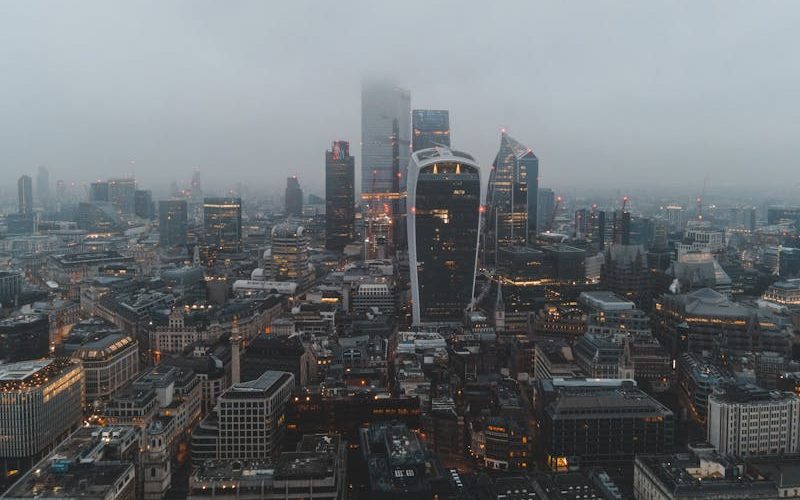
Just six London boroughs produce roughly a third of the city’s most harmful air pollutants, London Atmospheric Emissions Inventory data shows.
Hillingdon, Enfield, Bexley, Barnet, Ealing, and Westminster appear among the city’s ten worst-emitting boroughs for both fine particulate matter (PM2.5) and nitrogen oxides (NOx).
This collectively accounts for 30% and 38% of London’s emissions respectively as the capital fails to meet World Health Organisation (WHO) guidelines for air quality.
The pollutants are linked to a wide range of diseases, including lung cancer, heart disease, and dementia, and experts have warned that they are dangerously impacting Londoners’ health.
Imperial College London’s Professor Frank Kelly, whose Environmental Research Group helps the WHO draw up its air quality guidelines, explained: “We breathe in about 11,000 litres of air every day, so if that air has a small amount of pollution in it, there’s an awful lot of pollution going into our body.
“When we have higher pollution episodes, a lot more people are admitted to hospital. There’s a direct and very obvious link between air quality and health.”
Professor Kelly has spent much of his career analysing London’s air quality, and stresses that, while the city has made progress over the past decade, there’s an urgent need to do more.
The aforementioned boroughs have seen improvements over the past decade, with all six reducing their NOx emissions by between 20% and 60% since 2016, but reductions in PM2.5 emissions have been more modest — ranging from just 12% to 24% for five of the boroughs, with Hillingdon emitting 8% more than in 2016.
“We’re not improving quickly enough to achieve the WHO guidelines for either PM2.5 or nitrogen dioxide [a subset of NOx pollutants],” Kelly said. “Until we get down to those levels, there will be a significant health burden on our population.
“We should be concerned.”
Catherine Kenyon, Head of Clean Air Programmes at Global Action Plan, an NGO that aims to shape environmental policy worldwide, explained that children and vulnerable adults are disproportionately impacted by air pollution, adding that many of London’s children suffer from reduced lung growth.
She said: “Children are breathing in this air while their lungs are still developing. And remember that children are shorter, so pollution from exhaust pipes hits younger lungs first.
“We wouldn’t let our children drink dirty water, so why do we accept them breathing contaminated air?”
Kenyon said that elderly people and those with underlying health conditions are also impacted more severely, and that the UK has one of the highest prevalences of asthma in Europe — with an unduly high number of cases occurring in the capital.
The government’s Environmental Audit Committee announced an inquiry into air quality in January, citing the tens of thousands of lives ‘shortened in the UK by air pollution’, but campaigners believe more must still be done to tackle the problem at a local level.
Many also point out that the effects of pollution are felt most acutely by lower-income households.
Georgina McGivern, co-founder and programme director of the London Clean Air Initiative — a non-profit organisation that works with communities and local authorities to improve air quality across the city — explained that this is because lower-income communities often face the greatest exposure to harmful pollutants.
She said: “Air pollution is both a symptom and a driver of inequality.
“Historically, more deprived communities have been pushed towards busy roads, industrial sites, and areas with limited green space — all of which drive up exposure.
“Maps of air pollution align almost perfectly with maps of other social inequities.”
According to McGivern, similar inequities can be seen between London boroughs, both in terms of the difficulties they face and in their attempts to address them.
She said: “Every borough is unique and has its own challenges.
“For some, the biggest issue might be vehicle emissions; in others, it could be commercial emissions or emissions from construction.
“And certain communities or councils have more resources, or political leverage, to do something.
“There are disparities across the board.”
The borough facing the biggest challenge is Hillingdon. The site of Heathrow Airport, and London’s biggest annual emitter of both PM2.5 and NOx pollutants, it produces ten times the emissions of the capital’s cleanest boroughs.
Andrew Boff, a Conservative member of the London Assembly’s Environment Committee who was born and raised in Hillingdon, believes that many of Hillingdon’s problems, and those of other boroughs, stem from government complacency.
He said: “They’ll only find a bit of money [to alleviate air pollution] if it becomes a political issue for them. But there’s not a single borough where people don’t care about air quality — they care very much.”
Boff’s claim reflects the findings of an investigation conducted by the community organisation Mums for Lungs in November, which revealed that central government funding for local air quality initiatives decreased by more than 99% over the previous five years — leaving councils across the country ill-equipped to address air quality.
Boff was Hillingdon Council leader when plans to build a fifth terminal at Heathrow were mooted in the early nineties, and claims the airport’s then-chief executive ‘swore blind’ that if planning permission was granted, as it ultimately was, notions of a third runway would be abandoned forever.
He said: “Now, when people say we need this third runway, I always ask them ‘where’s the fourth going to go? And the fifth? Where will all the other runways go?’
“The government needs to listen to ordinary people more.
“We’ve seen examples of young people losing their lives because of air pollution. And it’s not from the want of complaining. It’s not from the want of lobbying.”
Despite reductions in government funding, campaigners have stressed the need to continue lobbying councils, and have identified the run-up to May’s local elections as an invaluable opportunity for Londoners to make their concerns known.
Izzy Romilly, Head of Urban Transformations at climate justice charity Possible, has called for London Mayor Sadiq Khan and borough councils to develop precise plans to meet WHO targets.
Romilly insists that local authorities already have the power to implement policies that will improve air quality if the desire is there.
She said: “Things like higher parking charges for SUVs and the most polluting vehicles, support for electric car clubs, reallocating road space to prioritise electric buses and cycle lanes, and creating wider pavements to help change people’s travel habits can all be done at a local level.
“People should talk to their local candidates about air quality. Ask them how bold they’re willing to be, and whether they have the political courage to crack down on the major sources of air pollution.”
Simon Birkett, a trained engineer who relinquished his career as a city banker to found the advocacy group Clean Air in London, agrees that Londoners must demand more from their councillors.
Birkett said: “All borough manifestos should pledge to have a cabinet member with ‘air quality’ in their title — and to achieve the WHO’s interim guidelines for PM2.5 and nitrogen dioxide by 2030.”
“Measures to drastically reduce diesel, construction, commercial cooking, and buildings’ emissions are also vital.”
Birkett, who has fought for clean air for almost two decades, including four years as an advisor to the United Nations Environment Programme, echoed calls for urgent action, and implored constituents across all of London, not just those in its worst-polluting boroughs, to “vote for clean air”.
“There is a wonderful opportunity to make London healthier, quieter, and more successful by cleaning our air,” he said. “But we need to go much further, faster, and smarter.”
Representatives from Hillingdon Council and London Assembly members from the Labour Party and the Green Party were approached for this article but declined to comment.
Feature image credit: Ollie Craig