
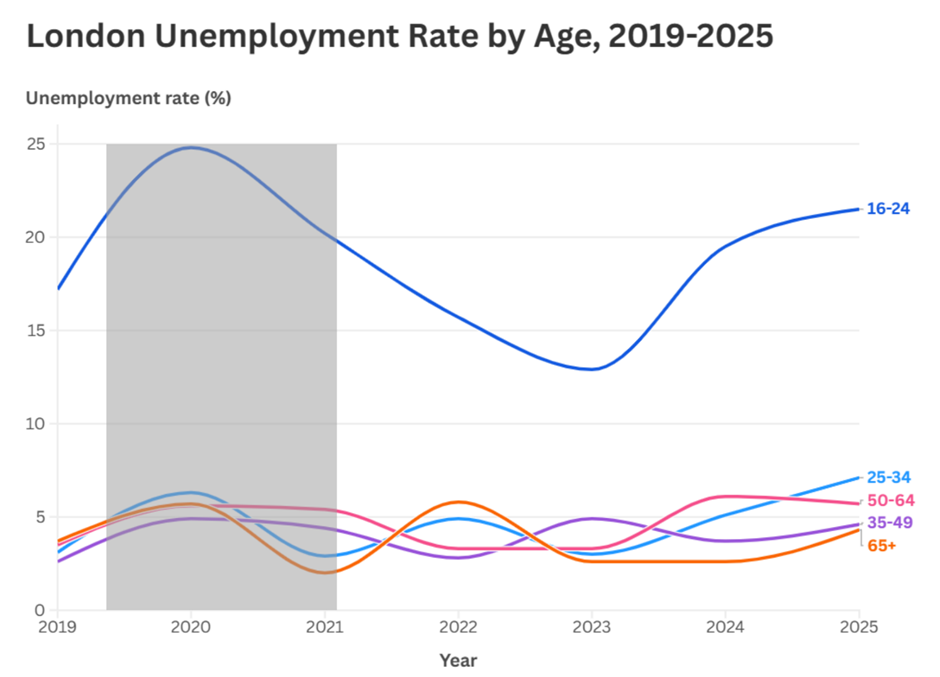
The unemployment rate in England’s capital has risen to 21.5% amongst young people, a post-COVID high, according to the latest figures from the Office for National Statistics (ONS).
This equates to 121,000 young people aged 16-24 out of work – an increase of almost 2% compared to 2024 figures.
Young people continue to be disproportionately hit, with unemployment amongst 25-34 year olds standing at a significantly lower rate of 7.1%.
These figures come as the government announces an inquiry examining the causes and impacts of young people not in employment, education or training (NEET).
When compared to the rest of the UK, London recorded one of the highest youth unemployment rates, with only North East England surpassing the region where unemployment amongst young people reached 23%.
This is a 4.5% increase in the North East region, compared with 2024 figures.
In contrast, East of England, South West England, South East England and Scotland all saw a drop in youth unemployment in 2025.
Ned Longfoot, 20-year-old Sheffield University student studying Biological Sciences, is fearful of moving back to London after university.
Longfoot said: “I’m from London so always planned to move back down once I graduated but I can’t deny that the thought of trying to break into London’s competitive job market is scary.”
The causes of London’s youth unemployment
According to Youth Employment UK, an independent not-for-profit, youth unemployment can be attributed to the following factors:
- A shortage of quality local jobs, intensified by extended retirement ages that limit opportunities for new entrants
- Disconnects between education, vocational pathways, and labour market needs, resulting in widespread skills and qualification mismatches
- Poor-quality careers information, leaving young people ill-prepared to make informed training and employment choices
- Recruitment practices that favour experience and exaggerate misconceptions about young people, creating barriers to entry
Another critical factor is the rising cost burden on employers following successive government budgets.
Measures set out in the Autumn 2024 Budget included increased employer National Insurance contributions and the scaling back of business rate relief.
These pressures have since been added to by the announcement of increases to the national minimum wage, including an 8.5% rise for 18- to 20-year-olds and a 6% increase for 16- to 17-year-olds and apprentices.
Together with wider inflation-driven operating costs, these changes have hit the hospitality and retail sectors particularly hard – industries that employ a high proportion of young people.
ONS’s 2023 report showed that while the youngest workers make up 10% of the total workforce, they account for around half of the workers in some hospitality roles, and 1 in every 8 retail employees.
The report indicates that the tendency of young people to hold these jobs, may have left them especially vulnerable to job losses during the coronavirus (COVID-19) pandemic.
It seems that pattern has continued into 2025’s financial landscape.
Youth Employment UK’s 2025 Youth Voice Consensus surveying over 8,200 young voices found that career experiences and wider opportunities that act as bridges into full-time employment are narrowing.
Whilst 76% of respondents said they valued work experience, only 26% undertook work experience last year.
The consensus also revealed that the future of work feels conflicted with only around half of respondents feeling like they have the right skills and work experience that employers are looking for.
Importantly, young people not in employment, education or training (NEET) record the lowest confidence overall.
Tackling London’s youth unemployment
Earlier this month, the cross-party Work and Pensions Committee launched a new inquiry examining the causes and impacts of young people NEET and measures to fix it, claiming that tackling the NEET challenge for people under 25 is a priority for the Government.
This follows an investigation launched in December 2025 by former Heath Secretary Alan Milburn into the root causes of youth inactivity.
Steps are already being taken by the government in an effort to tackle youth unemployment, with the announcement in December 2025 of a major £725 million investment to deliver expanded apprenticeship and training opportunities for young people.
This includes a new wave of apprenticeships in the retail and hospitality sectors.
Through this investment, 50,000 young people across the country will be better equipped for jobs of the future.
Work and Pensions Secretary, Pat McFadden, said: “Every young person deserves a fair chance to succeed. When given the right support and opportunities, they will grasp them.
“That’s why we are introducing a range of reforms to help young people take that vital step into the workplace or training and to go on and make something of their lives.
“This funding is a downpayment on young people’s futures and the future of the country, creating real pathways into good jobs and providing work experience, skills training and guaranteed employment.”

Alex McCann, author of Financial Times’ recommended ‘the death of the corporate job’ Substack article, said: “The unemployment figures we’re seeing are indicative of a system that hasn’t really caught up with reality.
“Young people aren’t taught to understand how their specific experiences and interests position them to solve problems others can’t see – they’re taught to fit into predetermined boxes, not to discover what makes them uniquely valuable.”
Feature image credit: Rachael Cooper