Two centuries on, Wright of Derby is still teaching us how to look.
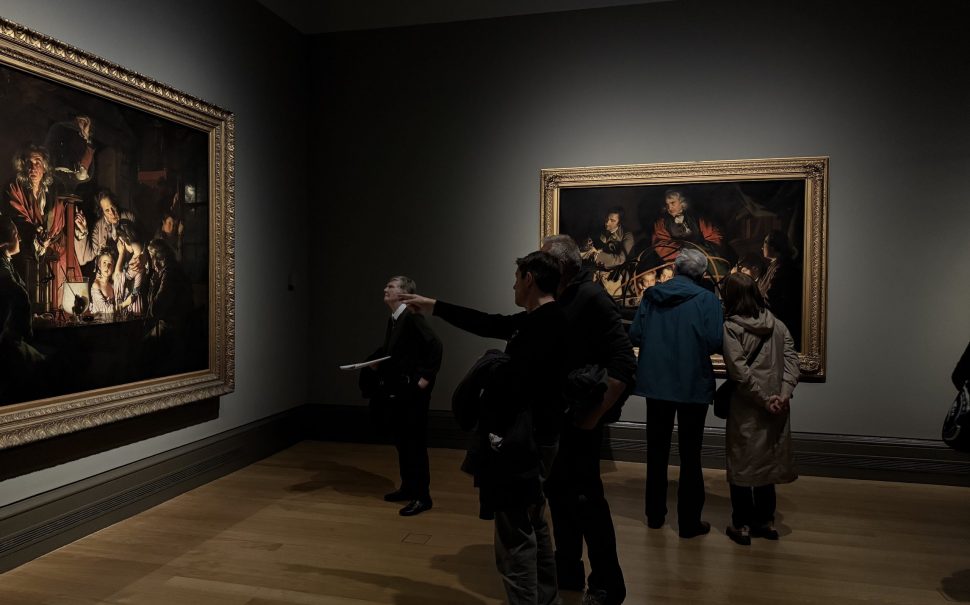
Tucked away beyond the Pre-Raphaelites and the van Goghs is Room 43, the aptly named Sunley Room at the National Gallery — at the moment, it is darker than usual.
The lights have been dimmed to emphasise one thing above all else: light itself — specifically, the imagined candlelight of Joseph Wright, a painter from Derby, working at the dawn of the modern age.
The National Gallery’s latest exhibition, ‘Wright of Derby: From the Shadows’, revisits an artist who captured the drama of science and observation at a pivotal moment in the rise of modern knowledge.
Unlike many of his 18th century contemporaries, Wright of Derby was less interested in depicting scientific experiments and more interested in the act of looking: who understands, who watches and who remains in the shadows.
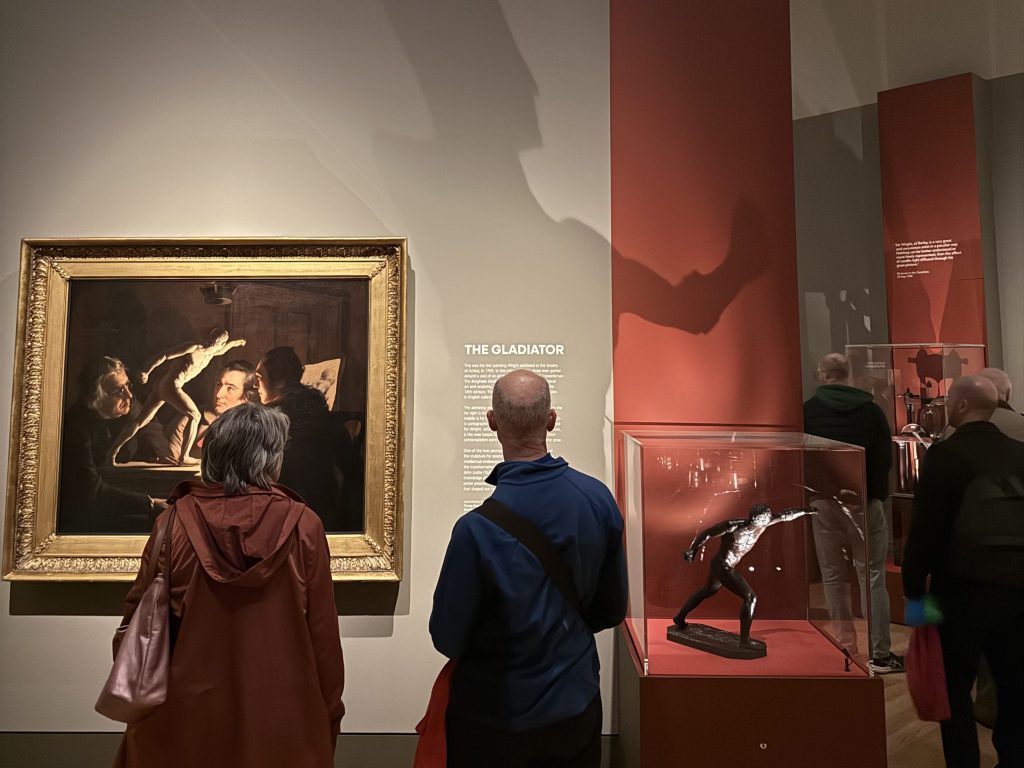
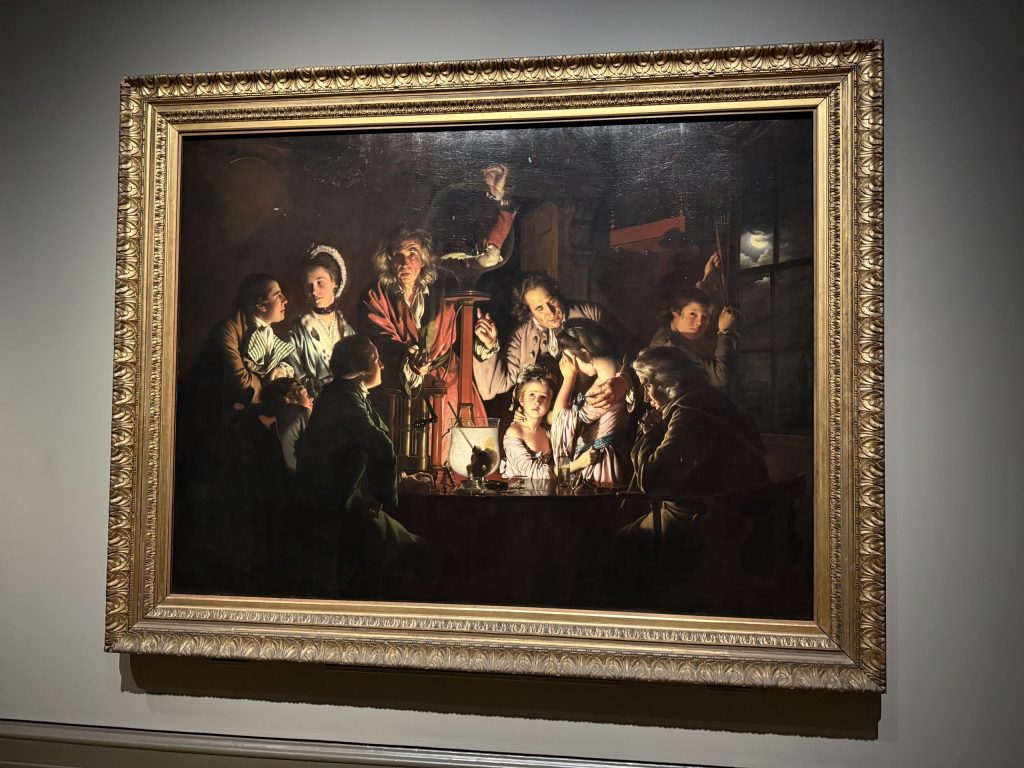
His compositions magnify the people gathered around experiments, rather than the experiments themselves. Faces glow in candlelight and expressions range from wonder to anxiety.
As exhibition-goer Rachel Rowan said: “Even today the looks on the faces — the fear, scepticism and amazement — feel incredibly contemporary, even though we know so much more about science now”.
The exhibition’s centrepiece is the reunion of ‘A Philosopher Lecturing on the Orrery’ (1766) and ‘An Experiment on a Bird in the Air Pump’ (1768), brought together for the first time in decades.
Paired alongside each other, the works reflect how the exhibition’s central focus on illumination was not a momentary theme for Wright, but a lifelong study.
With the former on loan from Derby Museum and Art Gallery and the latter held by the National Gallery, the exhibition also symbolically reunites Derby and London — Wright’s two homes.
Rowan described seeing the works together as transformative.
She said: “I thought I knew these paintings, but seeing them collected in one place creates such intense drama.
“You can imagine the people arriving, the anticipation and then the conversations that follow once it’s all over.”

Wright is best known in his field for his use of tenebrism — where contrasts of light and dark heighten drama and emotional intensity.
But ‘From the Shadows’, curated by Christine Riding, makes clear that this was more than an artistic technique. Light in Wright’s work is never painted by accident but is rather used as a tool for shaping hierarchy.
What makes the exhibition feel unexpectedly contemporary is how closely it mirrors the way we gather around light today.
Wright’s candlelit experiments anticipate the glow of phone and laptop screens, and our obsession with them — small circles of illumination around which we assemble to learn and be entertained.
Wright’s use of light finds echoes in modern rituals of technological spectacle: Apple launches, SpaceX lift-offs, TED talks and viral science videos.
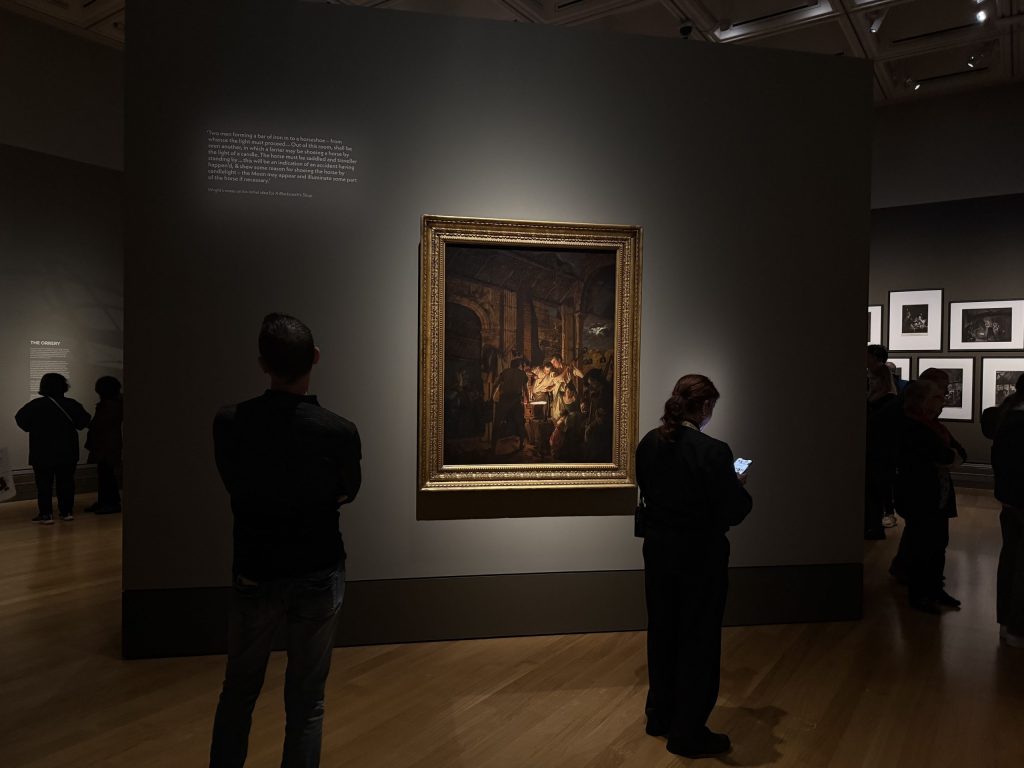
The curatorial approach reinforces this idea. Quotes and objects are spotlighted, casting shadows onto the walls and the room itself feels staged — as though Riding has stepped into Wright’s role.
And in the Sunley Room, that effect is unmistakable.
Rowan added: “You don’t just look at the paintings, you feel like you’re inside them.
“You’re so brilliantly drawn in by the light and dark that you immediately feel part of the audience Wright has painted, part of the moment.”
‘A Philosopher Lecturing on the Orrery’ will return to Derby Museum and Art Gallery alongside ‘An Experiment on a Bird in the Air Pump’ for the exhibition’s second stage, restoring Wright to what heritage expert Jane McArdle calls his ‘spiritual home’.
For McArdle, who is a project manager at the University of Birmingham, this return matters not just geographically but philosophically.
She said: “There’s something very grounding about Wright being understood through Derby and the Midlands.
“The idea that enlightenment only came from big cities like London really doesn’t hold up when you look at Birmingham, the Lunar Society, and figures like Erasmus Darwin and Matthew Boulton, who were so central to this period, and indeed to Wright’s work.”
Wright’s links to the Lunar Society, a network of scientists rooted in Birmingham, reinforce that sense of knowledge emerging from regional, collaborative spaces rather than elite institutions.
It is perhaps no surprise, as Riding notes in the exhibition, that Wright never felt at home in the metropolitan Royal Academy of Arts.
McArdle added: “He wasn’t interested in closed, formal spaces of learning. His paintings are about people coming together naturally.”
McArdle draws a direct parallel with ‘Helios’, artist Luke Jerram’s large-scale inflatable sculpture of the sun, which has toured the country and will soon be installed at The Exchange in Birmingham — not in a lecture hall or gallery, but in a public café.
McArdle said: “People of all ages and backgrounds just sit underneath it.
“You don’t have to understand the science. You’re simply looking at one thing together.
“That’s very similar to the experience Wright paints, where the community aspect of popular science matters just as much as the knowledge itself.”
For McArdle, that is where Wright’s modern relevance lies.
She said: “You can be curious without being an expert, and that’s reassuring.
“Wright includes children so deliberately because he’s saying that anyone can get involved, regardless of age or background.
“Knowledge doesn’t belong to institutions. It belongs to people who are willing to look.”
Wright of Derby: From the Shadows is at the National Gallery until 10 May 2026.