Londoners are equally as misinformed as the rest of the country on human rights, a YouGov poll has revealed.
The survey conducted in October 2025 in response to push by politicians, such as Kemi Badenoch and Nigel Farage to leave the ECHR, revealed that almost all English regions lacked basic knowledge of some of the key rights protected by the ECHR.
The survey showed widespread misinformation regarding a wide range of protections covered under the ECHR, particularly Article 8, which protects the right to private and family life.
Tom Southerden, Amnesty UK’s Legal Programme Director said: “It’s deeply concerning but not accidental.
“Human rights are often misrepresented as abstract or only protecting ‘others,’ when in reality they safeguard everyday essentials: dignity, healthcare, family life, free speech, and fair trials.
“When people don’t realise what rights do, they’re easier to strip away.”
With the ECHR coming under fire from UK Politicians for allegedly allowing an increase of ‘Illegal asylum seekers’ to claim asylum protections in the UK under Article 8 of the ECHR.
Southerden added: “The ECHR has been wrongly portrayed as something that exists just to protect ‘foreign criminals’.
“In reality, the people who have been treated as falling into that category include people born or brought up in this country who are racialised as ‘foreign’ even when their crimes are minor or committed under duress.
“The whole point of the ECHR is that it protects everyone, whether they are politically popular or influential, or not. It protects victims, families, protestors, journalists, and survivors of state failure.”
Recently, home secretary Shabana Mahmood has announced that there will be domestic reform to certain articles of the ECHR, including Article 8 (the right to respect for private and family life) in an effort to curb illegal immigration numbers.
Alexis Deswaef, Human Rights lawyer and president of the International Federation for Human Rights (FIDH) said: “The real reason politicians want to leave the ECHR, is that they view it as an obstacle for their policies that they know are against human rights.”
He said: “If you have a government that will abandon the ECHR for migrants, afterwards it will do the same for prisoners, poor people, gay people, etc. and this is very dangerous to say we don’t want a specific category of people to benefit from it.”
Misinformation surrounding Article 8, explains why 36% of Londoners and Northerners believed that leaving the ECHR would have some sort of positive impact on the number of migrants that can be deported successfully.
With over 40% of respondents in the Midlands and rest of the South, believing that leaving the ECHR would increase the number of migrants that can be successfully deported.
This has been challenged in a recent study by the Oxford Bonavero Institute for Human Rights found that only four cases concerning the deportation of a foreign national since 1980 had made it to the ECtHR (European Court of Human Rights).
With 55% of the 29 cases brought to the ECtHR since 1980 having voted in favour of the UK not violating the ECHR regarding the deportation of foreign nationals.
The report highlights Article 8 as a prominent source of contention surrounding misinformation regarding immigration rights and protections under the ECHR.
However, immigration cases that rely on Article 8 must meet a highlight threshold for the ECtHR to rule there has been a violation of article 8 in the case of deportation.
Southerden said: “The role of the ECHR in deportation cases has been hugely exaggerated, but the rights that the ECHR protects in those cases are the absolute ban on torture, respect for the family life of people born or brought up here, and due process while people’s cases are being considered.
“These are all fundamental basics for a fair society, not things to be given away in a political race to the bottom.”
On the political motivations of this attack on Article 8, Southerden said: “Scapegoating migrants has distorted public understanding of what the Convention really does.
“It’s a pattern we see being used by politicians all over the world, and it has the convenient benefit of meaning that there are fewer checks on their power or accountability for their abuse of it.”
Results revealed that the wide majority of the country, including Londoners are misinformed and thought the right to migration was under the ECHR.
With 28% of Londoners answering True to the statement ‘The right to migrate between countries is an area covered by the ECHR’. In contrast to 29% of the rest of the south, 28% of the north and 33% of Midlanders.
However, compared to other regions of England, 7% more Londoners answered correctly that it was ‘False’ that the right to migrate between countries is an area covered by the ECHR.
Interestingly, more people who voted to remain in the 2016 Brexit election believed that the statement was true in comparison to leave voters.
With 9% more leave voters answering that the right to migrate between countries is not an area covered by the ECHR.
Deswaef added: “I think migration policy should be in conformity with the ECHR, because we are speaking about human beings.
“Just because we are speaking about migrants, it doesn’t mean that they do not have human rights like everyone else.”
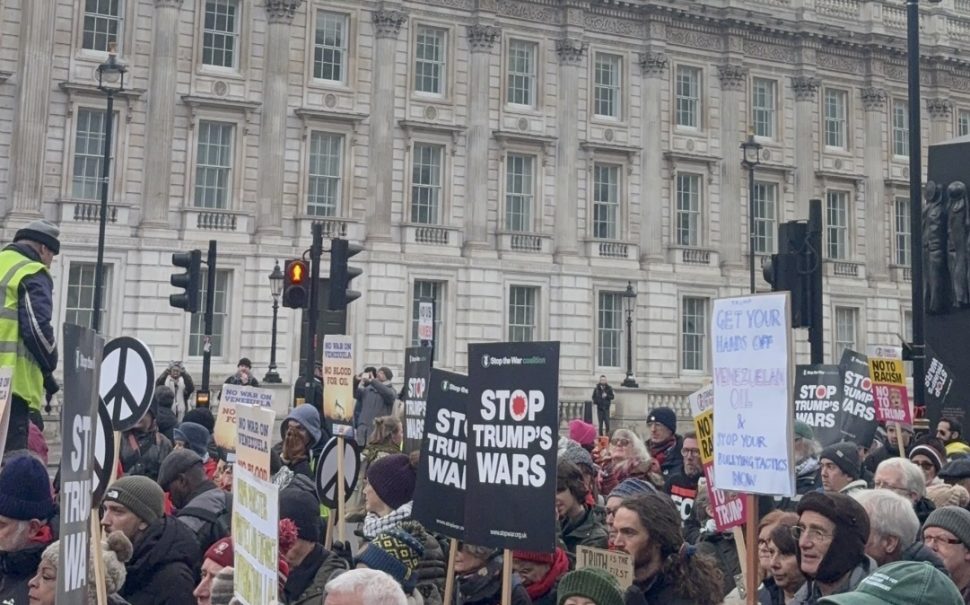
This widespread lack of knowledge across England on human rights is concerning, particularly as, since 2019, successive governments have cracked down on free speech, especially in relation to protests.
With the Metropolitan Police being as a great institutional force behind preventing freedom of expression at large demonstrations in London.
For example, in 2019 following the rise of Extinction Rebellion, the Metropolitan Police’s ban on Extinction Rebellion protests were ruled unlawful by the high court.
In fact, a recent FOI from Greenpeace found of all 705 arrests made for conspiracy to commit public nuisance from 2012-2024, only 26 or 3.6% resulted in charges.
Southerden said: “Human rights law is fundamental to protecting protest, journalism, and free speech, particularly when these challenge those in power.
“Without strong legal protections, peaceful dissent becomes vulnerable to political interference and suppression.”
He added: “It shows a worrying trend of authoritarian creep. When peaceful protest is increasingly criminalized, it signals a move away from democratic accountability and toward greater state control, exactly why independent human rights protections exist.”
“Human rights are at risk, not because rights have failed, but because they are being deliberately undermined.
“When protections are framed as optional or inconvenient, rather than permanent and universal, everyone becomes more vulnerable.”
The percentage of Londoners wanting to remain in the ECHR has dropped by 3% in the last three months, with the percentage wanting to leave rising.
Southerden said: “Human rights are often deliberately misframed as obstacles to security or fairness, rather than protections for everyone.
“Simplistic narratives, especially around migration, ignore how rights actually work and fuel mistrust. This rhetoric thrives when facts are replaced with fear.”
“By being honest about what rights are and who they protect; all of us. That means better public education, responsible political leadership, and challenging false claims when they arise.
“Human rights depend on public understanding and people’s willingness to fight for them as much as legal texts.”
The home office has been approached for a comment.
Featured image credit: Aneela Aslam.