For nearly 90 years, the sound of a south west London evening could be the mechanical hare and eight greyhounds tearing around a floodlit oval on Plough Lane.
Wimbledon Stadium opened in 1928 and, for generations, a night at the dogs was one of the most reliably popular things to do in the area.
Then, on 25 March 2017, the hare ran for the last time.
What happened to the stadium, and to the habit it served, says a lot about how leisure in this corner of London has changed.
A proper night out
For most of the 20th Century, greyhound racing was a genuinely mass pastime – and Wimbledon was one of its grand venues.
The track hosted the English Greyhound Derby, the sport’s blue riband event, every year from 1985 to 2016.
It ran speedway and stock car racing too, and on a busy night thousands of people passed through the turnstiles.
It was cheap, sociable and local – a few races, a few pounds on a dog, a drink with people you knew.
The betting was part of the evening, not the whole point of it.
The slow fade
The decline was decades in the making. Attendances slid as other entertainment multiplied, the ageing stadium saw little investment, and its owners eventually put the site up for sale.
When Wimbledon closed, London was left with just two licensed greyhound tracks, at Romford and Crayford, in a city that once had many.
The high street told the same story, where the betting shops and small clubs that dotted the area were thinning out, a trend which has followed across south west London for years.
The physical places where people had a flutter were quietly disappearing.
Football where the dogs ran
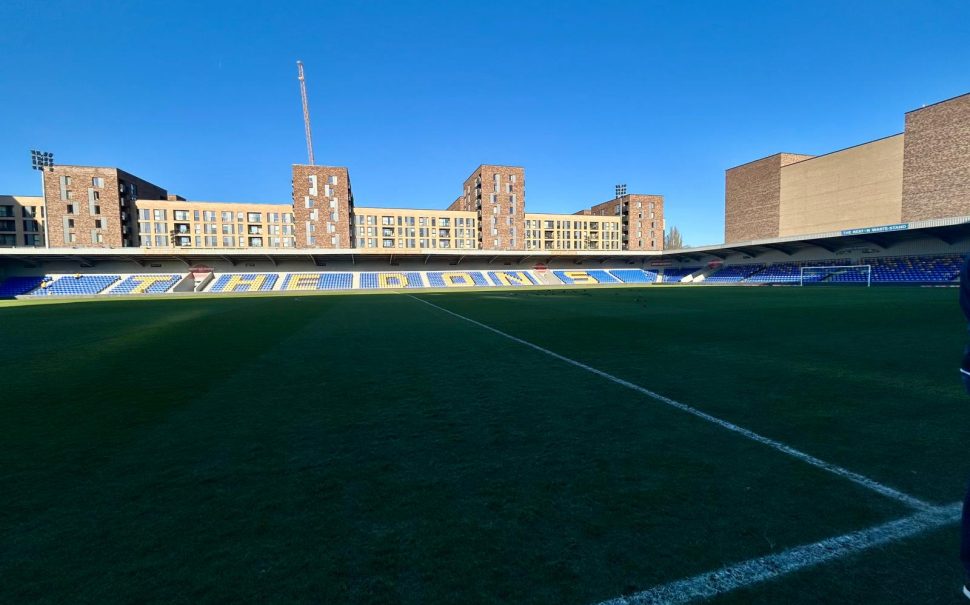
The site did not stay empty. After demolition in 2018 it was redeveloped into housing and a new football ground, and two years later AFC Wimbledon came home to Plough Lane, a few hundred yards from the club’s spiritual birthplace.
Where greyhounds once chased the hare, a football crowd now sings on a Saturday.
For a club with the history AFC Wimbledon has, the symbolism of the return was hard to miss, even if the turnstiles now click for a different sport.
The flutter moved indoors
The betting itself did not vanish with the stadium. It moved, as almost everything has, onto the phone.
The modern equivalent of the walk to the tote window is a few taps in an app, and the modern equivalent of the racecard is a comparison site.
Today casino.net lists the best casino sites for UK players, the digital descendant of the tipster’s chalkboard which once stood at the back of the Wimbledon stand.
The activity is much the same, but the setting has shrunk from a floodlit stadium to a screen in your hand.
Something gained, something lost
That shift is not all loss. Online play is more convenient, better regulated than it used to be, and easier to walk away from than a night out surrounded by the noise of the track.
But something communal went when the dogs stopped running. A night at Plough Lane was a shared occasion, a crowd, a spectacle, a bit of local ritual.
Its replacement is quieter, more private and, for better and worse, entirely your own.
The hare has stopped, the old stand has gone, and the flutter it once gathered has scattered into a thousand living rooms across south west London.
Feature image: Georgia Garnett