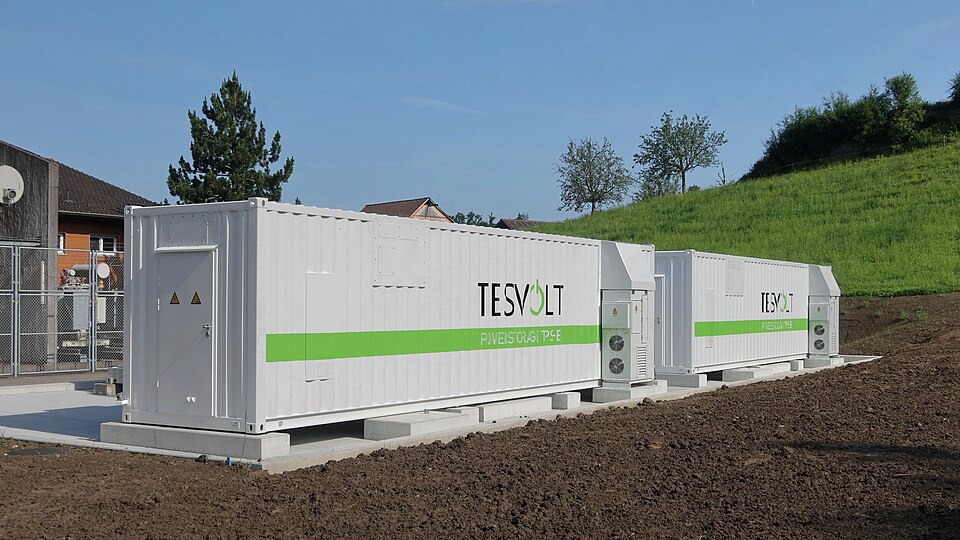
Battery energy storage systems (BESS) are being refused planning permission over fire safety and public health concerns, despite concerns from industry experts.
Planning refusals for battery projects in Britain have more than tripled since 2023, with more than 10% of all refusals last year citing fire as a main concern, according to analysis of government renewable energy planning data.
BESS use large banks of lithium-ion batteries to store electricity generated from wind and solar farms, releasing it into the national grid when needed.
These developments play a central role in the government’s effort to decarbonise the UK’s electricity supply, yet the number of refusals rose by a third between 2024 and 2025.
And experts have questioned whether the risks justify blocking developments critical to the country’s clean energy ambitions.
In East Devon, five battery storage projects were refused planning permission in 2025, with concerns that a fire could contaminate aquifers supplying residents with drinking water.
The council refused planning permission for more than 380MW of battery storage capacity in 2025.
“It’s like gambling,” said Mike Howe, a former chair of East Devon’s planning committee.
“Water sources aren’t there, the runoff from the water then is very contaminated.
“We need confidence that if something happens, or on the odd occasion when it happens, that our services can cope and manage and that we don’t make the situation worse.”
Current National Fire Chiefs Council (NFCC) guidance recommends provision for 180,000 litres of firefighting water where sufficient supplies are unavailable.
Howe claimed that with a hosepipe ban still in place, a local reservoir was at just 15% capacity and warned that specialist firefighting equipment for proposed sites around Axminster was 30 miles away.
Some developers and fire safety experts argue that the dangers of modern battery storage systems have been overstated.
Martin Blunden, a former fire chief and managing director of Greenfire Solutions, argued that the consequences of battery fires were being “overplayed” by opponents of the developments.
He said: “The likelihood of a BESS fire is less than that of a house fire. There’s a 0.8% chance of any house burning and the chance of a BESS fire is about 0.7%, so it’s really low.”
Blunden said fears of the fires had been fuelled by dramatic footage of older battery fires circulated on social media prior to improvements in modern technology.
“These fears are grounded in the old system,” he added. “About 80% of fires occurred in the first two years. So that’s not to do with the battery, that’s to do with the manufacturing standards.”
Global figures largely support Blunden’s claim. As battery storage development began to accelerate in 2016, reported fire incidents rose sharply relative to installed capacity.
Between 2020 and 2023, incidents have increased alongside rapid growth in global capacity.
However, in more recent years, reported fires have declined despite the continued expansion of battery storage, suggesting that advances in technology may be improving its safety record.
BESS developers also face a separate challenge: inconsistent fire safety guidance on how battery storage facilities should be designed and protected against fires.
Howe accused developers of “cherry-picking” between guidelines, pointing to contrasting recommendations on the spacing between battery containers.
The National Fire Chiefs Council recommends six metres between battery containers, while alternative guidance from FM Global and the US Department of Energy allows for smaller distances where other safety measures are in place.
This uncertainty is compounded by the fact that fire and rescue services are not statutory consultees for BESS applications, meaning that councils are not guaranteed specialist advice.
“I know at least one local authority who doesn’t consult with the fire and rescue service because they never respond,” said Blunden. “So it’s a really mixed bag all across the country.”
Simon Rothwell of Clearstone Energy, who saw his proposed 150MW BESS project refused in May 2025 despite planning officers recommending approval, said: “There is a risk that is inherent in lithium-ion batteries, but that’s managed to a level where there is no risk to public health and environment.”
The council claimed Clearstone Energy had failed to demonstrate that a fire would not contaminate aquifers or watercourses relied upon by residents.
Rothwell added: “Modern facilities are all now monitored on a 24 hour cell by cell basis to monitor everything from temperature through to what’s happening within the cell.
“We need education that these systems are actually safe now.”
Featured image credit: Kecko via Wikimedia Commons under CC BY 2.0 licence





Join the discussion