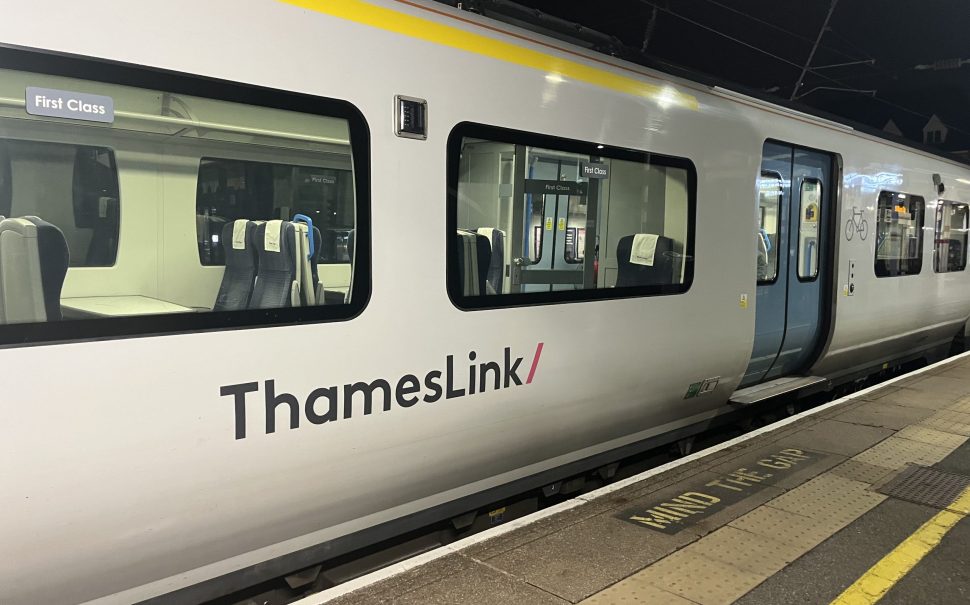
Greater Thameslink Railway (GTR) have introduced audio description guides to help blind and partially sighted people across various stations.
Southern, Thameslink and Great Northern Railway have developed audio description guides for four trains and six stations in collaboration with volunteers from Sight Loss Councils.
Audio guides now exist for London Blackfriars, Luton Airport Parkway, Brighton, Stevenage, Sutton and Eastbourne.
Sight Loss Council Engagement Manager for South East England, Dave Smith, said: “As blind people, you miss out on so much because you can’t see it.
“Unless you’re made aware of it, told about it, or bump into it, you just don’t know it’s there.”
Smith, 51, has retinitis pigmentosa and retinal telangiectasia, which caused his sight to deteriorate throughout his 20s and 30s.
He was registered as blind in 1997, has had little useful vision for the past decade, and has worked in the disability sector for over 25 years.
He said: “Blind people can’t just jump in a car and drive.
“We have to rely on public transport, so making sure that buses and trains are as accessible as they can be is a high priority for us.”
The audio guides were created to assist blind and partially sighted people in using the bird’s-eye view station plan maps of GTR stations, giving them context about their surroundings when travelling.
GTR Accessibility Lead Carl Martin, 46, said: “When you’re familiar with a station, you’re much more confident with it.”
Smith has worked alongside other volunteers at Sight Loss Councils to introduce these guides to the blind and partially sighted community.
He said: “There were people at Eastbourne that came along and listened to the guide and said, ‘I’ve used Eastbourne Station for ages and I didn’t know some of this existed.’”
The guides have been made available as both audio files and PDFs, and contain information about the number and location of gates and platforms, station layout descriptions, and potential obstructions.
They also provide where the trains operate; the layout and number of the carriage and toilets; the locations of handrails, buttons, bins and seats; and whether trains are driver-operated.
The chosen stations are in the vicinity of sight loss organisations, and are some of GTR’s biggest and busiest, containing more potential for blind or partially sighted people to become disorientated.
Smith said: “You’ve got the noises, the people, there’s obstacles – there’s so much going on.
“It’s actually really difficult just to navigate, and certainly when you can’t see or have very little sight, it’s really hard to walk in a straight line as well.
“So walking across a concourse is really, really difficult.”
Audio guides curently exist for Thameslink Class 700s, Great Northern Class 717s, Southern Class 171s, and Southern Class 377s, but Smith is working on creating guides for the other two train models used by GTR.
The guides were designed to be used alongside Aira Explorer, an app which links users with trained professionals who can help them navigate by using the camera on their phones.
In 2024, GTR extended free access to Aira inside of their stations.
The project was funded by GTR’s Your Station, Your Community improvement fund.
GTR and Sight Loss Councils are considering rolling out the audio guides for more stations, and are appealing for feedback from anyone who has used them.
Featured image credit: Lucy Pollock


Join the discussion