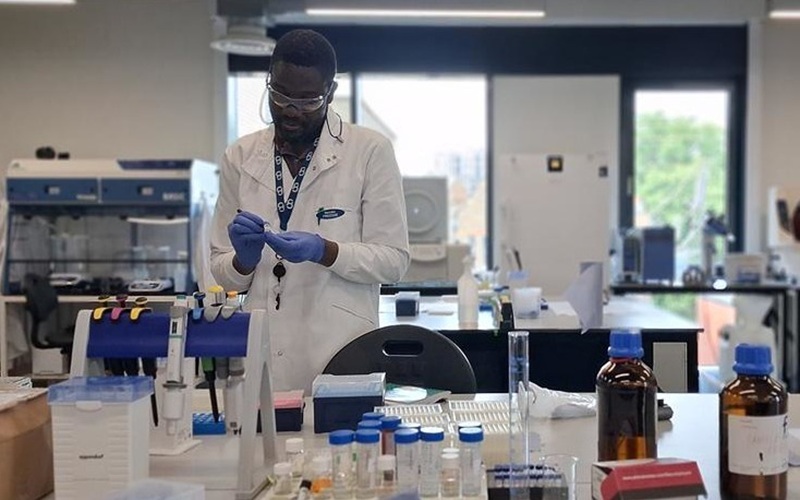
A Vauxhall biotechnology company has discovered eight new classes of infection-fighting antimicrobial agents since 2025 – accounting for 20% of all discoveries since the turn of the 20th century.
Bactobio, which specialises in synthetic biology, says these new antimicrobial classes are essential in the effort to tackle drug-resistant microbes.
Antimicrobials are chemicals produced by bacteria and other microbes to fight each other as they compete to survive. They are grouped into classes based on how they attack their target.
Antimicrobial resistance (AMR) occurs when microbes learn how to defend themselves against the medicine used to kill them, making the treatment ineffective. A 2024 study published in The Lancet projected that deaths from AMR could rise to almost 2 million annually by 2050 without new class discoveries.
Daniel Hansen, CEO of Bactobio, said: “Antimicrobial resistance is turning infections that were once treatable into life-threatening conditions.
“Without effective antibiotics we risk reverting to an era where a simple scratch could be fatal.”
Data taken from academic and industry sources shows antimicrobial discovery peaked between 1940 and 1960 – a period known as the “Golden Age”. During that time, 22 new classes of antimicrobials were discovered, representing nearly half of all new antimicrobial classes found since 1900.
A notable decline is seen in the following decades, with only three new classes identified between 1990 and 2024.
Bactobio’s eight new classes comprise a near-threefold increase in the total number discovered globally since 2000.
Using AI and DNA sequencing technologies, Bactobio replicates natural environmental conditions to prompt individual microbes to grow in a laboratory, allowing the company to study their antimicrobial properties.
Among the company’s findings are antimicrobial classes targeting Acinetobacter baumannii and nontuberculous mycobacteria – bacteria associated with serious lung infections.
Hansen said: “We have spent half a decade creating this platform. It is such a relief to realise this work will have an impact.
“We have a real solution which would mean that modern healthcare would be alleviated in ways that are substantial.”
Hansen explained that new antimicrobial class discoveries have decreased because microbes grow in complex communities known as microbiomes. This makes it difficult to isolate them from their natural environment so that they can be cultured (grown) in a lab.
For this reason, scientists estimate that 99% of all microbes are yet to be discovered and cultured.
He said: “We went and picked all the low hanging fruit. We’ve finished exploring that resource and there is nothing left for us to discover in the 1%.”
As a result, scientists have resorted to slightly modifying the chemical structure of antimicrobials found within existing classes to maintain their efficacy against bacteria harmful to humans.
However, this brings on a new problem, Hansen said, as harmful microbes, called pathogens, are familiar with the function of old classes and can swiftly adapt to minor changes.
“The microbe itself already knows part of the solution and will very quickly evolve and become resistant again,” he said. “You see this constant slight changing but without the long-term impact.”
He added that new antimicrobial classes present an entirely new mechanism of action, forcing pathogens to come up with a different system of defence – something which costs them time and energy.
And because each antimicrobial class works in a different way, for example, by inhibiting a microbe’s protein synthesis, DNA replication or cell division, there are many opportunities to weaken a microbe.
“It’s a weapons race,” he said. “The more ways you can attack an organism, the harder it gets for it to defend itself and the worse it is at attacking the human patient”.
Hansen said that although pathogens will eventually learn to defend themselves against these new classes, having a variety of new antimicrobial options and periodically rotating their administration, can help slow the development of AMR.
Using public health data from 204 countries, The Lancet study showed a 13% increase in global deaths attributed to AMR from just over 1 million in 1990 to 1.2 million in 2019.
Scientists project a 68% increase from 1.14 million deaths in 2021 to 1.9 million in 2050 if no new antimicrobial medicines are found – this would mean an 80% increase since 1990.
A 5% reduction in deaths between 2019 and 2021 is attributed to the COVID-19 pandemic.
Hansen said the key factors contributing to the rise in AMR-related deaths globally are the overuse and misuse of antibiotics in medicine and agriculture, and the stifling of innovation which is brought on by high production costs.
“The problem is not just discovering new classes, it is bringing them to market,” he said.
Hansen said that because public health bodies fear the spread of AMR in new antimicrobial classes, they prefer to use existing antimicrobials as a first response in patient care, reserving newer and potentially more effective discoveries for worst-case scenarios – an approach known as antimicrobial stewardship.
He said that the low demand for new antimicrobial medicines results in a lack of adequate government funding in this area of research.
Consequently, small pharmaceutical companies must take on the cost of designing new antimicrobial drugs and risk financial loss when bringing them to market.
He said that the government must be responsible for funding such projects.
Hansen said: “In a certain way it’s actually immoral. They are stopping innovation while not being willing to pay for the development of future medications that will be needed.
“We could end up in a situation where hospitals don’t work, and a lot of people die from antimicrobial resistance because no new discoveries have been made.”
A Department of Health and Social Care (DHSC) spokesperson said the government has piloted a novel subscription-based framework that pays companies developing new antimicrobials a fixed annual fee rather than paying them based on sales.
Under the new framework, known as the Antimicrobial Products Subscription Model, companies will be paid for their product even if it is not used.
The DHSC spokesperson said: “Responsible antimicrobial stewardship is essential to slow resistance and preserve the effectiveness of antibiotics to help patients get better.
“Through our investment, the UK is leading the way globally to support innovation in new antimicrobials.”
The model aims to remove the financial incentive from the production of medicines, ensuring their appropriate use and preventing the spread of AMR.
The National Institute for Health and Care Excellence (NICE) is currently evaluating contracts which would pay pharmaceutical companies between £5-20 million a year.
Main image: A Bactobio scientist labels his test tubes. Credit: Athena Vlachou