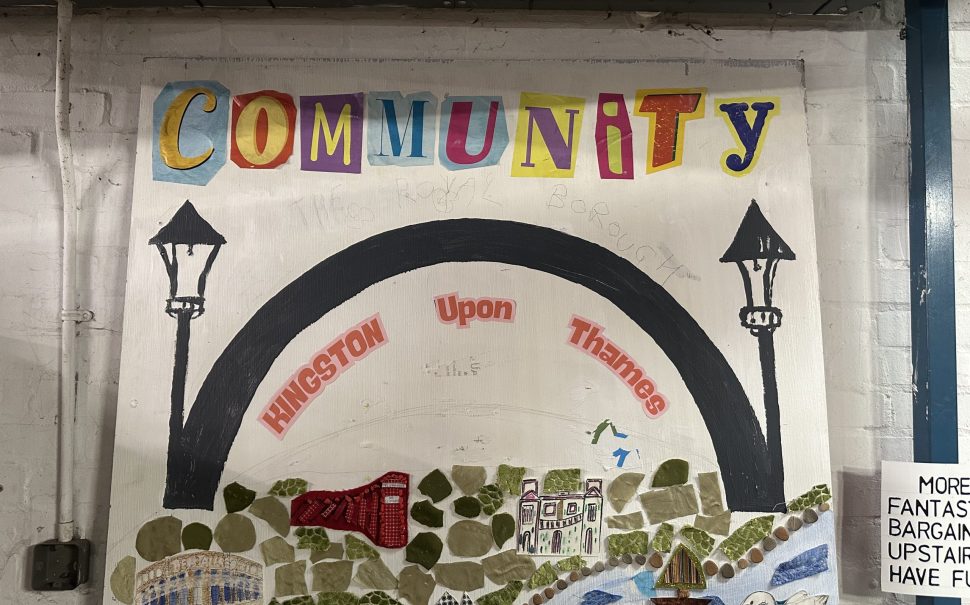
The future of community kitchens remains uncertain as more are closing or reducing their services, especially in southwest London.
Save the World Club is a social enterprise based in Kingston that has been operating for decades.
They piloted a community kitchen last month, but have not been able to fully implement it due to a lack of funding that would help pay for cafe workers.
This has raised concerns over the sustainability of community kitchens and whether they will be able to continue operating long-term – as official figures lay bare the scale of the issue.
Save the World Club’s secretary general, Dr Tariq Shabbeer, said: “Charities and community cafes are certainly more vulnerable because [there’s] so much more competition for those grants.
“If the volunteers are burnt out and you haven’t got a lot of new volunteers coming, you get tired of doing it.”
Many small charities seek government funding to keep their doors open but as less money is being given to charity grants, it means they often operate in a deficit.
Shabbeer added: “On the one hand the council gives us £10,000 [in funding] and then they take £11,500 away in council tax.
“It’s the government trying to squeeze money out from everyone. Surely they should make council tax free for charities or near free.”
All 32 London boroughs were sent freedom of information requests outlining the number of registered community kitchens that have been operating in their area since 2020/21.
Of those 32, only eight could supply the information requested at time of publication.
In Kingston upon Thames, there were two registered kitchens in 2020/21 which both closed the following year.
More community kitchens were formed afterwards, with the borough seeing five registered kitchens in 2024/25.
However, three of those kitchens have now closed.
While the closure of community kitchens seems positive as it implies less people are relying on them, 13,103 food parcels were delivered to people in Kingston last year – a 100% increase since 2019, according to the Trussell Trust.
Of those 13,103 parcels, 30% of them were distributed for children.
As more people are relying on community kitchens to survive, these social enterprises need to come up with other means of income to ensure they can provide struggling families with food access and security.
Kitchen Roots Community (KRC) is a non-profit social enterprise that aimed to feed struggling people by providing them with freshly cooked meals every Thursday for free.
However, they had to reduce their operating hours to just monthly because of a lack of funding.
Robin Hutchinson MBE, director of KRC parent company Community Brain, said: ”The amount of money that is being awarded to organisations is getting smaller and smaller.
“We had to do a calculation, and the calculation showed that we were losing a lot of money on the kitchen.
“So we had to take an awful decision and reduce the service of our community lunch from once a week to once a month.”
A similar trend can be seen in Sutton, where two community cupboards were registered in 2021/22, which rose to three the following year. Only one now remains.
Lambeth saw a 61% decrease in available community kitchens from 2021/22 to 2025/26 despite a 25% increase in food parcels being delivered, according to Trussell Trust data.
For Shabbeer, money is not the only issue they have had to contend with. Save the World Club is unsure where they will be located in the coming years as their lease runs out soon.
He said: “If we had to close down it would be catastrophic.
“It means the [community] fridge would close as 50 families per week or more wouldn’t get food, so 22,000 people a year.”
Despite these challenges, both charities affirmed that they will keep going to support their communities.
Featured image: Susu Anitche