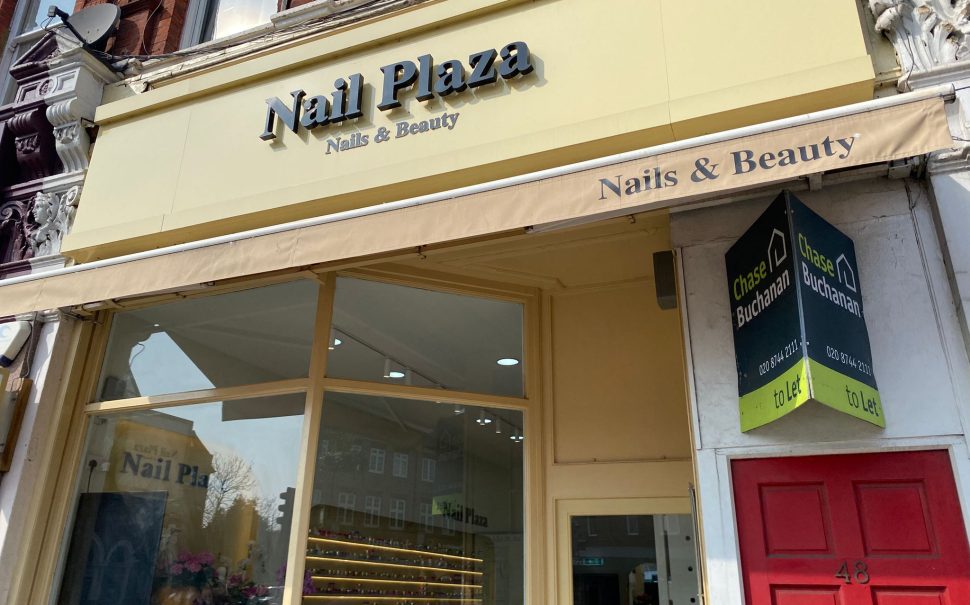
Hanh Hoang, the manager of Twickenham’s Nail Plaza, has found a noticeable shift in client habits as the cost-of-living crisis continues to bite.
The recently reopened beauty salon is just one of many across London which has seen a growing trend of clients cutting back on appointments as rising everyday costs push discretionary spending further down the list.
Hanh says the shift has been gradual but unmistakable. While the salon continues to attract clients, longer gaps between appointments are becoming the norm as prices increase across their supply chain.
“Clients are extending the time between appointments, with what was once a two-week cycle now stretches to three, four, five or even six weeks,” Hanh said.
“Rising costs across products, rent and bills have forced us to increase our prices.”
Those increases are being felt by regulars like Erica, 43, who describes her monthly nail appointment as her one splurge.
“I worry about my nails not being done. They are the one thing I splurge on and I wish I could do it as regularly as I used to,” she said.
But the cost of living crisis causing inflation in salon prices means she is part of a growing trend of cutting back on luxuries.
Erica is one of the many customers affected by price increases as the National Hair and Beauty Federation (NHBF) reports 62% of its members are raising prices to stay afloat, passing on higher costs for energy, rent and staffing.
The beauty industry, worth £30bn in the UK and powered largely by a 90% female workforce, is being squeezed from both sides. According to a 2025 report by CBI Economics, salon services are impacted three times more by labour taxes and VAT than other high street businesses.
With around 95% of beauty salons operating as microbusinesses, often female led and based in lower income neighbourhoods, even small increases in overheads have significant consequences. Around 21% are already operating at a loss.
For customers, the changes are reshaping habits rather than eliminating them entirely.
One South Londoner, Georgia Kourpas, 24, stopped going to the hairdresser altogether for three years before finding a more affordable student service.
“I miss the conversation and the reset it gave me in feeling good,” she said.
This tension reflects the trend Estée Lauder deemed the “lipstick effect”, where consumers cut back on large expenses but continue to spend on smaller treats during periods of uncertainty. Spending on personal care rose by 8% in 2024, even as wider economic pressures grew.
But even these smaller luxuries are now under strain.
Pier Reid, general manager at Percy & Reed on Great Portland Street, says conversations with clients reflect the shift.
“Clients are talking all the time and we know they are cutting back too,” she said.
Salon owners are also seeing changes in the types of services people choose. Elizabeth Ocampos Silva, owner of Elizabeth Studio London, says clients are opting for lower maintenance options.
“Clients now keep away from the extra treatments. Before people used to get their hair dyed more often and now they leave the roots much longer,” she said.
“Balayage is increasing as it is low maintenance and refresh appointments used to be six months and now it is eight months to a year.”
While this may appear as a shift in style trends, it is largely driven by necessity.
At the same time, policy changes are adding further pressure. The 2025 Autumn Budget confirmed a 4.1% increase in the National Living Wage. While positive for employees, it raises costs for small salons already operating on tight margins.
“The cumulative impact of increased minimum wage and inflation could challenge the commercial viability of many small salons,” Lesley Blair MBE, CEO of the British Association of Beauty Therapy and Cosmetology, said.
Despite this, demand has not disappeared. Google search terms such as “best facial London”, “nail salon near me” and “hairdresser Shoreditch” remain consistently popular, suggesting people are still seeking moments of normality even as financial pressures grow – a clear demonstration of the “lipstick effect”.
As women make up just 35% of MPs in the House of Commons with a large socioeconomic background remaining largely upper and middle class, it is unsurprising to see the female led beauty industry, one which is dominated by marginalised communities, unrecognised in the face of economic hardship.
For many women, salons are not simply about appearance. They are spaces of routine, confidence and connection.
As trends shift towards low maintenance treatments, longer gaps between appointments and money conscious spending, the impact this has on the livelihood of women at the heart of these communities is significant.
Beauty is not simply about aesthetics. For many women it is tied to a sense of normality, self-presentation and personal control.
As these costs rise, those small but meaningful routines become less accessible.
Continuing to frame beauty as a nice to have allows a multi-billion-pound industry to remain vulnerable, while overlooking the very real role it plays in women’s lives.
Featured image credit: Myfanwy Fleming-Jones