Research indicates that the odds of accidental drowning are almost five times higher when the UK’s average maximum temperature reaches 25°C.
As temperatures rise, so does the appeal of water. Teenagers gather on riverbanks, families head towards lakes and reservoirs, and people who may never normally consider open-water swimming jump in to cool down.
Most return home safely. Some do not.
Figures from the National Water Safety Forum’s Water Incident Database (WAID) recorded 202 accidental water-related fatalities in the UK in 2025, up from 193 in 2024. The rise of almost 5 per cent came during the country’s hottest summer since records began in 1884.
But annual totals reveal only part of the relationship between heat and drowning. A summer need not remain exceptionally hot for months to become dangerous. A handful of very warm days can change where people go, what they do and how quickly they decide to enter the water.
Research led by Dr Sam Hills, a lecturer in sports science at Bournemouth University, examined accidental drowning fatalities alongside daily air temperatures.
“When temperatures reach around 25°C, we see a massive increase in the proportion of people who get into trouble while swimming,” Dr Hills said.
It also found more than three times as many accidental drowning fatalities on days at or above 25°C as on an average summer day.
The change appears to be driven in part by human behaviour. The study further explains that hot weather does not simply make water more appealing. It changes who enters the water, where they swim and how spontaneously they decide to go in.
A river or reservoir can quickly become a gathering place during a heatwave. Unlike a supervised swimming pool or lifeguarded beach, it may have no marked swimming area, rescue equipment or easy exit point.
Someone entering the water to cool down may have little idea of its depth, temperature or current. They may be wearing ordinary clothes, swimming alone or entering at a location never designed for bathing.
Shepperton Open Water Swim, a family-run open water swimming venue, has taken measures to prevent any accidents. They have deliberately limited opening hours, restricted entry to adults only, and provided safeguarding at all times.
“We don’t call ourselves a leisure lake – we take safety seriously. We have seen a massive increase in swimmers since COVID, but because of our safety precautions in place, we have not necessarily seen a causal link with warm weather.”
Young people are particularly sensitive to rising temperatures. Separate analysis by the Royal Life Saving Society UK found that the number of teenagers and young adults entering the water increased sharply as temperatures rose.
Yet the latest annual figures show the danger reaches far beyond teenagers. Men aged between 60 and 69 were the group most affected in 2025, while 43 per cent of all accidental fatalities involved people under 40.
What the annual figures show
Analysis of UK mortality figures from the World Health Organisation, combined with Central England Temperature records, shows that deaths classified as accidental drowning and submersion rose from 225 in 2019 to 336 in 2023 – an increase of 49 per cent.
Drowning caused more deaths than fire in five of the eight years examined between 2016 and 2023. In 2023, there were 336 deaths from accidental drowning and submersion, compared with 291 caused by fire.
Road incidents remained far deadlier, accounting for 1,510 deaths in 2023. However, the longer-term direction was different: road deaths fell by 11 per cent between 2016 and 2023, while drowning deaths increased by 27 per cent.
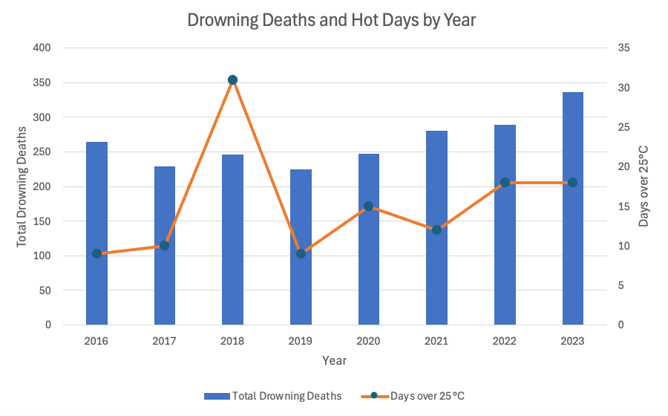
Figure 1: UK deaths classified as accidental drowning and submersion against the number of Central England Temperature days reaching at least 25°C, 2016–2023. Sources: supplied spreadsheet (WHO Mortality Database and Met Office Central England Temperature series)
Against that backdrop, the chart shows that 2018 recorded the most days above 25°C but only 246 accidental drownings. Apart from that anomaly, the correlation between the number of hot days and deaths from accidental drowning appears consistent. Data for 2024 and 2025 were not available, but WAID reports indicate the trend continues.
Men account for three-quarters of deaths
The risk is not shared equally.
Men accounted for 1,580 of the 2,116 drowning deaths recorded in the WHO data between 2016 and 2023 – almost three-quarters of the total.
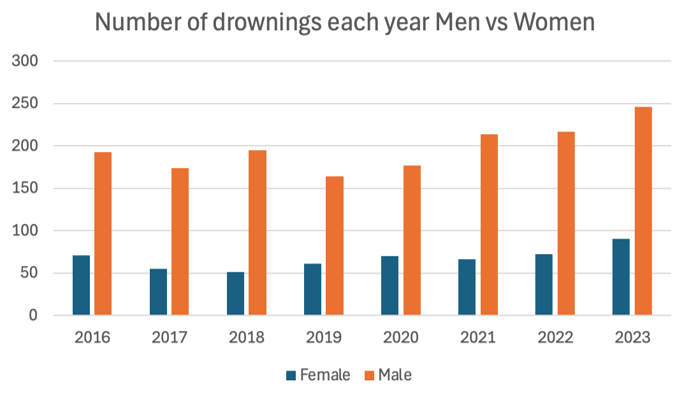
Figure 2. UK deaths classified as accidental drowning and submersion by sex, 2016–2023. Source: WHO Mortality Database
The imbalance was even wider in the latest WAID figures. Men accounted for 85 per cent of accidental water-related fatalities in 2025, following 84 per cent in 2024.
The difference may reflect greater exposure to open water and attitudes towards risk.
However, not every victim intended to get wet. Everyday activities such as walking and running accounted for almost one-third of accidental water-related fatalities in 2025.
Inland locations present the greatest danger. These locations may appear safer than the sea because the surface often looks calm. Beneath it may be strong currents, sudden drops, weeds, underwater obstacles and few obvious places to climb out.
Warm air can also disguise dangerously cold water. Many British lakes and rivers remain at or below 16°C even during summer. Sudden immersion can cause an involuntary gasp, rapid breathing, panic and loss of swimming ability. It can also produce a sharp increase in heart rate and blood pressure, potentially causing a heart attack even in someone fit and healthy.
If someone is struggling, the advice is to phone 999, tell them to float on their back and throw something buoyant. Witnesses should not enter the water themselves and risk becoming a second casualty.
Annual figures cannot predict how many people will drown during a hot summer. What the day-by-day evidence provides is more immediately useful: a short, potentially lifesaving warning that rising temperatures are about to change behaviour.
A day beside the water should offer relief from the heat, not end with a family waiting for someone who will never return home.
Feature image credit: Wikimedia Commons-by N Chadwick