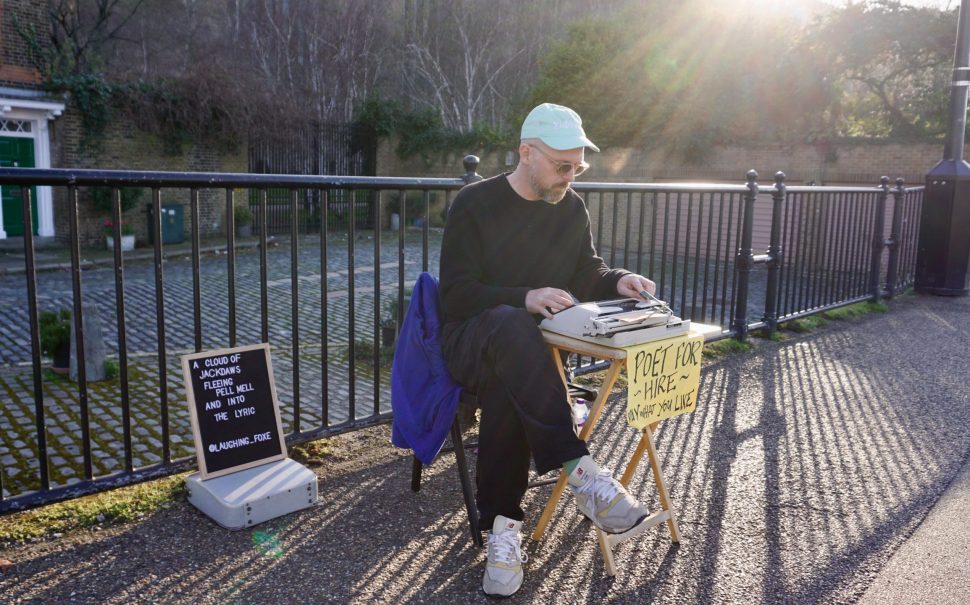
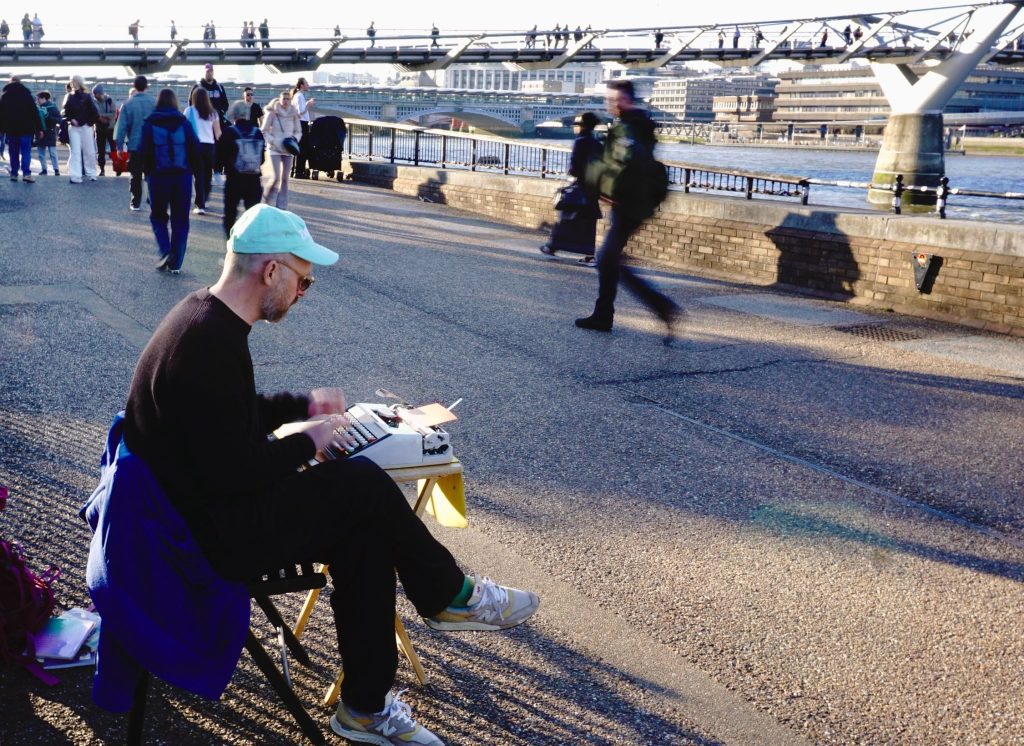
On the bustling South Bank of the Thames, you hear the click-clacking of typing. A bell rings, the carriage slides and an original poem on brightly coloured paper is handed to a delighted passer-by. It was type-written in a flurry of keys just seconds ago by one of the South Bank’s poets for hire.
Luke Davis pitches up on the promenade almost every day. He places his vintage typewriter on a fold-out table and tapes a hand-written sign onto it saying ‘pay what you like’. He’s ready for a day of meeting strangers, asking about their ambitions and loved ones, and writing pieces of unique poetry about them off-the-cuff.
Luke is one half of the poet-for-hire group Word Trade. Since his partner-in-rhyme Edmund Davie introduced him to freelance poetry eight years ago, he’s been writing almost every day. Before that he had been a painter, decorator and done odd jobs around London – even working on Thames Clipper ferries, which cruise past his breezy workspace on the busy river.
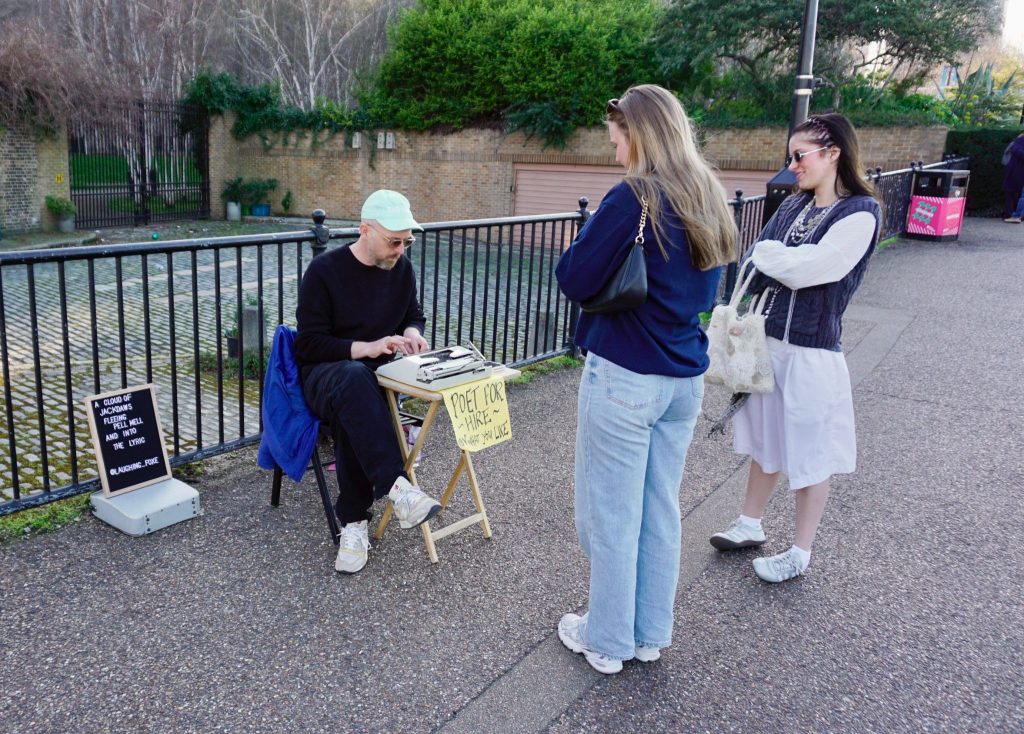
A pair of American women approach the table, one of them requesting a poem for her boyfriend back in Virginia. They talk cheerfully about life details – discussing how the couple met and what they’re interested in.
Luke ponders for a moment.
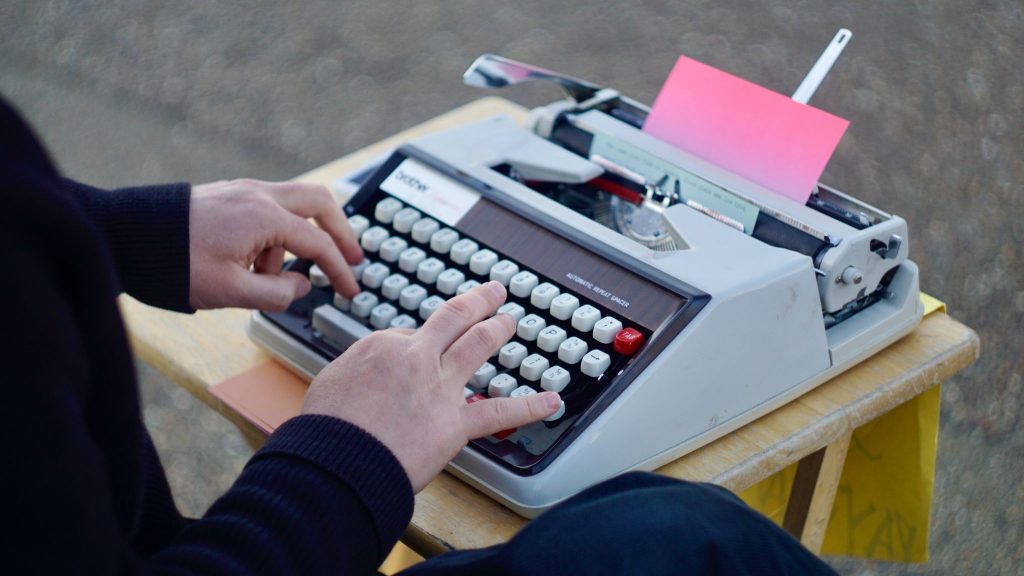
Before he begins, he leans forward on his creaking fold-out chair. His fingers start flying across the keys, and lines of paper begin scrolling out of the typewriter. A bell rings, and he virtuosically slides the carriage lever at the end of a line. Typebars smack bright pink paper with a mechanical clanking and words spring into existence on the page.
“There’s a theatricality to typewriters. People come for that, not for the poet,” he says.
He pulls the rustling page out from the machine, and hands it to the stunned woman without a second look. She says: “That’s perfect, wow!”
“No messing around,” he replies.
The typewriter itself is a compelling part of his busking. As well as giving customers a physical souvenir, Luke’s 1970s Brother Deluxe 1350 is eyecatching, loud and lightweight – perfect for lugging around London. In an age of spellcheck and endless editing, he prefers the analogue feel. Luke says: “It’s part of the appeal – you’re free of all the interference… that digital presence over your shoulder.
“I like the fact that you’re committed. You do it and it’s done.”
The most popular request for Luke is to write about romantic partners, or ‘love in its various guises’. After that, his next most popular is for mothers. “Not nearly so many dads,” he says. Following this trend, he has noticed more commissions for sisters than brothers, and he also regularly writes about people’s dogs.
Luke’s been spurred on by the positive reaction of the public: “They don’t stop to take the piss, they stop to admire – and because they want their poems to be good!”
The pace of writing is staggering. “There are two types of writers: The ‘chiselers’ who agonise over commas, and there’s me,” he chuckles. Preferring to work quickly, he’s rarely stumped by the requests of patrons.
Sometimes even he gets writer’s block though, such as when a child asked him for a poem about Roblox. This is usually smoothed out by his brief questions to explain the subject: “You can use a little sketch as a launchpad.”
By letting customers pay what they want, Luke explains that the risk is taken out of the interaction. “People have different amounts of money in the bank,” he says. This has allowed a wide range of clients, from students to older tourists.
He was once memorably given £200 for writing an emotional piece for a woman going through a difficult time in her life. Reactions to his writing have ranged from laughter to tears. He says: “Keep being amazed.
“You’ve got to try not to take it for granted.”
Making a living through poetry requires discipline and a lot of travel. Word Trade have written at weddings, corporate events and the Hay-on-Wye Festival in Wales, but they still find time to lend their keys and creativity to the public as bankside’s poets in residence.
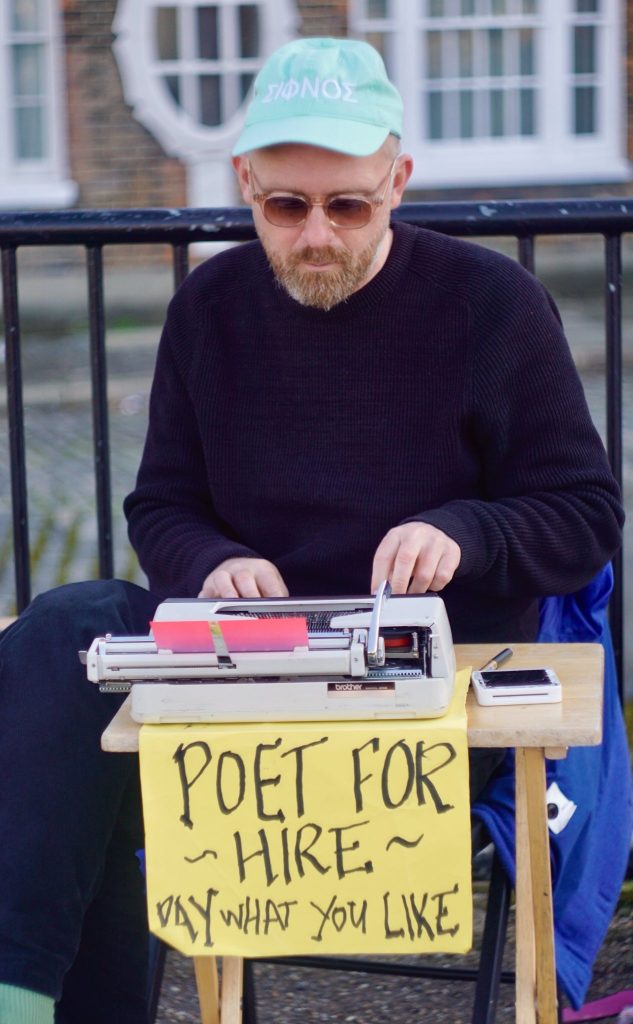
Edmund picked their usual spot next to the Bard’s theatre. “It’s part of the reason it works so well,” says Luke, noting the connection to British literary history.
Poetry runs in his family. Growing up, his father would recite poems at the dinner table that described ‘the atmospherics of London’, which included works by T. S. Eliot and Samuel Taylor Coleridge. Luke has become part of this atmosphere – his poems illustrating the scenes and lives of Londoners and visitors. They’re folded up in pockets, tucked into books and carried around the world by the people he’s met and written for.
“Writing for me is a kind of communication channel between the conscious self and everything else – The world, the stars, the gods,” he says.
“For me to be operational, I need to have that channel open.”
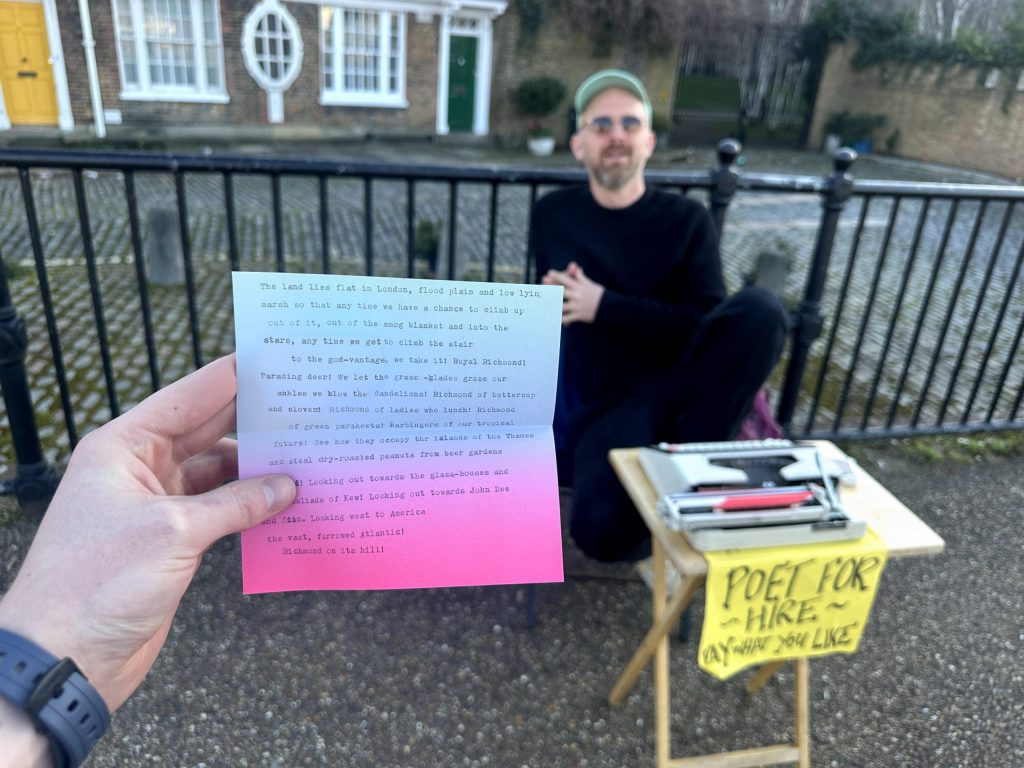
Asked to write an original poem about south west London, Luke hesitates for a moment, then explains that he used to ride bicycles around Richmond Park with his family.
He begins typing:
The land lies flat in London, flood plain and low lying marsh
So that any given time we have a chance to climb up
Out of it, out of the smog blanket and into the stars,
Any time we get to climb the stair
To the god-vantage, we take it!
Royal Richmond! Parading deer!
We let the grass-blades graze our ankles
We blow the dandelions
Richmond of buttercup and clover!
Richmond of ladies who lunch!
Richmond of green parakeets!
Harbingers of our tropical future!
See how they occupy the islands of the Thames
And steal dry-roasted peanuts from beer gardens.
Richmond! Looking out towards the glass-houses
And bromeliads of Kew!
Looking out towards John Dee and Sion.
Looking west to America
The vast, furrowed Atlantic!
Richmond on its hill!
All photos taken by Louis Greaves