When Aza Raskin invented the infinite scroll in 2006, he had no idea what harm this would have caused 20 years on.
He invented the feature so that people everywhere could flick through pages and pages of content while barely lifting a finger.
Now a whole generation of young people are so reliant on a mobile phone that he’s sorry he ever invented it.
“He even finds himself falling victim to his own creation – visiting somebody for dinner but just sitting on the loo scrolling on his phone”, said Dr Aric Sigman, a psychologist and health education lecturer.
Dr Sigman is a chartered member of the British Psychological Society and has been researching the harm of recreational screen time on young people for years.
“Most guidance on average screen times say two hours a day is ideal. This would really prevent so many of the problems that are appearing in medical journals,” he said.
Ask any member of Gen-Z and it’s likely that their average screen time would not sit anywhere near this ideal.
Presley Esquivel, 17, is an example of this trend and between talking to long distance friends and doomscrolling on TikTok, she found herself racking up 11 to 12 hours of screen time each day.
This troubling average is not unusual for a generation that, for the most part, grew up with a phone or tablet glued to their hand and more young people are starting to realise this problem and take steps to reverse the damage.
Dr Sigman said: “Studies find that after having a dumb phone, or disconnecting from the internet for a few weeks, young people end up with significantly better attention and tend to be happier and calmer.
“I think young people have discovered for themselves that it’s causing a degree of unhappiness in them and they simply want to control it.”
A dumb phone is a device solely designed for texting and calling and they lack most of the smart features that people are familiar with.
In a recent tech trend which has taken the internet by storm, young people are ditching their iPhones for flip phones and dumb phones in an attempt to digitally detox.
After being inundated with social media and modern technology, Gen-Z seems to be craving a simpler life with less choice, less distractions and less screens.
TikTok is full of young people romanticizing the early 2000s, longing for a time before we became so reliant on our phones.
But with things like QR codes, online banking and Uber in the modern day, how feasible is this swap?
Since realising she was addicted to her phone and swapping it for a flip phone a year and a half ago, Presley hasn’t looked back.
“I don’t pick up my phone as much when I’m at the gym. I don’t have it set up waiting for a text. I have it on silent, not even on vibration,” she said.
Without the constant stream of notifications, Presley is able to engage with her phone on her own terms, rather than allowing it to demand her attention the whole day.
“Sometimes I’ll take a day or more to answer my friends because I’m doing things that are right in front of me and need my immediate attention,” she said.
“I spend much more time with my family and when we are watching movies, I’m actually watching the movie, not just texting my friend about how good the movie is and missing what’s happening in front of me.”
Since the dawn of smart phones, a trip to the cinema has become more appreciated as a time to detach from the outside world and immerse yourself in a film.
Ironically, in the age of streaming services, the cinema experience is at the tip of our fingertips but digital addictions are holding us back.
Presley’s flip phone is not entirely dumb but has apps like Instagram and TikTok on it.
Despite still having access to these apps, she explained that the slow functioning nature of the flip phone serves as a deterrent, keeping her from endlessly scrolling.
“Smart phones are so fast paced, they take no time to load. I’d gotten so used to content loading immediately, that when the flip phone lagged for two, maybe three, seconds, I was getting frustrated,” she said.
“On a smart phone, even when an ad pops up, it doesn’t stop you. You just wait until you can scroll past it and then keep going.
“But it’s that little lag spike on a flip phone, where it’s buffering and your phone’s getting hot, that tells you that you’ve been on it for a while.”
Presley described a slower pace of life as an advantage of her flip phone.
“It slows me down. It keeps me at a perfect level where I can still do the things I enjoy and actually enjoy them, not speed through them before hopping onto the next app,” she said.
The immediacy and ease at which content is available to us has not only shortened our attention spans but it has created a whole generation that is incapable of being bored.
Madison Westbrooke, 26, is a Dallas based influencer who has been creating content since she was 12 and now has almost 200,000 followers on TikTok.
She started with her own YouTube channel and as social media developed, she moved onto Instagram and then TikTok, now creating a range of lifestyle content.
She said: “I eventually realised I could make money off of social media and being 13/14 and making the kind of money that I was, was a crazy concept.”
Having grown up creating content from a young age, Madison’s life has been consumed by social media and she explained her love-hate relationship with TikTok that she’s developed as a result.
“When TikTok first took off in 2018/2019, I didn’t want to be on it because I’d keep scrolling and was wasting too much time on it,” she said.
“I found myself in a back and forth thing of deleting and redownloading the app over and over, because it truly is an addiction. I even found myself allocating scrolling time before bed.
“It’s a toxic relationship. It’s like a toxic ex that you keep going back to – you know it’s bad but you can’t seem to get rid of it!”
It seems to have become normalised for phones to be an automatic part of everyday life and shape how people begin and end their day.
Madison said: “As soon as I wake up, the first thing I do is go on TikTok. I’m fully aware of the issue because I see my screen time and it’s not good.
“I’m not very good at managing my time and when I question why this is, I notice I go on my phone without realising it and these minutes add up.
“It’s that instant gratification and being able to escape from your reality for a little bit that makes it so addictive. It’s just kind of mindless too.”
Dr Sigman drew attention to what most healthcare professionals are concerned about, which is what he terms ‘discretionary screen time’. This is screen time not related to work or school and it continues to increase.
He said: “The devices that you can use are smaller, they’re portable, you can use them anywhere.
“You use phones as an alarm to get you up in the morning and almost everything depends upon looking at this one device.
“There’s so much to look at, so much to watch, that the hours are going up.”
Phones were created with the purpose of communication and building connections between people globally and while this is true, the pendulum seems to have swung back and the digital age is isolating many young people.
Dr Sigman said: “Face-to-face contact and physical movement has been declining and much of that has been displaced by the use of new technology, where people are sedentary and solitary.
“They’re not seeing the world for real, they’re seeing a virtual version of it.”
Presley found her flip phone has allowed her to create deeper bonds with people, encouraging her to call people rather than message them, and when she does message, each one is thought out.
“Before I wasn’t even really reading what my texts were saying, I was just trying to think of a response so I could answer the next person. Now I have to think about what I’m typing as it takes longer.”
Madison said: “I think there was a lot more true connection between people in the age of flip phones than there is now. It’s easy to isolate yourself, especially when you feel like you have a connection to everybody through your phone.
“But this cannot replace physically being with someone and I think the lack of true connection is affecting us more than we think.”
“I think there’s a beauty in not constantly knowing what is going on in somebody’s life and then looking forward to sharing that at the end of the day.”
Dr Sigman said: “Media companies want parents and children to fear that they will be disconnected without social media.
“But it would enable young people to find different methods of communicating like FaceTime and Zoom, and they’ll feel more bonded with the people they are connecting with.”
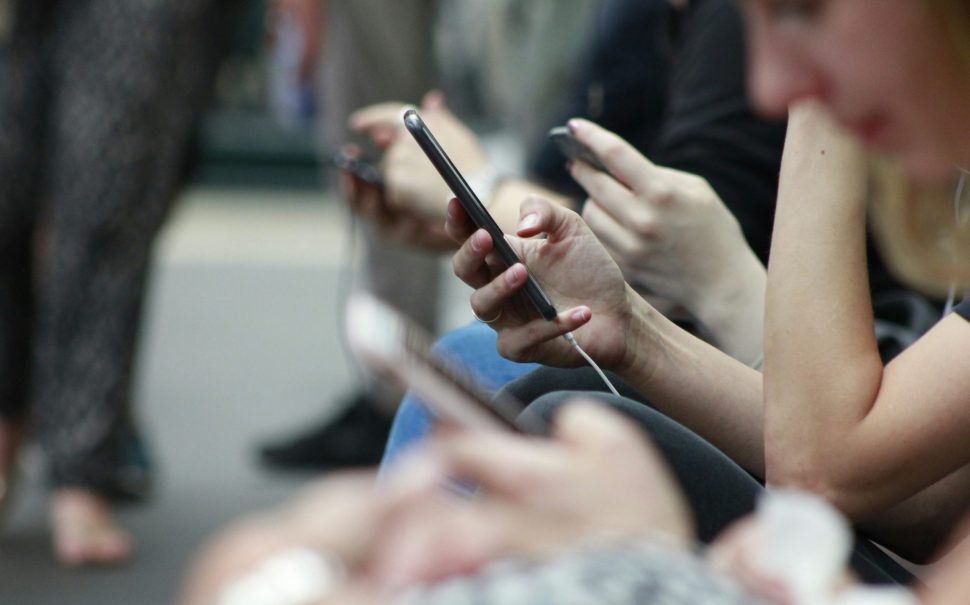
Featured image credit: Robin Worrall via Unsplash