In still image alone, there is very little – other than peroxide – that separates Norma Jeane from Marilyn Monroe. At 14, with ringlet curls and red lipstick, Jeane grins film-star like into the lens of an automatic photobooth; at 36, with her hands clasped and hair ruffled, Monroe blows a girlish kiss at the camera for the last time. From girl to star, and ultimately, icon, she – Norma Jeane, Marilyn Monroe – pulled off one of the twentieth century’s most extraordinary feats of self-invention.
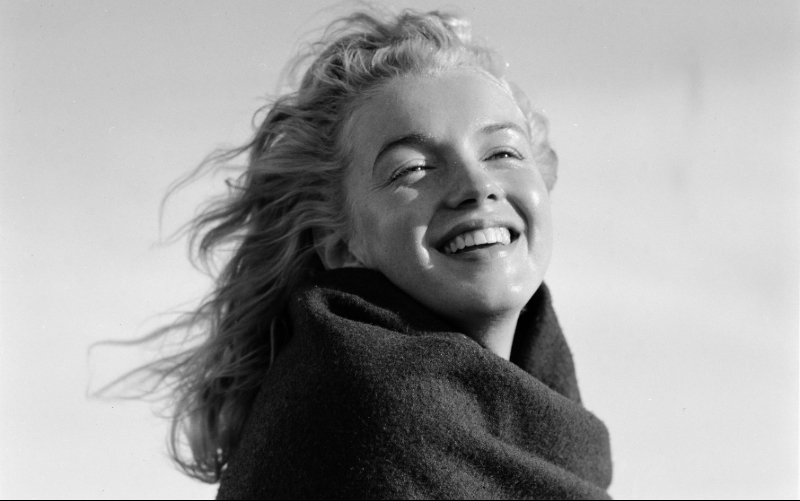
No clearer is the metamorphosis of Monroe than in the work of Hungarian photographer André de Dienes. In Death Valley, 1945, then chestnut-haired, she clambers up a rock face wearing a green polo neck jumper and slacks. A year later, she was blonde and had a new name. On Malibu Beach, she was joy, introspection, sadness, and serenity. When asked by de Dienes to depict death, she threw a blanket over her head.
At the National Portrait Gallery’s centenary exhibition for the actress, this is the room everyone returns to. Not to the Sam Shaw’s, the Cecil Beaton’s, or the Milton Greene’s. But to the de Dienes. The early years. The moment we think we can see her creation. Where those characters that swirled around her for a lifetime – and now eternity – are visible all at once. The Pin-Up; The Serious Actress; The Troubled Girl. Marilyn the Real.
“He was photographing her right at the beginning of her career, when she was on that threshold of becoming Marilyn Monroe, so young and full of life and tender,” said acting senior curator of photographs at the Gallery, Brandei Estes. “It’s a side to her we don’t usually see.”
Arnold)
That seems to be the premise of the exhibition. To give Marilyn the last word – it is her voice narrating the showcase – and to remind us again of the aspects of her we’re inclined to forget; her modernity, her agency, her realness.
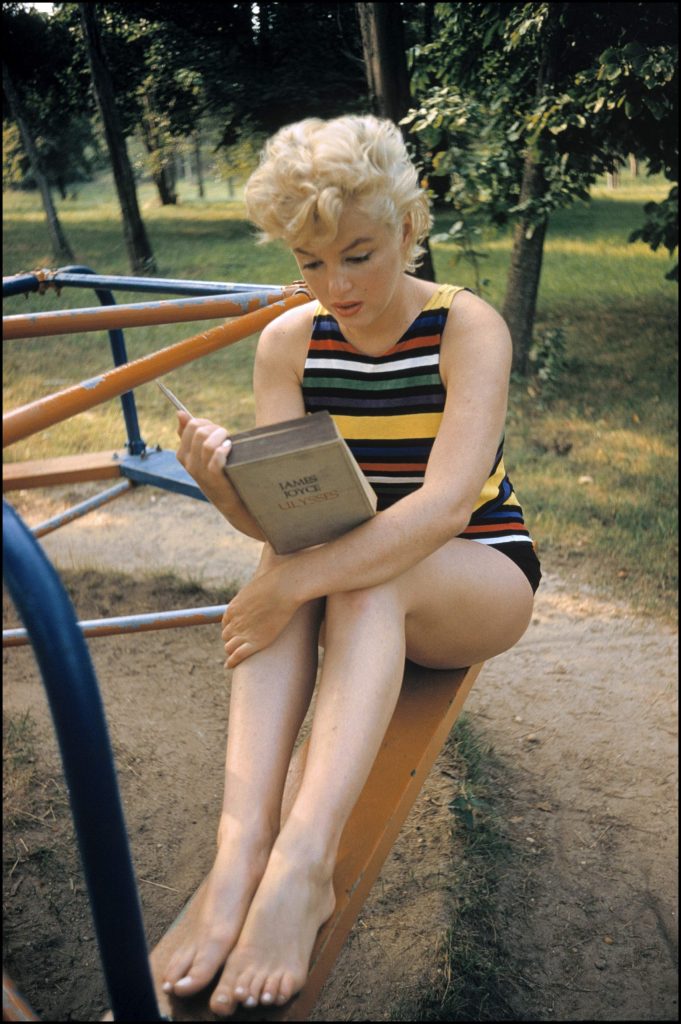
Marilyn laughs wildly, Marilyn lifts weights, Marilyn reads James Joyce’s Ulysses, Marilyn poses nude. In 1954, she established her own film production company with Milton Greene. It is a move that is widely considered to have been pivotal in the downfall of the Hollywood studio system. Throughout her many reproductions lining the walls, one gets the sensation that she was a very modern woman.
Perhaps most modern of all, is that everything we learn about Marilyn arrives via her image. Her carefully curated image. “Her real skill, her genius, is in front of the still camera,” said Rosie Broadley, Joint Head of Curatorial and Senior Curator of 20th Century Collections at the Gallery. “She had this amazing ability to control the image, to direct the image in a way that was taken away from her when she made movies.”
Calling me from Los Angeles, Greg Schreiner, the President of the Marilyn Remembered fan club since 1982, emphasised as much. Knowing Marilyn first through her films, and eventually from meeting the people that knew her, Schreiner revered this ability. “The camera loved her whether it was a photograph or on film, there’s a certain magic that happens on the screen.”
As one of the most photographed people of the 20th century, Marilyn understood better than most that her image was a construct. She was as much a maker as a muse in the process of image-creation, collaborating with photographers to breathe life into her ideal, perfect, second self. It is the buzzword of the exhibition – collaboration, collaboration, collaboration. “She was very smart in knowing the power of her image in her lifetime,” said Estes.
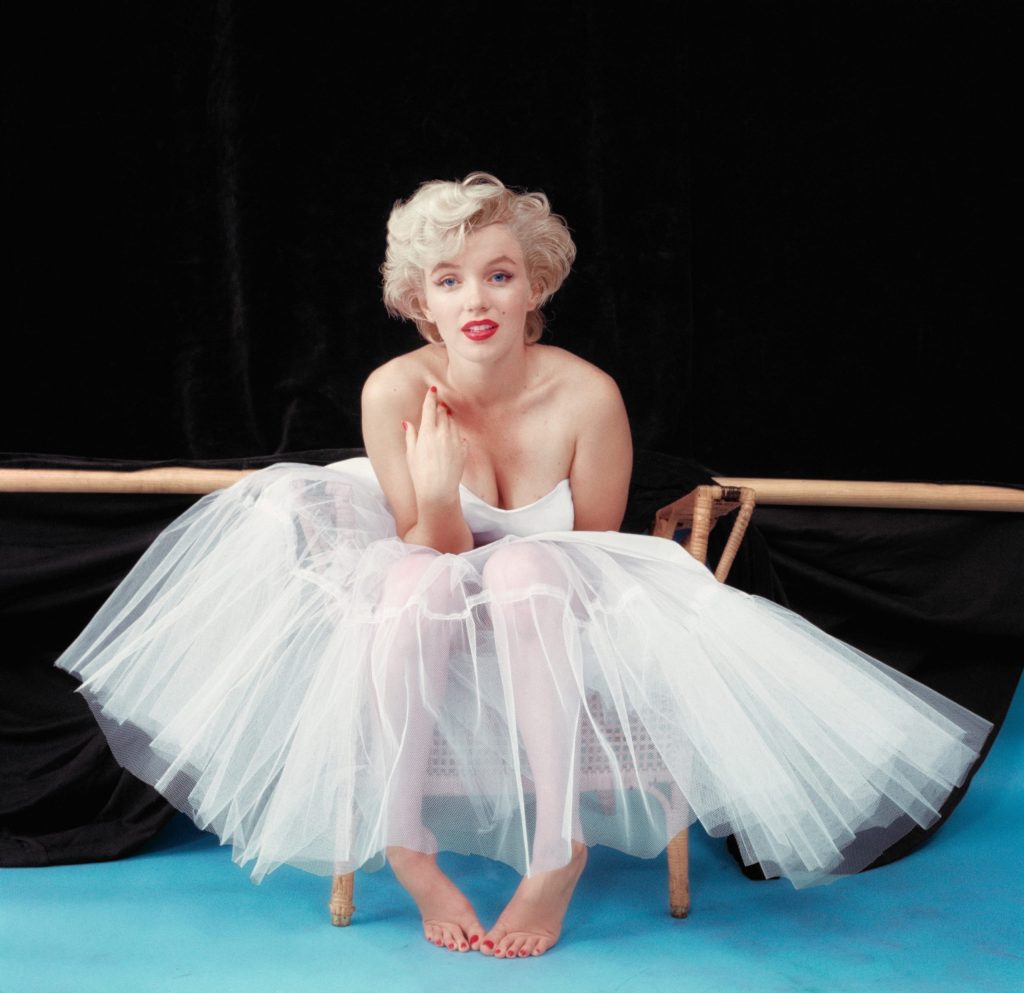
Only upon granting photographers her consent could they capture her in a moment of quiet pensiveness. Richard Avedon, the renowned Vogue photographer, recalls watching her slouch into herself after she’d ‘done’ Marilyn for the camera. She remained fully aware of the camera’s watchful gaze. Between shoots with Ed Feingersh, she became drained of energy and totally unlike ‘herself’. She ‘hardly knew’ he was still shooting; she hadn’t necessarily been asked to pose.
She would pore over every picture to select the ‘honest’ one, or the ‘right’ one, or the ‘real’ one. Photographers would send over their shots for approval – with a magic marker she’d X through the ones that didn’t fit. When one image she had no control over – the nude taken by Tom Kelley in 1949 in return for $50 – threatened to overshadow her budding career, she sat for an interview to discuss her impoverished childhood. Her image, even as the ‘accidental’ sex symbol, was never too far out of her control for long.
It is startling to look at those images and see so much of yourself reflected back. In other images of other female historical figures – of other film stars even – a gauze lies atop, blocking any real chance for connection. We’re linked by virtue of our sex, but there is little else to relate to. With Marilyn, however, it’s different. She could be any one of the girls I see on Instagram, or any one of my friends, or even myself.
Because in 2026 we are all mini-Marilyn’s. If Marilyn was the first modern celebrity, and modern celebrities, who have now been distilled into influencers, are the metric for modern aspiration, then we are closer to Marilyn than we think. Our image has never mattered more to any of us, nor have we ever been so in control of it. How many hours go into securing an Instagram plandid that sends the ideal message about our ideal self? The resulting contradiction is a world where we know so much, and yet so little, about the inner lives of celebrities, and each other. Like Marilyn, our pictured, performed self, is the powerful one; the lines between the real and unreal have blurred.
Any search for or discussion of Marilyn’s realness – in this exhibition and beyond – is therefore confusing. Futile, even. “I don’t know if there’s an answer for who the real Marilyn was,” said Schreiner. “Even those who knew her did not know all of her. Underneath it all, there was always Norma Jeane, and maybe that’s the reason that we’re so attracted to her, because there was the dichotomy of two people under the same shell.”
Susan Sontag wrote that ‘photographs, which cannot themselves explain anything, are inexhaustible invitations to deduction, speculation, and fantasy.’ She is correct. Marilyn Monroe revelled in the opportunity to create such images, just as audiences today do the challenge of deciphering them. The exhibition intended clarity, but, ultimately, I was invited to deduce, speculate, and fantasise. In real and unreal ways, she – Norma Jeane, Marilyn Monroe – was a gloriously modern woman. Who could say otherwise?
Marilyn Monroe: A Portrait will run at the National Portrait Gallery from 4 June to 6 September.
Featured image: Marilyn Monroe, 1946, by André De Dienes, © André de
Dienes / MUUS Collection