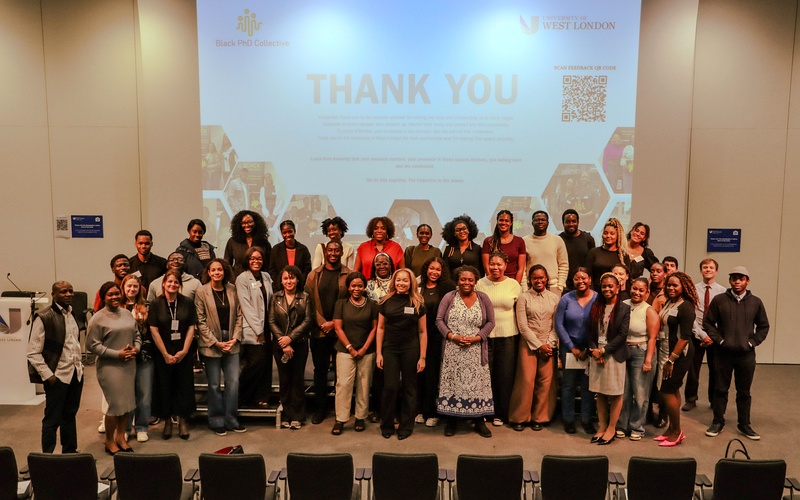
The Black PhD Collective, founded by a Nottingham doctoral student who felt isolated and unsupported, held its inaugural conference at the University of West London — bringing together researchers from across the UK and Ireland.
Meléa Sinclair was partway through her PhD at Nottingham when the isolation became hard to ignore. Few Black faces in her department. Fewer at conferences. No structures built for doctoral students who looked like her.
So she built one.
The Black PhD Collective, which Sinclair founded last year as what organisers describe as the UK’s first national network for Black and Black-mixed PhD students, held its inaugural conference at the University of West London on 12 June.
Researchers travelled from across the UK and Ireland for 20 oral presentations, five poster presentations, keynote speeches and professional-development workshops.
Sinclair said: “It was founded purely out of feeling isolated and wanting to connect with other students.”
The isolation she describes is well documented. A systematic review published in BMJ Open found that Black university students in the UK experienced mental distress compounded by pressures their non-Black peers did not face, including family expectations linked to immigration and financial sacrifice.
These pressures reflect wider social determinants of health: the conditions in which people study, work and build support networks can shape their mental wellbeing, particularly when discrimination, financial strain and social isolation overlap.
Research published in BMC Public Health linked experiences of racial discrimination among nearly 5,000 ethnic minority adults in the UK with greater psychological distress and poorer mental functioning over a two-year follow-up.
The underrepresentation continues throughout academic careers. Higher Education Statistics Agency data shows that Black students are less well represented in postgraduate research than at undergraduate level, while Black academics account for around 1% of UK professors.
A UK Research and Innovation review found that Black doctoral students in the life sciences were less likely to complete their programmes and less likely to enter academic employment.
Sinclair said: “I shouldn’t have had to create a national network during my PhD. It’s hard enough as it is.
“I shouldn’t have to recruit volunteer PhD students. I should be able to pay them for their time.”
Global-majority students, she added, were often “having to do more than our white counterparts in order to feel the same level of support and community”.
Demand for the Collective has outstripped anything she anticipated, with students travelling from as far as Ireland and Scotland to attend its events.
She said: “There is such a demand for events like these.”
Marisha David, a psychology and neuroscience PhD student at UWL, presented her research at the conference. Other researchers raised questions she had not anticipated and offered suggestions that could strengthen her work.
Presenting in a space centred on Black researchers, she said, made her feel “very proud and included”.
David said: “There was research focused on countries with predominantly Black populations, and it showed how important it is for Black researchers to bring their knowledge of Black cultures into the academic literature.”
She wants to become a university lecturer and said that ambition had carried her through the hardest stretches of her PhD, alongside something more personal.
She said: “I want to show my daughter that she can do anything she wants to do when she gets older and that there is no ceiling.
“Your background is an asset, not a limitation.”
Professor Caroline Lafarge, head of UWL’s Graduate School, said the burden of addressing inequality should not fall on those experiencing it.
She said: “It is very unfortunate that the responsibility for equity falls on those who are disadvantaged in the first place.
As a society, we need to do better than placing undue burden on the very people facing inequalities and discrimination.”
Lafarge has studied the issue directly. Research she co-authored at UWL, published through the British Educational Research Association, found that doctoral students from ethnic minority backgrounds experienced “conscious or unconscious non-inclusive behaviour” within universities that their white peers did not encounter.
The study used the term BAME (Black, Asian, and Minority Ethnic) to describe the students who took part.
Lafarge first met Sinclair at a 2025 conference on equality in doctoral research and offered to host the Collective’s event. But she was candid about the limits of a single day.
She said: “I understand how hosting a one-day conference could be seen as tokenistic “.
UWL is developing training for supervisors on recruiting and supporting students from global-majority backgrounds.
Lafarge said the university would also like to offer a dedicated scholarship, although no funding was currently available.
The university has supported Professor Bernadine Idowu’s annual BME Early Career Researcher Conference for five years. The conference marked its 10th anniversary in July 2026, and UWL was nominated for an Allyship in Action Award at the inaugural BME ECR Legacy Awards in Academia.
Sinclair said UWL’s involvement showed what was possible when universities committed to supporting Black researchers beyond seasonal initiatives.
She said: “Many universities promote EDI initiatives only seasonally, such as during Black History Month. UWL champions it all year round.”
Lafarge stressed that the conference had remained the collective’s own, but said universities had a responsibility to support such work beyond individual events.
She said: “Bringing about change requires courage, sustained effort and openness to conversations that can be, at times, uncomfortable.”
Featured image credit: Ms Brooke Darrow