For many women, the phrase “text me when you get home” is heard so often that it has become second nature. Whether it’s after dinner with friends, leaving work late or heading home from a night out, letting someone know you’ve arrived safely has become part of everyday life, and many take extra precautions simply to feel safer.
New figures suggest those habits are far from uncommon. A YouGov survey commissioned by Active Travel England found that almost nine in ten women (88%) have felt unsafe while walking at night.
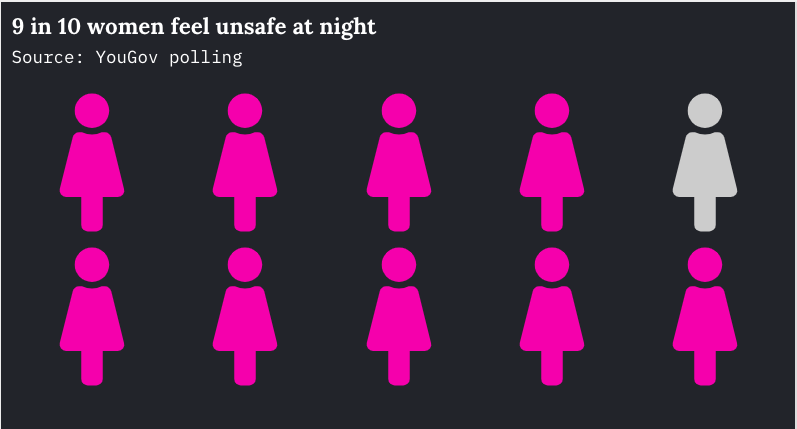
Additionally, more than seven in ten (71%) said they have deliberately changed their route home to avoid walking alone in the dark.
In response, the government have announced new guidance for councils to help put measures into place with women’s safety in mind. This includes better street lighting to improve visibility and CCTV coverage.
The survey found that inadequate lighting, antisocial behaviour and poorly maintained routes are the main causes of fears around safety for women.
But for many women, concerns about personal safety extend beyond poorly lit streets and late-night journeys.
Actor and texture hair stylist Uche Abuah, 42, experienced harassment while walking through Shepherd’s Bush at around 4pm in broad daylight, in the summer of 2025. A man repeatedly followed her through the streets, ignoring her when she said she was not interested, before asking for a hug and continuing to pursue her.
Uche said: “He wouldn’t leave me alone, I had to just keep circling the block because I was trying to get to where I live.
“At the time, I didn’t feel scared because it happens, it’s something that’s happened to me before, but it just went on a bit longer than usual.
“Normally, they just get bored and walk away, but this guy was persistent.”
The encounter became more alarming when the man suddenly ran towards her from behind.
“If I had headphones on, I wouldn’t have noticed, and he could have just grabbed me,” Uche added.
Fearing the incident could escalate, Uche decided to get out her phone and film what was happening, “I just thought I should start recording, because if this gets heated, I need to have evidence, if something were to happen, and I also wanted to make sure his face was out there,” she said.
At that moment, Uche’s instinct was not only to protect herself but to gain evidence that could possibly warn other women. She reported the incident to the police and posted the video on social media, where she was contacted by another woman on TikTok who had had a similar experience with the same man a year earlier.
Her experience reflects a wider reality for many women, who feel they need to alter their behaviour, stay alert and even gather evidence because they lack confidence they will be believed if they report harassment.
Now, Uche encourages others to report incidents where they feel able to, “I advise women to report it and, if they can, get them on camera so you’re prepared if anything happens,” she said.
However, for Uche, this incident was not an isolated experience; for several months, when she was just 13 years old, she was followed almost every day on her journey to school.
Experiences like these have become so commonplace that many women have succumbed to adapting their behaviour. Avoiding quiet streets, not wearing headphones, sharing live locations, staying on the phone with friends and gripping keys between their fingers have become routine precautions rather than exceptional ones.
Women have grown accustomed to adapting their behaviour rather than expecting the streets around them to be safer.
For some women, those precautions extend beyond changing routines, with many turning to personal safety products in the hope of buying themselves valuable time to escape if the worst happens.
Shannon Donnelly, 29, founded Get Personal, six years ago, after her own experiences throughout her life, left her feeling unsafe.
After reporting concerns of harassment to the police, she says she was advised not to go out after dark and to carry a panic alarm. “I just thought that was awful advice,” she said.
The Met Police’s guidance on stalking and harassment states that victims do not need to collect evidence themselves. They emphasise that occurrences of harassment are not the victims fault and no person should feel they have to change their behaviour.
However, they advise to carry a personal alarm, head to a place of safety if being followed, and report incidents to the police or specialist organisations.
Shannon felt frustrated that she could not find the personal safety products she wanted in the UK, she decided to start her own business.
“I thought, why don’t I just do it myself? Imagine all the people across the UK in similar situations, who don’t know where to turn,” she said.
The company’s best-selling product is Farbgel, a legal defence spray that temporarily stains an attacker’s skin red, making identification easier, whilst giving the victim time to escape.
“Panic alarms are great, but they don’t work in every situation, whereas a spray they’re more than likely not going to expect it. It’s bright red, so it stains the skin for up to 7 days,” she added.
Shannon stressed that no product can ever guarantee safety. “Women should be allowed to go out at night and feel safe, and if that means carrying something to protect themselves, then that’s the way forward,” she said.
She believes that the wider problem lies in a lack of confidence in the justice system, “people don’t want to report it to the police because they are worried they are not going to be believed,” she said.
Campaigners argue that while personal safety may offer reassurance, lasting changes and feelings of safety depend upon preventing harassment in the first place.
For Estella Adeyeri, 36, communications officer at the Good Night Out Campaign, that means challenging the normalisation of harassment rather than expecting women to shoulder the burden of protecting themselves.
“People might experience something and feel like that’s just part of a night out,” she said.
The organisation has spent the last 12 years working with venues and festivals to improve responses to sexual harassment. They have worked with 293 organisations and trained more than 5,800 staff to recognise harassment and intervene safely, offering better support to victims.
Estella believes that attitudes have begun to change, “I’ve noticed the conversation becoming a bit more commonplace, even the phrase nightlife safety, I think a lot more people use and understand it.”
She believes everyone has a role to play, “there are ways you can show allyship by looking out for other people,” she said.
For Uche, she has noted a bystander effect where people don’t offer help to victims. “People don’t want to get involved, like strangers, they may see you in distress or maybe see you having an issue, and they just walk away, and there’s no community spirit,” she said.
Uche added: “The phrase, text me when you get home is more than a thoughtful gesture.”
Staying alert, altering routes and making constant calculations about personal safety will remain until those precautions are no longer necessary; the responsibility of staying safe will continue to fall disproportionately on women rather than those who make them feel unsafe.
Featured image credit: Christian Mack via Unsplash