I cried at The Exchange last night.
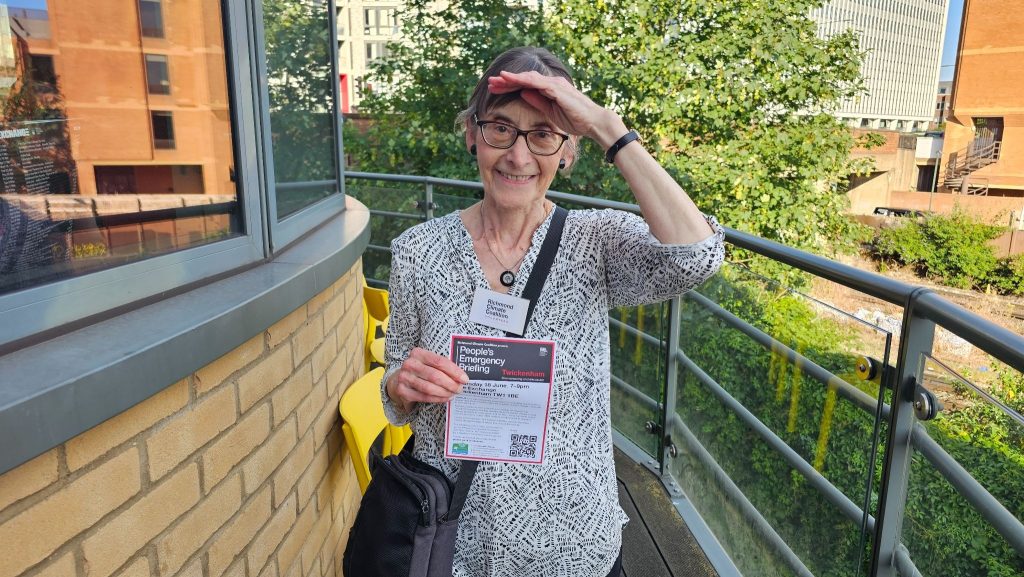
Let me contextualise: I went to watch The People’s Emergency Briefing – a chilling look at the future of the climate crisis, set to hit us sooner than you think.
Having worked in environmental sustainability for a decade – regularly standing on stages to explain these challenges – I consider myself well-read on the subject. Yet, this documentary laid bare how the climate crisis will unquestionably lead to societal collapse far faster than even the best experts predicted.
This isn’t just ‘a bit of warming’; Lt General Richard Nugee CB CVO CBE used the term “ungovernable state” to describe our future. As the military acronyms in his name suggest, Nugee knows a thing or two about national security.
Perhaps the most haunting clip of all was watching a flash flood sweep cars away in Valencia, Spain, accompanied by the knowledge that 237 people died in this flash flood alone.
This was on 29 October 2024 – “a date now etched into the psyche of the people of Benetússer and many other towns in the Valencia region, in eastern Spain”.
In the next frame, there’s a wide-angle shot of a German flood in the Eifel mountain region of western Germany and eastern Belgium. The death toll? More than 200 people.
What do both of these events have in common? They are a predictor of what is to come, say the nine experts gathered to break down how the climate crisis will affect every element of society as we know it.
The documentary is the brainchild of Simon and Nick Oldridge, two brothers who describe themselves as “climate funders and communicators, with a background in business”.
In just 50 minutes, it covers nine topics: extreme weathers, food security, health, nature, climate, national security, economics, the energy transition and tipping points. When asked to define what a ‘climate tipping point’ is, Professor Tim Lenton OBE responded in the film: you only need to lean your chair back to understand what it means for us if we cross a certain tipping point.
Worryingly, the film shows how woefully underprepared the UK is. One expert noted this year’s weather will likely be the coolest and calmest we ever experience from here on out. In London, we are fresh out of one record-breaking heatwave and just set to enter another.
To drive this home, the documentary cuts to everyday people and celebrities (including Jennifer Saunders and Deborah Meaden) reacting in real time. Their stories ground the science: a man with Multiple Sclerosis (MS) explained how he is now housebound during heatwaves, and a mother shared her autistic child’s inability to regulate in extreme temperatures.
Whether it’s unfarmable land, deadly temperatures, or economic collapse on par with a large global recession, the future of this climate crisis is far more immediate than we think. After every passage, the film features members of the public and celebrities – including Jennifer Saunders and Deborah Meade, who sit on a sofa and react to what they have just seen. While many are stunned, many also relay the findings to their everyday lives.
One man with MS said he is now housebound whenever temperatures soar because his health struggles so much in the heat. Another talked of her child’s autism and her inability to regulate herself in extreme temperatures.
Surprisingly, the film concludes with hope. Angela Francis, director of policy solutions at WWF, revealed the cost of the UK’s net-zero transition is now 73% cheaper than projected five years ago. While acting sooner would have saved more, the financial cost of inaction is infinitely worse.
The National Emergency Briefing team has clear aims: they want this film televised in a prime-time slot on all television channels, introduced by the Prime Minister, to spark a wartime-scale mobilisation. The ethos of the film is this: our response to the climate crisis should be tantamount to the UK’s response to the Second World War.
I asked Simon Oldridge – co-founder of the National Emergency Briefing – the organisation behind the documentary, for his observations: “The public still has little sense of the scale and immediacy of these risks. We want to ensure people are informed about both the threats and the opportunities that come from responding at scale”.
What are Simon’s calls to action?
- Attend or host a screening of this documentary.
- Check if your MP supports the Parliamentary Call for the government to stage a televised emergency briefing.
- Sign the petition to get the 100,000 signatures needed to secure a Parliamentary debate on this subject.
- A full list of the calls to action can be found here.
With over 1,600 screenings nationwide, this film will undoubtedly fuel conversation and, one hopes, action. Speaking to the organisers of this local screening in Twickenham, I was surprised to hear that 260 people were expected to attend this screening alone.
I left believing even more firmly that reaching net zero is entirely achievable. But I also left with a small but sinking feeling that Westminster will continue to treat the climate crisis as a political hot potato. Only time will tell which future has the power to triumph.
Either way, one thing is clear; if we do nothing, only the climate crisis will triumph, and that spells disaster for us all.
Featured image credit: Elsa Nightingale