The absence of Ireland in Vienna this year may pose a problem for the UK’s already dwindling number of votes at Eurovision, analysis of voting patterns has found.
The six-time contest winner is on record as the UK’s number one fan, giving 274 points over the 58 years that both nations have participated.
But, Irish broadcaster RTÉ has made the choice to boycott Eurovision this year – alongside Slovenia, Iceland, Spain, and The Netherlands – on the grounds of the European Broadcasting Union (EBU) not expelling Israel from the contest.
Before this, Ireland has only been absent twice, in 1983 and in 2002, and out of the 58 times that it has participated, it has given the UK points 84% of the time.
British Eurovision analyst Gabe Milne reckons the relationship is due to cultural overlap between the two nations, even despite a colonial history and often contrasting politics.
Milne said: “Britain and Ireland are countries with a lot of cultural exchange, owing to their proximity.
“In Eurovision, it comes back to what cultural views you’re going to understand, the things that align most with your own personal lived experiences – for British and Irish people, they’re more likely to feel that.”
Irish Eurofans online also agreed with Milne’s assessments.
One said: “Most Irish people watch British television channels, especially the BBC, and lots of past Eurovision entries would be familiar already to Irish viewers that way, hence the votes.
“Also, the common language is a big factor.”
While the relationship between the UK and Ireland is the strongest that both nations have, it is far less intense than other allyships between geographically and culturally close nations, such as Greece and Cyprus.
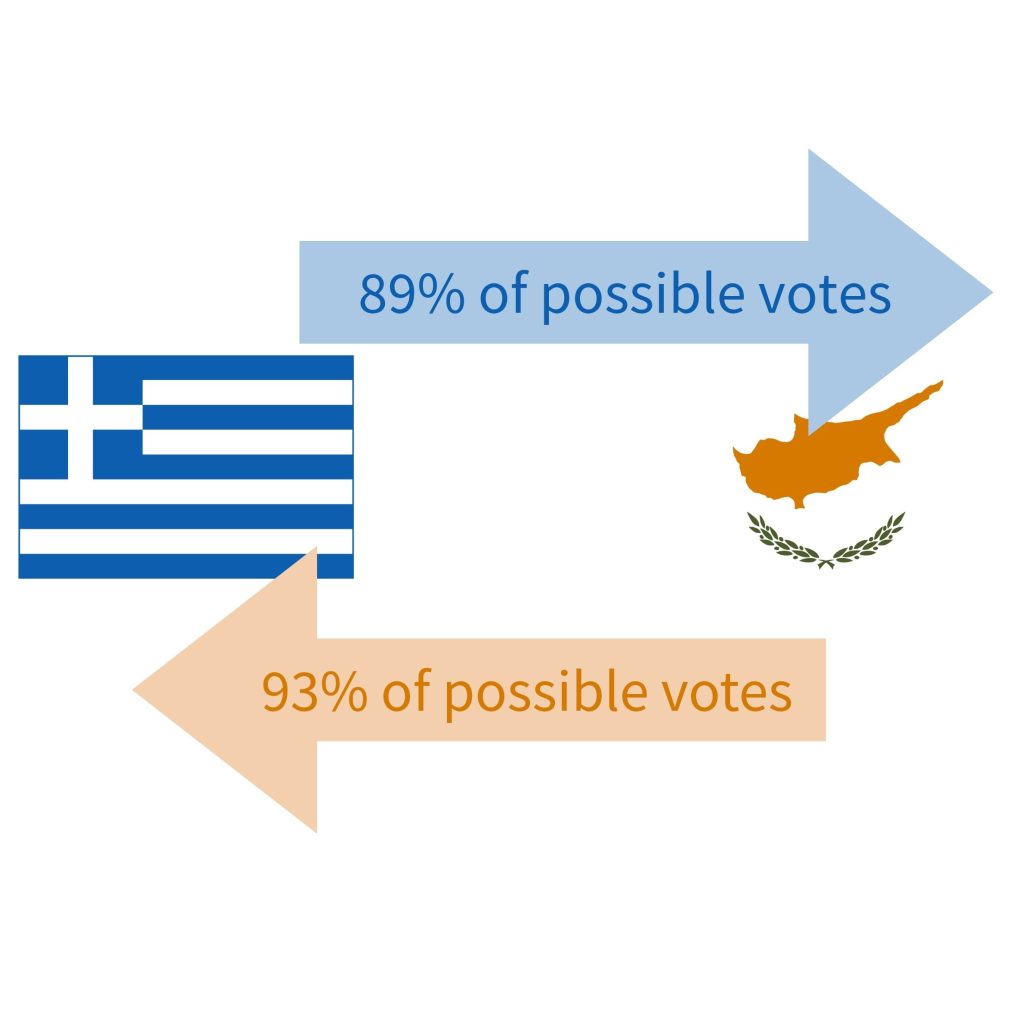
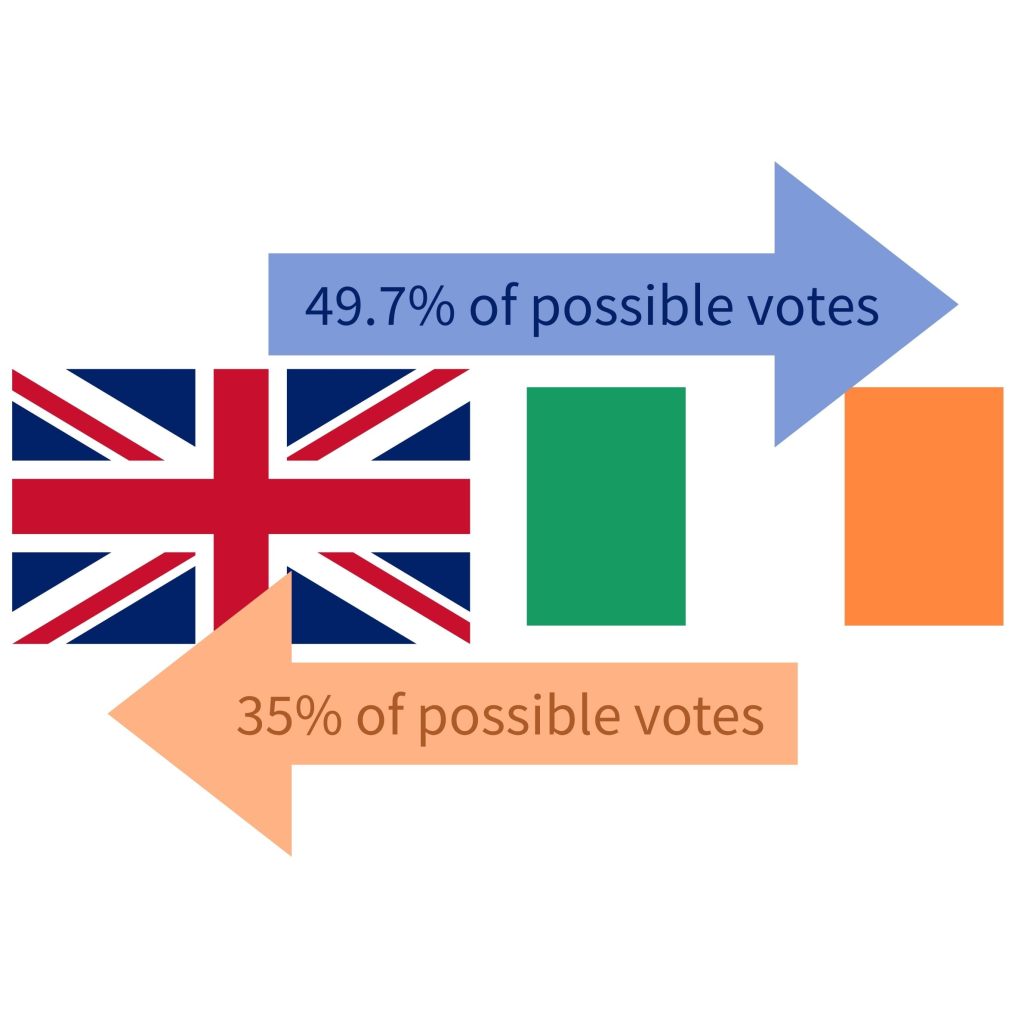
This means that the relationship does not guarantee the UK big points from Ireland all the time.
Milne added: “We’re not ever going to get big points from Ireland without earning them. We might get one or two otherwise.”
When the UK has achieved a top three result (since the 12 points system was introduced), Ireland has given the UK an average of seven points.
Comparatively, when the UK has come 18th and below in the same period, Ireland gives the UK an average of five points.
This may not seem like a large discrepancy, but for the UK, whose results have taken a tumble since the turn of the century, any votes are important.
Ireland’s televote is a bigger fan of the UK than its jury, and so for a nation that has not had more than 10 televotes since 2018, the 4.7 votes lost from Ireland on average might hurt the UK quite a bit.
Eurovision voting has long been accused of being political over its 70-year history, most infamously by late BBC commentator, Terry Wogan. In a tirade after Russia’s Dima Bilan won in 2008, he laid out claims of “voting blocs” dominating the contest, and then quit his role as commentator altogether.
While EBU describes the contest as “a non-political musical event”, it is clear that geographical and historical context does matter in Eurovision, and it benefits the UK as well.
The UK’s biggest voting allies tend to reside all in Western Europe, with Israel and Australia being the most notable outliers.
Compared to some of the UK’s other voting allies, Ireland’s favourable relationship with the UK has held strong since it began, when Ireland gave Kenneth McKellar five points in 1966, its second year in the contest.
Since then, Ireland has given the UK 30% of the total number of votes they could possibly give, with an average of 4.7 votes per contest.
Furthermore, no allies have voted for the UK as consistently as Ireland, though this is partially due to other countries having more frequent absences.
Luxembourg, for example, were gone for 29 years, only returning recently in 2024, and Malta also left the contest for 15 years from 1976 to 1990.
That being said, Luxembourg has not given the UK much love since being back, giving six jury points in 2025, and none in 2024.
Similarly, Austria, which gave the UK a steady stream of votes in the early years of the contest, gave the UK an unfortunate string of nil points during the televoting-only era (1998–2008).
Another country that may unexpectedly be disadvantaged by the boycotts against Israel’s participation is Israel themselves.
Spain and The Netherlands both gave Israel the coveted “douze points” in televoting in last year’s contest, with Ireland not far behind, awarding ten.
Milne believes that these absences, alongside the return of some eastern European countries, reduce the number of favourable televotes available to Israel.
“The number one predictor of how well Israel does with the televote, is essentially how far Western Europe you are,” he said.
“And in the new countries returning – Romania, Bulgaria, Moldova – the salience of the issue of Israel in the contest, is so much lower.”
The addition of new voting rules may curtail its televoting dominance even further.
The EBU seemingly acknowledged claims of vote-rigging levelled by broadcasters against Israel after it came second in 2025, and have changed the system to “strengthen trust, transparency, and audience engagement”.
The changes mean professional juries will increase in size, the number of televotes per voter will be restricted, and participating countries and their governments will be discouraged from undertaking “disproportionate promotion campaigns”.
Recently, the Israeli broadcaster KAN has been cautioned by the EBU for a social media campaign encouraging the public to use all ten of their votes on its act, Noam Bettan.
The contest’s CEO, Martin Green, said encouraging such focussed voting was against the rules of the competition, and that the broadcaster removed the videos from all platforms when asked.
Many in the Eurovision community attribute Israel’s recent televoting success completely to KAN’s campaign, such as content creator Stuart MacLean.
He said: “At the end of the day, we can’t get inside the heads of every voter.
“What we do know is that the Israeli government is investing millions into getting the score as high as possible.”
Ireland’s absence will not only hurt the UK and Israel, of course.
There are large Polish and Lithuanian diasporas in Ireland, which means that Ireland has contributed an even greater proportion of both nations’ points than that of the UK.
As for the four other boycotting nations, their absences will be felt in many different ways.
Iceland has the highest viewer share of the EBU, breaking over 97% of its population watching the 2025 contest.
“Which makes it no coincidence that the Eurovision movie was centered around Iceland,” MacLean added.
Spain and the Netherlands have decades of history in the contest. The Dutch are founding members of the contest, and this will be the first Grand Final in 65 years without Spain’s presence.
Slovenia has the least pedigree of all the five, but has shown strong dedication to the contest, having never left since joining in 1993 – until now.
MacLean added: “Each of these countries brought a unique flavour to the contest, one that will not be there in Vienna.
“The organisers will emphasise how special it is that Eurovision is celebrating 70 years, but there will be no mention of how their own decision-making has caused these countries to walk away.”
What now for synth-toting entrant, Look Mum No Computer, with the UK’s best friends in the contest gone this year?
Fan site ESC Insight’s data-led model thinks the UK might eke into the double digits.
Milne agreed, optimistically: “I think it’s a step in the right direction. We’re not going to get zero.”
The EBU hs been contacted for comment.
Featured image credit: Alma Bengtsson | EBU