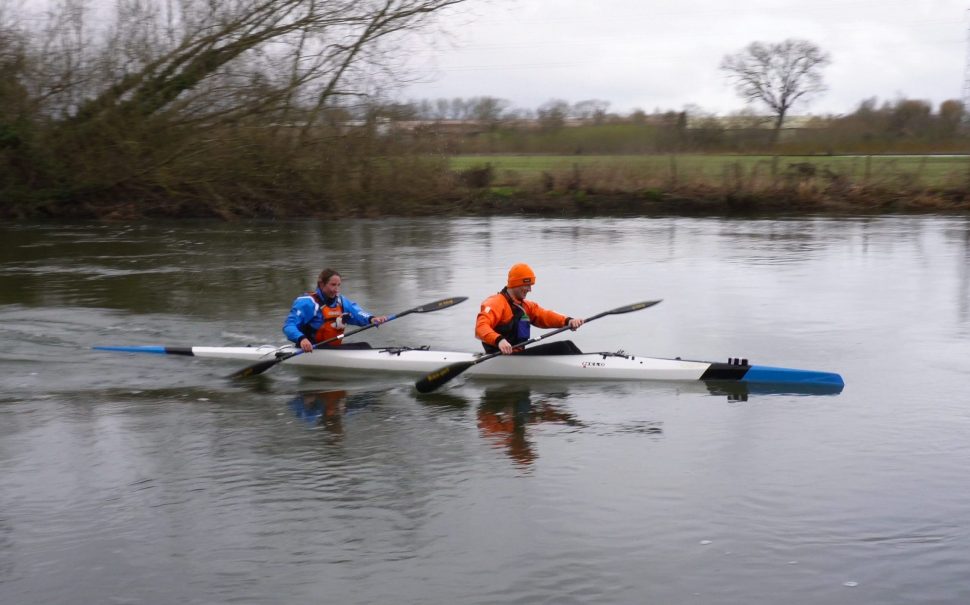
A pair of kayakers have smashed the world record for the fastest time to paddle down the navigable Thames in a time of 14 hours and three minutes, beating the previous record by one hour and 41 minutes.
Brynde Kreft, 32, and Joe Petersen, 27, started at dawn in Lechlade and paddled nearly 200km down the Thames river in a double kayak to Teddington, navigating 43 lock portages where they had to run while carrying their boat.
The previous record of 15 hours and 44 minutes was held by Billy Butler and Tom Dawson.
Kreft and Petersen are no strangers to ultramarathon kayaking, having raced the notorious 125 mile Devizes to Westminster race together last Easter. Both have also represented Great Britain in marathon racing before.
Kreft said: “When I was feeling quite overwhelmed and tired, Joe was really nice and supportive and made it better.”
The combination of a fast flowing river, longer days and warmer weather made for optimal conditions to attempt a record.
However, the fast flowing conditions meant that Petersen, who was responsible for steering the boat, had to use his arms more, causing him issues with tennis elbow and wrist pain.
Both paddlers also suffered with fatigue at points throughout their massive effort.
Petersen said: “It’s when you start doing the maths and it’s like ‘I’m tired five hours in and I’ve still got nine hours to go’, and you realise that nine hours is quite a long time.”
Kreft said: “When we hit the low and my shoulders started getting sore, I remember being like ‘I shouldn’t take it so lightly, it’s so far.’ I was going into it a little bit more like ‘this is just a light-hearted adventure’ which meant that I was not quite prepared for how painful it would still be.
The pair were met at points by supporters on the riverbank. “I was very touched that they thought it was a worthwhile, interesting thing to do to come up and say hi,” said Kreft.
Petersen’s highlight was Molesey Weir. He said: “There were so many people there, everyone was really lively.
“By then it would have taken a genuinely serious disaster to have not broken the record so it was quite a jubilant mood.”
Petersen and Kreft had a support crew who provided them with food and changed their drinks bottles at portages.
The crew consisted of a group of fellow paddlers led by Andy Birkett, Shaun Harte and Tim Gannicott-Porter, along with Kreft’s partner Desmond Fairall and Petersen’s partner Claudia Perry.
The support crew has an important role because fuelling is a key part of success in ultra challenges.
Petersen fuelled himself with carbohydrate drinks, flapjacks and boiled potatoes.
In previous races Kreft struggled with nausea and acid reflux, so she relied mainly on carbohydrate drinks, energy gels, sweets and dates for this record attempt.
After paddling the final stretch in darkness, the pair celebrated their effort in Teddington with sparklers alongside paddlers from Richmond Canoe Club, where Petersen trains.
“There’s definitely a bit of euphoria when you stop,” said Petersen.
He added: “But the next day was akin to a hangover. I felt like I could move around but I just felt tired and weak and headachey. I couldn’t feel my fingertips which is still a bit of an ongoing issue.”
Kreft said: “When I get off the water I feel like the ground is rocking almost like I’ve been in the water for so long that I still feel like I’m rocking. So for a while I thought I was dizzy and I needed to sit down.”
As a young athlete Kreft used to hate longer distance races, gaining the nickname ‘short-course’ from her coach because she would quit training sessions and efforts early.
She attributed this to a lack of confidence, something which has developed over the years.
“I really think feeling like I have a support network of people who believe in me and that I feel safe with, and also just having a stronger sense of myself, what makes me feel good, what makes me want to train hard, and what I need in terms of rest, has made a big difference,” said Kreft.
“For me, something that was unexpectedly exciting about ultra distances is how extreme it feels. You’re going so far and you’re asking so much of your body and, at the end, you’re so tired. I like that there’s more adrenaline.”
Kreft grew up in South Africa where she got into kayaking through the sport of surf lifesaving, which involves swimming, running, paddling a kneeboard, and paddling an ocean kayak called a surf-ski.
However, despite a strong start in kayaking, from the age of 16, Kreft began to struggle with the symptoms of undiagnosed endometriosis and, by 19, she had stopped training entirely.
She said: “I was only diagnosed when I was 18 so there were two years of managing the symptoms not really knowing what was wrong with me.
“During that time I had a number of different doctors suggest different things they thought it was. Eventually, I was diagnosed by going to a doctor and being like, ‘I am bleeding all the time and it’s painful all the time’.”
Kreft underwent a surgery to remove endometrial tissue from her organs and she now manages the condition with medication.
“It’s a complete night and day change from what it was like before where I just felt like I was tired all the time, I was in pain all the time, I was kind of emotional erratically,” said Kreft.
“I was just managing with way fewer resources than I should have, so it was obviously really hard to train, hard to do normal functioning, whereas now that’s basically not an issue at all, which is amazing.
“The few times where I have a difficult week or two, it’s still much less severe than it was before there was any treatment.”
Upon moving to the UK, Kreft joined Oxford Falcon Boat Club at the age of 27 and gradually made her return to competitive racing. She is now faster than she ever was as a junior.
Petersen joined Banbury Canoe Club aged 13 to kayak with friends.
He said: “There was a great group of people there and I think it’s always easier when you’re going down to train with people you like seeing. Back then, I still am, but I was very competitive so I would work really hard to do better and that kind of carried on.”
He now lives in London, works as a data scientist in Formula E, and trains at Richmond Canoe Club. He said he was amazed by the quality of training and social, friendly nature of the club.
Petersen said: “Paddling for me provides quite a big focus. I like to think about how I can get better at it.
“I can focus my thoughts on training, racing and planning the year ahead, that’s quite nice to have. I think that’s maybe something that a lot of young people lack, and that’s why people focus on work.
“I’m glad that I’ve got that kind of outlet from a professional life.”
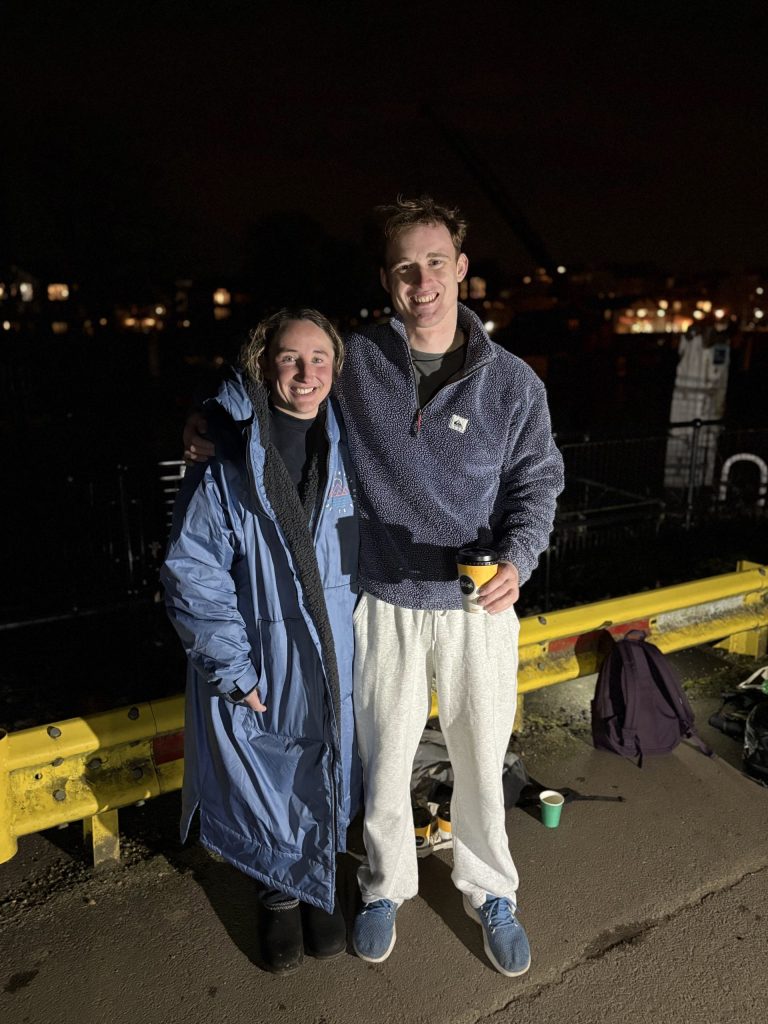
For Kreft, a PhD student in public policy, kayaking plays a different role in her life.
She said: “I’ve always really loved being on the water, around water, in water. I’m someone who thinks a lot. I think doing something really difficult is nice because it means there’s less time for thinking.
“It’s something that is much more instinctive, I often will be blank, reacting to whatever’s going on in the water and I really like that feeling. I find it really peaceful and calming.”
The pair will both compete for the opportunity to represent Great Britain in marathon kayaking this summer. Kreft will also represent Great Britain in ocean racing.
Next year, they will take on the 125 mile Devizes to Westminster race on Easter weekend. They will likely be favourites to win.
To follow this year’s Devizes to Westminster race, click here.
Featured image: Brynde Kreft and Joe Petersen. Credit: Betsy Ray