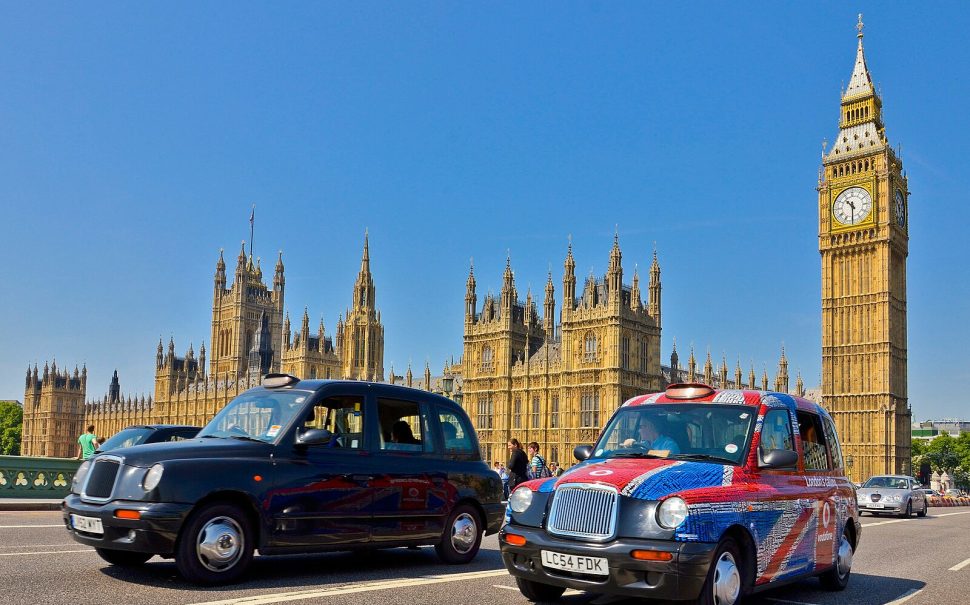
TfL data reveals that new black-cab driver numbers have fallen to record lows, yet applications to sit the qualifying exam are beginning to climb.
In 2015, the hackney carriage was voted the city’s most iconic design in a poll conducted by TfL.
Ten years later, London’s taxi industry is facing unprecedented crisis as the number of people qualifying to become drivers has fallen by nearly 90%, according to new figures.
The dwindling numbers in those completing the Knowledge of London (the official name of the black cab qualifying exam) are in keeping with a decline in taxis more generally.
As the demand for private hire vehicles (PHVs) has soared, there has been a dramatic change in the makeup of London’s roads.
PHVs have increased by around 55% over the past decade, rising from 62,700 in 2015 to more than 97,000 today, while the number of licensed black cabs has fallen by over a third during the same period, from 22,500 to around 14,500.
In light of this data, the London Assembly Transport Committee recently called on TfL to limit the amount of app driver numbers which have created an ‘extreme competition for fairs’, according to Elly Baker the chair of the group.
Steve Bolton, 69, who has been driving a black cab on London’s roads for over 30 years, said: “The culture of hailing cabs is ending.”
“We’re signed up to the apps as well but they also charge us 20% for every ride. So they’ve stolen the work from us and now they’re charging us to get it back”.
Quality of life
The dramatic reduction of taxis in the city does not only mean the loss of one London’s centuries-old cultural institutions, but the black cab is one of the city’s most accessible forms of transport, so their decline has a disproportionate impact on disabled Londoners too.
Wendy Bell, 63, who has been a black cabbie in London’s suburbs for over 12 years, said: “I’m not just a cab driver. I’m a carer, I’m a social worker, I know how to help vulnerable passengers get to their destination safely.”
“A lot of people will tell you about their problems once they’re in the back of your cab. One of the nice parts of the job is making someone smile if you know they’re having a bad day”.
Bell, who is British-Ghanaian, adds that her job also gives her a sense of pride.
She said: “I feel more proud to be a Londoner, I feel more proud to be in that car, because black cab drivers go through a process.
“And the drivers themselves respect the road, you see a difference in attitude. I’ve done both taxi driving and private hire, so I know”.
The potential loss of a transport service that adds to the quality of life in London is also why many are now calling for more to be done to protect the black cab trade.
Earlier this year, TfL responded to these calls by publishing its Taxi and Private Hire Plan 2025.
Some of the actions laid out to protect black cabs specifically include improving access to London’s bus lanes as well as updates to The Knowledge.
The London Assembly transport committee however argued more drastic action was needed than was laid out in this new plan, calling for a cap on app driver numbers.
In response to these concerns TfL replied: “We recognise the vital role that London’s licensed taxi drivers play in the capital’s transport network and remain committed to supporting the trade…We are working closely with the taxi trade to identify and address barriers to entry, including the cost of vehicles and the time required to complete the Knowledge of London.”
Road blocks
Although competition from private hire vehicles, as well as the pandemic, have both played their part in the decline in the black cab, it’s far from the entire story.
“Being a black cabbie is not what it used to be. It’s quite a stressful job and you have to put in a lot of hours to earn enough these days”, says Gert Kretov, long-term cabbie and co-owner of of Knowledge Point School, one of London’s highly-regarded training centres for prospective new cab drivers.
Kretov pinpoints a variety of issues facing taxi drivers today, one of those being the steep rise in the cost of a car over the past ten years.
The average price of a new cab was roughly £43,000 in 2015 and is now roughly £75,000 in 2025, according to industry price listings.
The cost of a new London taxi has soared largely because, since 2018, all newly licensed cabs must be zero-emission capable. This means most new drivers have to buy an expensive LEVC TX electric taxi as the cheaper diesel model has been phased out.
Add to this soaring maintenance costs (“ten years ago it was £10,000 annually now it’s at least £20,000”, says Kretov), increased road closures, the proliferation of 20mph zones, plus harsher penalties for cabbies that breach them, and the fall in those qualifying to become black cab drivers becomes a little less surprising.
Kretov said: “They keep adding things. If someone wants to do The Knowledge, they really have to think about it: do they want to spend three or four years under that much pressure, only to risk losing it all in an instant?”
The Knowledge of London
The test to become a black cab driver, The Knowledge, has earned a reputation for being one of the hardest exams in the world.
Through a series of stages, applicants must demonstrate they know, by memory, the quickest way through 26,000 streets and 6,000 ‘points of interest’ (clubs, hospitals, hotels, theatres, embassies, stations and historic buildings) across 320 routes, within a 6-mile radius of Charing Cross.
This is all done without the aid of GPS, and without consulting a physical map.
Answers to questions are given orally in a one-on-one situation with an examiner who is looking to apply the everyday pressures of being a cabbie to the trainee on the spot. It means nerves too often get the better of students.
Joanne, 53, a black cabbie who completed The Knowledge nearly two years ago said: “The examiner seems to always know if you haven’t put the work in, it’s like they have a magic power. You can’t do the tests half-hearted.”
The learning process is also gruelling, requiring students to study the roads physically, often on cold nights when the city is quietest.
Joanne said: “It’s not just about learning the roads or the points of interest. You have to know how you’re going to approach the route, where you can exit, where you can do U-turns, the quickest park-ups. The best way to do that is by walking or biking the routes.”
The study is so cognitively demanding that British neuropsychologists have conducted studies on black cab drivers and found significant growth in the part of the brain responsible for memory and spatial awareness, the hippocampus.
This change is only present in cabbies that have successfully completed The Knowledge.
It takes most people around 3-4 years to fully pass the Knowledge and earn the license to drive one of London’s black cabs across London.
Most applicants never gain the coveted green cabbie’s badge awarded upon completion, and the pass rate has been steadily declining too, falling from 59% in 2020 to 38% in 2025 so far (according to FOI figures from TfL).
With the odds stacked against black cabbies, the falling pass rate suggests new students are finding it increasingly difficult to motivate themselves to complete the final stages of The Knowledge. This is where a passion for the job is required, above all else.
Kretov said: “It sounds crazy but when you want to do something in life you will get through it.
“The main thing I tell students is that if you want to pass The Knowledge, you need to fall in love with London and how it works. Once you do that, The Knowledge becomes a lot easier, you become obsessed with it.
“It’s amazing what your brain can do when you’re that engaged.”
Turning a corner?
Though completion numbers for The Knowledge are at record lows in 2025, the outlook for London’s black cab industry is not entirely negative.
Over the past few years there has been an uptick in the numbers of people applying to take the test, according to new data from TfL.
This should mean that completion numbers will naturally start to follow too, given the pipeline for a pass is roughly 3-4 years.
Though the rate of change in completions drops more steeply than it climbs in applications, this new data offers a moment of optimism for those who are determined to preserve the Hackney carriage.
In response to the shift in numbers, TfL said: “We’re encouraged by the number of applications we’ve seen this year so far. This will help to ensure that the capital’s world-famous black cabs can continue to serve Londoners for years to come.”
Some caution should be exercised however. Earlier this year, think tank Centre For London published a report signalling that, at the current rate of decline, London’s black cabs could vanish from the streets by 2045.
They also plotted out the fall in applications from the year 2000 onwards, and showed the overall fall in enrolment is far greater than the small uptick in numbers that we have seen over the last few years.
Hailing the future
The age demographic for cabbies leans towards 45 and above, as evidenced by the latest figures from TfL.
This slant towards older drivers is partly due to an aging cohort of long-term cabbies as well as the decrease in Knowledge students making it through the pipeline.
Often too, new cab drivers switch from other careers later in life, or supplement jobs with taxi driving.
However a new wave of cabbies have recently begun gaining widespread attention due to their preciousness.
In 2024, Mohammed Ben Bead became the youngest person to pass The Knowledge at 20-years-old and his story went viral online. He now promotes cab driving as a career and lifestyle on his TikTok channel.
‘I would say more young people should look into the career early on’, Mohammed explains in one of his TikTok videos.
He said: “It’s definitely worth it we have our own clientele… everyone should do The Knowledge.”
This year, Ben Bead’s Knowledge record was beaten by Connor Dill, who is still too young to drive a cab.
In an interview on YouTube, Dill said: “This is a job like no other, and I try to recommend it to everyone, because it needs to get younger.”
The rise of apps may have hastened the decline of the hackney carriage, but now it seems it could also help bring about its revival.
Featured image: Black Taxi/Charles01, CC BY-SA 4.0 via Wikimedia Commons