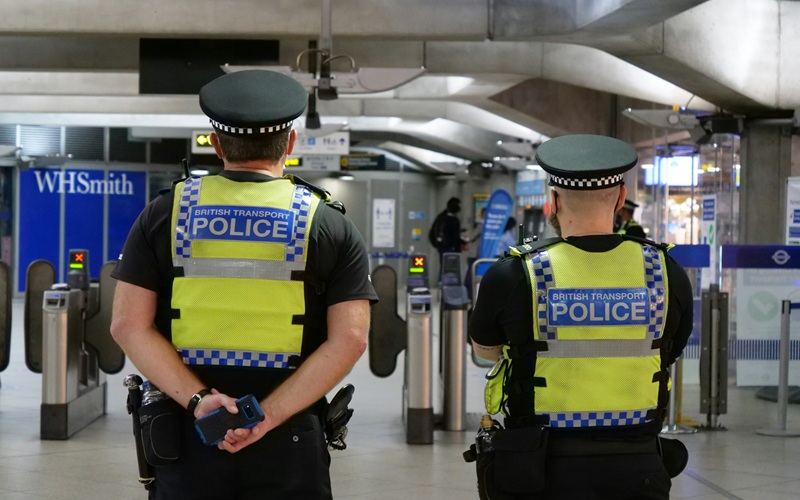
Stops and searches in London have more than halved in the last five years, according to the latest Home Office data.
The 61% decline mirrors the national picture, which highlights a 26% drop across all of England and Wales.
This comes after shadow home secretary Chris Philp said he would triple suspicionless stop and search under a Conservative government, in his party conference speech.
Although stop and search numbers have decreased overall, Habib Kadiri, executive director of anti-suspicionless stop and search group Stopwatch, claimed the raw numbers don’t tell the whole story.
He said: “It’s not manifesting in an obvious way where the volumes just go straight up across the board.
“The increases are coming from suspicionless stop and search powers, mainly driven by Section 60.”
Indeed, the number of suspicionless stops and searches, known as Section 60, has risen for the third consecutive year, largely conducted by the Met Police.
Kadiri continued: “It’s more about the type of stop and search and the purposes for which they are used, and Mark Rowley’s using the kind of stop and search that targets black people disproportionately.”
However, it is not clear what stops count as reasonable grounds (Section 1) or what the police class under Section 60, as vague reasons are often given to those stopped.
Trey-Wayne Saunders, a 16-year-old black boy, was on his way back from college when he was stopped and searched at Barking train station.
He said: “Apparently there was a [knife] suspect in the area… they were just looking for people who matched it.”
The police also searched a fare evader who had pushed through the gates before him – an Asian man who the police said also matched the description.
Trey-Wayne said: “It feels overwhelming because they just surround you, there were people recording as well.”
The police searched him, put his name through their database and found nothing, so he was let go.
Trey-Wayne said his encounter made him dress differently to deflect attention, notably trading in his all-black jacket.
He said: “I know they have a job to do, but I feel that some of them take it a bit too seriously or don’t bother with it at all.”
There’s been a 27.6% fall in offensive weapons searches on reasonable grounds (Section 1 PACE 1984), in London between 2024 and 2025, compared to drugs which fell by 8.1%.
Kadiri said: “This tells us that drug searches remain the operational priority for forces across the country when it comes to standard level searches.
“The operational decision of the Met police to conduct significantly more section 60 searches suggests that this is increasingly the power through which weapons searches are conducted.”
Chuks Chibueze*, a 30-year-old black man was in his neighbourhood, running to the bus stop when a policeman emerged from a parked car and stopped him.
The police officer questioned why he was running, what he was doing in the area, then asked to search him due to nearby suspected robberies.
Chibueze said: “I was shocked really. I lived in the area, so I didn’t think they had any cause to search me. I just didn’t want any trouble.”
The search resulted in no further action and he was let go.
He said: “It’s best to listen to them and not pick a fight, I just wanted to get to where I was going.”
“It was a freak occurrence so I just kind of moved on.”
The Met conducted 41.5% more searches on black people under Section 60 than last year compared with white people, which dropped by 54.1%.
This means stops for black people under the power have increased five times the amount of those conducted on white people.
Kadiri said: “I think there’s some strong patronising element where they genuinely believe if they go in hard, they’ll correct the problems of black people in highly concentrated urban areas, as though that’s the only or biggest issue that black people have to face in London.”
He said there are valid reasons for stops such as if the police have received intelligence of violence happening in that area, and endorses dispersal orders when used appropriately.
“When almost all stops are not finding anything it raises that big question of ‘what are you actually doing this for?’ ‘It’s too big a question to ignore’.”
The Met police were contacted for comment.
*Represents a name anonymisation at the interviewees request
Featured image credit: Ethan Wilkinson via Unsplash