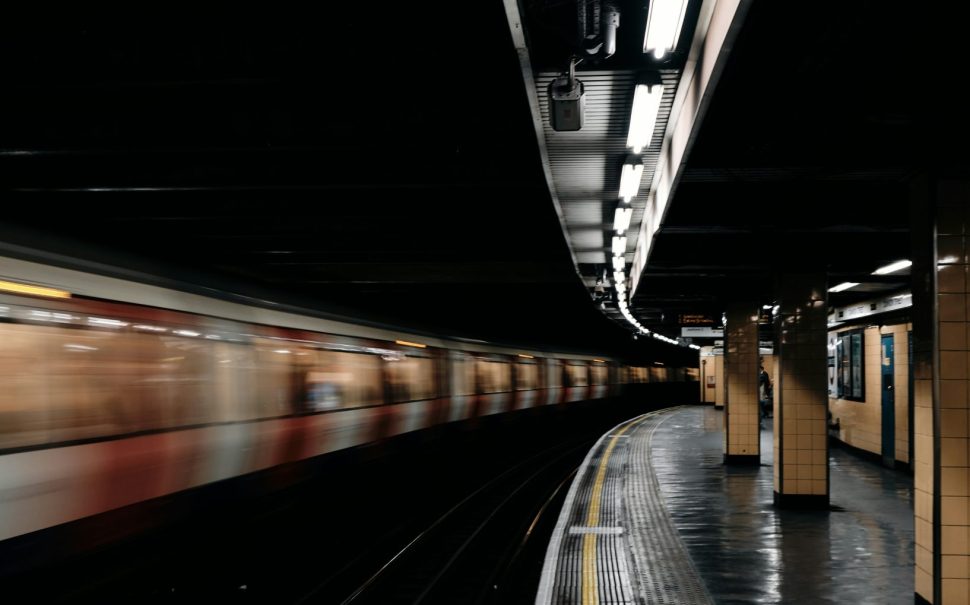
When she boarded the Windrush Overground line, Phoebe did not anticipate that the next minutes would taint the memory of her favourite train forever.
Phoebe, whose name has been changed to protect her identity, said she was left shaking violently and in tears after she was sexually harassed by a man on the train last year, which prompted her to call the British Transport Police (BTP).
According to data provided by the BTP, sexual offences against women or girls on London’s public transport have been rising since 2020 on all TfL modes.
Between 2023/24 and 2024/25 the BTP witnessed a total 14.3% increase in reported offences classified as ‘sexual’.
The Elizabeth Line experienced the sharpest growth, where the reported offences went from 23 to 94, an increase of over 300% since 2022/23, TfL data reveals.
Contrary to public perception, most sexual offences take place during the evening rush hours, when the stations are the busiest.
Data gathered from a Freedom of Information (FOI) request the Londoners submitted to the BTP confirms this, finding that sexual assaults between 6pm and 7pm are highest, and have increased to 83 in 2025 from 68 in 2024.
It also shows that the month with most reported offences last year was July with 81, and the lowest was January with 46.
Yet sexual offences are not limited to assault or rape, as victims of harassment and non-violent offences like Phoebe illustrate.
Additionally, TfL’s situation is uniquely severe: of all 2,132 sexual harassments and assaults reported to BTP in 2016/17, which covers England, Wales and Scotland, 1,032 were in London alone.
However, reported sexual assaults, although rising, have not yet reached pre-pandemic levels.
When Phoebe first sat down, she said she was still taking off her jacket as a big, grey figure boarded the carriage, and walked towards her.
Because there was nobody else at Crystal Palace station, Phoebe said she now felt a sudden discomfort.
Mindful of strangers when travelling alone, she had avoided the first carriage and walked down to the middle section of the empty train, but her mood shifted when the stranger chose the seat right in front of her, out of hundreds of empty ones.
Worried, but keeping it together, she thought she was being paranoid. After all, this is London, the capital city with the highest CCTV density in Europe.
But when she noticed the man staring at her, she said she suddenly felt overcome by fear.
She said: “I entered a state of panic and I knew there was no way to get out of the train, as it was moving.
“At that moment I felt that no matter how loudly I screamed, no one would be able to hear me.”
Although most sexual offences happen during rush hour in crowded environments, BTP submitted a document to a House of Commons Women and Equalities Committee in 2018 pointing out that ‘less crowded environments create their own challenges; situations where lone victims and/or a lack of witnesses can enable different types of sexual offences’.
Phoebe’s experience took place at the end of the line, but most sexual offences take place in major stations, with the most dangerous ones for sexual assault in 2025 being Stratford station (31 reported offences), Kings Cross (24) and Liverpool Street (17).
When Phoebe’s train stopped, and the doors opened again, she experienced a moment of relief, the voices of a few new passengers felt like a lifeline.
Phoebe explained she immediately stood up and moved closer to them, but so did the man, who reportedly followed her into another carriage, after multiple attempts to move away from him failed.
She said: “In that moment I felt like my legs were giving up on me, I couldn’t even move one carriage down.”
At this point she wept and entered a shouting match with the man, appealing to the closest passengers of the now full train in Canada Water.
Luckily, some alerted bystanders got involved and comforted her, and the man finally left the train.
The ride from Crystal Palace to Canada Water takes 21 minutes, but Phoebe said that to her, that journey felt like a lifetime.
TfL’s new campaign Act as a friend emphasises the crucial role of bystanders, and the need for educating passengers on how to intervene safely when an offence takes place.
Siwan Hayward, TfL’s director of Security Policing Enforcement, said: “Our new campaign shows how powerful it can be to strike up a conversation with the targeted person and treat them like a friend, to help them feel less alone and make the first steps towards reporting the incident.”
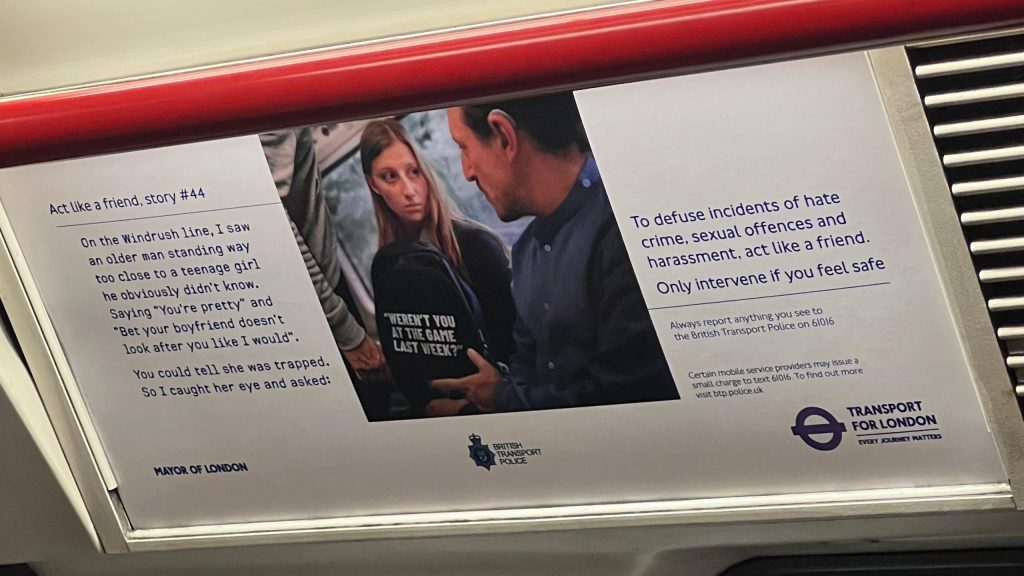
British Transport Police also launched campaigns such as Speak Up and Interrupt to urge bystanders to intervene safely and report incidents to the authorities.
Detective Superintendent for Public Protection and Vulnerability Sam Painter said: “We work tirelessly to encourage victims and witnesses to report incidents, no matter how small, because every report is significant.
“Officers in uniform and plain clothes are deployed daily to deter offenders and protect passengers.
“Remember: nothing is too small to report, and sexual harassment is never your fault. Save our text number 61016 in your phone today.”
A British Transport Police survey showed in 2023 that over half of those who have been victims of sexual offending say that other passengers tried to help them.
The Freedom of Information request submitted to BTP shows that between January and 21 October 2025, 610 passengers reported a sexual assault on the Underground, Overground, Tramlink and DLR.
Although the data reveals an overall decrease of 4.8% in reported sexual assaults compared to the same period the year before, it shows an increase of offences on specific lines and hot spots.
While offences on the Central Line saw a decrease in that period, the Northern Line saw an increase from 86 to 89 offences in 2025.
And most reports of sexual assault on TfL do not end up with a suspect identified either. Over 60% of the 797 reported cases in 2024 were closed without a suspect being identified, while another 130 had to stop due to the victim declining or being unable to support action to identify the offender.
Out of all 797 reported sexual assaults in 2024, only 45 ended with someone being charged, that is just over 5.6% of cases.
Furthermore, as is the case with many sexual harassment and abuse crimes, the data suffers from underreporting.
A 2020 government survey found that only a third (33%) of those who experienced sexual harassment had formally reported it.
And for bystanders it is even lower, with only one in five witnesses of sexual harassment reporting it to the police, according to the BTP in 2018.
Featured image credit: Sohaim Siddiquee via Unsplash