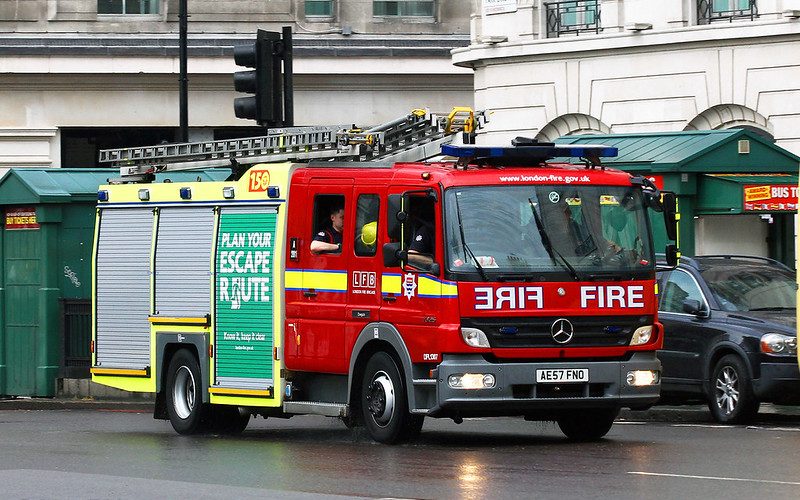
Hoax calls to the London Fire Brigade (LFB) are at an all time high since 2018, with more than half a million pounds already spent dealing with them in 2025.
Costs associated with LFB brigade deployment following a hoax call are at just under £537,000 in 2025, a 30% increase since pre-COVID years, according to LFB call records.
The data for 2025 is available up until October, meaning the 2025 total will be significantly above the current highest year for hoax call costs, £484,300 in 2023.
An anonymous firefighter, in the LFB for two-and-a-half years, said: “As the Brigade gets squeezed and squeezed, and there’s less and less money and less and less personnel, then hoax calls will become a bigger and bigger problem.
“It would be quite easy to make the brigade really stretched with just a few, well-timed hoax calls across different parts of the city.
“You could probably tie up half the brigade with about four or five clever phone calls.”
Consequences of hoax calls could increase in gravity as one in five fire engines in London are unavailable and roughly 2,300 firefighter positions could disappear due to service cuts, according to the Fire Brigades Union.
The amount of hoax calls, after a drastic decrease during the COVID crisis, has exceeded its previous levels, with 687 false alarms recorded between January and June 2025, an all time high over a six-month period since early 2019.
The average number of calls over a six-month period has increased by 21% since the COVID crisis, with 494 calls on average during the crisis and 596 since it ended in 2022.
London Fire Brigade’s assistant commissioner for operational resilience and control, Pat Goulbourne, said: “Diverting fire engines to a hoax call could prevent firefighters from reaching someone who really needs our help as quickly as possible.
“Hoax calls are illegal and can result in a fine or prison sentence.”
The anonymous firefighter described hoax calls as a regular occurrence, and said he was deployed following a hoax call between once a month and once every two months.
Hoax calls only represent a small proportion of false alarms, with consistent levels of more than nine in ten false alarms being recorded as ‘good intent’.
Goulbourne said: “The vast majority of calls made to the Brigade’s Control Room are from people with genuine concerns, reporting emergencies in good faith.”
However, the anonymous firefighter said that some hoax calls might be passed off as good intent once the caller is faced with emergency services.
He said that some hoaxers are interested in emergency services, and call the LFB because they want to see them in person.
Many hoax calls are also made by drunk people.
Another instance of non-recorded hoax calls are cases where automatic fire alarms are voluntarily triggered by someone, then reported as a faulty detection.
This suggests that the numbers recorded by the LFB are a lower estimate, and that the 1,132 recorded hoax calls between January and October 2025 are shy of what the reality is.
Not only is the number of hoax calls on the rise, but each of them are getting increasingly expensive to the LFB.
The average cost associated with a hoax call has seen a 39% increase between 2018 and 2025, going from £342 to £474, with a record £485 average cost in the period between June and October.
The increase in average cost can be attributed to inflation, but also to the increase of predetermined attendances (PDA), that is, the quantity of resources human and technical resources deployed for any given call.
The anonymous firefighter said that the increase in PDA has led to a “safer system of work” and that “the average incident has become more expensive because it has more personnel on it”.
To minimise the chances of a hoax call leading to an LFB deployment, operators are trained to identify calls that may not be genuine.
Contact 999 in case of an emergency.
Feature image: Samson Ng . D201@EAL, Flickr